Google Genie3 runs at 24 FPS with real-time interaction, minute-long scene memory, and prompt-driven world changes. A big step toward large-scale real-world applications.
What if you could not only watch a generated video, but explore it too? 🌐
Genie 3 is our groundbreaking world model that creates interactive, playable environments from a single text prompt.
From photorealistic landscapes to fantasy realms, the possibilities are endless. 🧵
OpenAI has published a guide on fine-tuning their open-source models, gpt-oss:20B and 120B. Fine-tune via full SFT or PEFT (LoRA/QLoRA); align with DPO or RLHF/PPO (plus GRPO/Online-DPO).
https://t.co/4YuChd5UGs
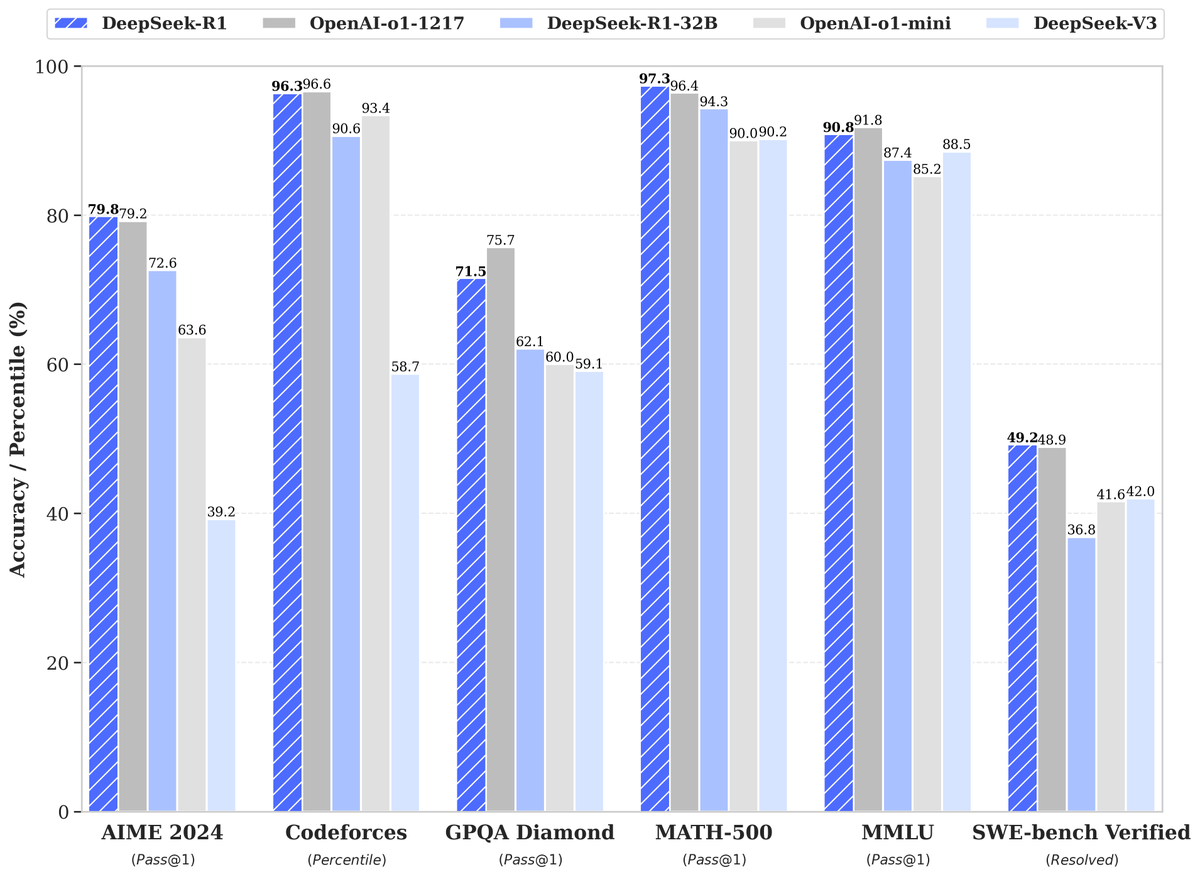
🚀 DeepSeek-R1 is here!
⚡ Performance on par with OpenAI-o1
📖 Fully open-source model & technical report
🏆 MIT licensed: Distill & commercialize freely!
🌐 Website & API are live now! Try DeepThink at https://t.co/v1TFy7LHNy today!
🐋 1/n
.@OpenAI just dropped o3 and o3-mini!
This is AGI (not clickbait)
o3 is the best AI ever created, and its performance is WILD.
Here's everything you need to know: 🧵
World Labs' groundbreaking 3D world generation model! From a single image, it predicts a fully interactive 3D scene with unmatched consistency and control. A leap beyond typical image-to-3D tools! #single#image#AI#3DGeneration
https://t.co/6Og3qxvBfn
We’ve been busy building an AI system to generate 3D worlds from a single image. Check out some early results on our site, where you can interact with our scenes directly in the browser!
https://t.co/ASD6ZHMwxI
1/n
OpenAI just officially released its Sora AI video generation model — alongside new unexpected video editing features.
Christmas just came early for the AI world.
OpenAI Reinforcement Fine-Tuning! This aligns closely with emerging techniques in the field, which highlights RLHF and dynamic policy optimization for domain-specific expertise. Perfect for coding, research, and finance! #AI#RLHF
paper: https://t.co/G44d5Mn0rU
Today we previewed Reinforcement Fine-Tuning, a new model customization technique that enables organizations to build expert models for specific, complex tasks in domains such as coding, scientific research, or finance.
AI Town author has released a new paper. Based on 1,000 interviews, this research explores if AI agents can truly simulate humans. This research benefits greatly from evaluation and expertise by social scientists and psychologists.
paper: https://t.co/JjWMMD22CV
Simulating human behavior with AI agents promises a testbed for policy and the social sciences. We interviewed 1,000 people for two hours each to create generative agents of them. These agents replicate their source individuals’ attitudes and behaviors. 🧵https://t.co/FOVcOQduXO
Scaling laws hitting a wall? As compute & data demands soar, models like OpenAI's Orion face diminishing returns. Is it time to shift from 'bigger is better' to 'quality over quantity'?
There's an ongoing debate about whether AI scaling laws will hold or hit a wall in the near future.
However, what's clear now is today's models already have the power to increase productivity in ways that would have been unimaginable just a few years ago.
In this episode of the @LightconePod, we dig into the results of a recent o1 hackathon hosted by YC to see what can be unlocked when founders leverage a SOTA reasoning model.
ChatGPT for macOS now integrates with coding tools like VS Code, Xcode, and Terminal, enabling it to analyze complex system-level code and provide deeper, context-aware answers.
ChatGPT 🤝 VS Code, Xcode, Terminal, iTerm2
ChatGPT for macOS can now work with apps on your desktop. In this early beta for Plus and Team users, you can let ChatGPT look at coding apps to provide better answers.
Promptim! Automating prompt optimization with custom evaluators and human feedback opens up new possibilities for refining AI systems. #PromptEngineering#LLM optimization.
🐧Promptim: an experimental library for prompt optimization
Promptim is an experimental prompt optimization library to help you systematically improve your AI systems.
Promptim automates the process of improving prompts on specific tasks. You provide initial prompt, a dataset, and custom evaluators (and optional human feedback), and promptim runs an optimization loop to produce a refined prompt that aims to outperform the original.
Blog: https://t.co/Eg6M6JC3Db
Video: https://t.co/Ft3eNuP5G5
This is wild.
Anthropic just dropped Computer Use and Claude 3.5 Sonnet & Haiku
And it will completely change the AI agent game.
6 wild examples:
1. Computer Use for Coding
Thought large models had reached their limit, with OpenAI focusing on optimizations like O(1) inference. However, if GPT-4.5o is released, it may be more about expanding modalities rather than a new model iteration. #openai#llm#gpt
@adridder Yeah, academia is really excited about using LLMs to automatically create agents that generate new connections and solutions. Meanwhile, industry seems more focused on building multi-agent platforms tailored to specific needs. Combining both could lead to some big breakthroughs.
OpenAI's Swarm. It simplifies how we build multi-agent systems by allowing seamless handoffs between agents based on conversation flow. Plus, the ability to call Python functions directly within agents gives developers more flexibility.
This came unexpected! @OpenAI released Swarm, a lightweight library for building multi-agent systems. Swarm provides a stateless abstraction to manage interactions and handoffs between multiple agents and does not use the Assistants API. 🤔
How it works:
1️⃣ Define Agents, each with its own instructions, role (e.g., "Sales Agent"), and available functions (will be converted to JSON structures).
2️⃣ Define logic for transferring control to another agent based on conversation flow or specific criteria within agent functions. This handoff is achieved by simply returning the next agent to call within the function.
3️⃣ Context Variables provide initial context and update them throughout the conversation to maintain state and share information between agents.
4️⃣ Client run() initiate and manage the multi-agent conversation. It needs an initial agent, user messages, and context and returns a response containing updated messages, context variables, and the last active agent.
Insights:
🔄 Swarm manages a loop of agent interactions, function calls, and potential handoffs.
🧩 Agents encapsulate instructions, available functions (tools), and handoff logic.
🔌 The framework is stateless between calls, offering transparency and fine-grained control.
🛠️ Swarm supports direct Python function calling within agents.
📊 Context variables enable state management across agent interactions.
🔄 Agent handoffs allow for dynamic switching between specialized agents.
📡 Streaming responses are supported for real-time interaction.
🧪 The framework is experimental. Maybe to collect feedback?
🔧 Flexible and works with any OpenAI client, e.g., Hugging Face TGI or vLLM-hosted models.
Meta Movie Gen key features:
1. Video Generation: High-quality videos (text prompts).
2. Personalized Videos: featuring your personal image.
3. Video Editing: Modify videos by editing elements/changing backgrounds (text inputs)
#meta#movie#GenAI#editing
https://t.co/8FCrnLWu4C
Curious about the future of LLM-based agents: Is it more effective to focus on auto agents that can autonomously achieve set goals, or should we prioritize auto action generation where agents discover new strategies mid-task? #AI#LLM#Auto#Agents
LangChain Academy is live! Our first course — Introduction to LangGraph — teaches you the in-and-outs of building a reliable AI agent.
In this course, you’ll learn how to:
🛠️ Build agents with LangGraph's graph-based workflows
🔄 Use memory + human-in-the-loop for smarter, self-corrective agents
📚 Create your own AI assistant that can perform knowledge tasks
Enroll now for free ➡️ https://t.co/oGYHCgurxo
Bring LangChain Academy to your company ➡️ https://t.co/3qwFcKNvsY
OpenAI new feature can auto-optimize system prompts. It could be leveraging pre-built layers of knowledge or shortcuts that help it quickly decide on the best approach (prompt structure, tone, format, etc.) for a given query. #ai#openai#meta#prompt
Attention! 🚨 @OpenAI's "meta" prompt for optimizing GPT prompts might have already leaked!
Just hours after they launched a new playground feature for automatically generating optimized system prompts—similar to Antropic's prompt generator—people might already have extracted the meta prompt used. 👀
I tested it in the playground, and the results look very similar. You use the “meta” prompt as a system prompt and then provide your task/query as user input. 🔥
The prompt is attached to the thread. Credits to @amebagpt