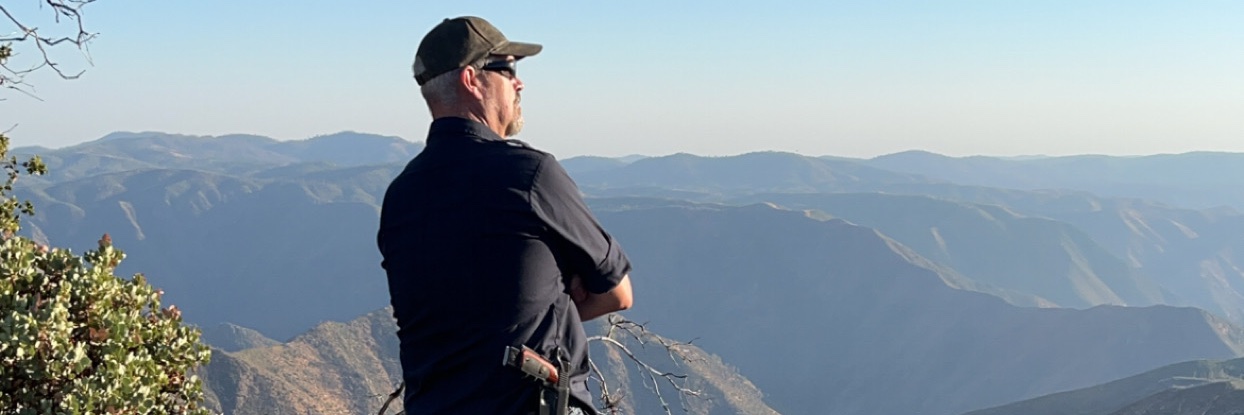
@FritzJohannPohl@BowTiedBroke Love the high desert.
Took my wife out to the backside of the Sierras a couple weeks ago for her first visit to Bodie/Bridgeport/Mono Lake.
@BowTiedBroke Ohhhhh I know bears.
I present “Evander Holyfield”.
He lost his right ear at one point to the ursine equivalent of Mike Tyson.
I shot a nice muley about 100 yards from this spot.
Photo taken at Ironstone Winery, Calaveras County, CA.
DAY 15 — NATIONAL GUN VIOLENCE AWARENESS MONTH THE ANSWER WAS ALREADY THERE. AUGUST 1, 1966.
August 1, 1966. Austin, Texas.
The University of Texas. A summer Monday. The kind of day that starts with the full weight of a Texas August already in the air by eight in the morning — the kind of heat that makes everything feel slightly unreal. Students walking across the South Mall. Faculty coming and going. Normal. Entirely ordinary in every way.
Charles Whitman climbs to the observation deck of the UT Main Building Tower, 307 feet above the ground. He is 25 years old. He is a former Marine. He is a trained sniper. He has already murdered his wife and his mother. He has brought a footlocker full of weapons and supplies.
At 11:48 in the morning, he opens fire.
For the next 96 minutes, the University of Texas becomes something America had never seen before on this scale — the first modern mass public shooting. Fourteen people are killed on the campus and surrounding streets. Thirty-one are wounded. Whitman shoots people from a vantage point so elevated that most of the law enforcement arriving on the scene cannot reach him with their service weapons. Pistols. Standard-issue, standard-range pistols — and he is 307 feet up. The math does not work in law enforcement's favor.
And then something happens that nobody talks about in the June awareness campaign.
The Texans go to their trucks.
Private citizens — students, faculty, people from the surrounding neighborhood who heard the shots — retrieved rifles from their vehicles and their homes and took up positions around the tower. Hunting rifles. Civilian firearms. Legally owned, personally acquired, not issued by any government.
They returned fire.
Officer Ramiro Martinez, who ultimately climbed the tower and killed Whitman alongside Officer Houston McCoy, has spoken in the years since about what the citizen return fire meant in that hallway. A civilian named Allen Crum — 40 years old, a University Co-op employee, not a police officer in any capacity — asked to join the assault, was deputized on the spot by law enforcement, grabbed a rifle, and climbed the tower with the officers. A civilian. With a rifle. Who made the decision himself that he was going to be part of the answer.
The citizen fire from below kept Whitman pinned behind the parapet during critical stretches of the assault. He could not aim freely when dozens of people below were shooting back. The attack was less lethal than it could have been because Texans with their own firearms changed the risk calculation in real time — before any policy, before any legislation, before any June awareness ribbon existed.
Contemporary accounts from survivors, press photographs, and law enforcement debriefs all document it. People who were there said it plainly.
Now here is what I want you to understand about 1966:
The assault weapons ban did not exist. Background check laws did not exist in their current form. The entire apparatus of modern gun control — the background checks, the waiting periods, the loophole legislation, the magazine capacity limits — none of it existed. And ordinary Texans with legally-owned rifles contributed to ending a mass casualty attack 59 years ago this summer.
The answer was there before anyone asked the question. Before the debate. Before the ribbon.
THE DATA THAT BELONGS IN THIS CONVERSATION AND IS NOT IN IT
Israel had the same problem America is still debating — and solved it before we started debating it.
Up through the early 1970s, Israel faced terrorists who took machine guns into shopping malls, schools, and synagogues and opened fire. That specific type of attack — mass public shooting with automatic weapons in crowded civilian locations — no longer occurs in Israel.
The reason is documented in Dr. John Lott's More Guns, Less Crime, citing Israeli criminologist Abraham Tennenbaum's work. In July 1984, in Jerusalem, three terrorists attempted to machine-gun a crowd in a busy public area. They killed one person. Then handgun-carrying Israeli civilians shot them down. The surviving terrorist, presented to the press the next day, said his group had not realized Israeli civilians were armed. They had planned to machine-gun multiple locations, expecting to escape before police or military arrived.
One armed civilian population changed the operational calculus of terrorism. Terrorists in Israel shifted to bombs — because armed civilians can stop a shooter. Nobody can stop a bomb once it goes off. The substitution they were forced into is itself the evidence that the armed civilian presence worked.
Contrast that with Mumbai, November 2008. India has some of the strictest civilian gun laws in the world. At the Taj Mahal Palace Hotel, while terrorists shot guests systematically, armed police were present — and did not engage. A photographer at the scene described his experience: "There were armed policemen hiding all around the station but none of them did anything." The hotel's security personnel had metal detectors but carried no weapons because Indian gun permitting makes that nearly impossible.
The lesson Lott draws from both cases is blunt: law-abiding citizens obey gun control laws. Terrorists do not. Disarming the law-abiding population does not disarm the attacker. It just changes who is standing in the room with a firearm.
And here is the data point that should be the center of every gun control conversation and almost never is:
Lott's county-level research found that the communities that benefit MOST from right-to-carry laws are high-crime, high-Black-population urban counties. Counties with approximately 37 percent Black populations experienced 11 percent declines in BOTH murder AND aggravated assault after right-to-carry laws passed.
Eleven percent. Both categories. The exact communities the gun control lobby claims to be protecting.
The political party with a 150-year documented history of disarming Black Americans — from post-Reconstruction statutes to the explicit Congressional testimony that the initial push for federal gun legislation in the 1960s was connected to fear of the Black Panthers carrying firearms openly and legally in California — is still, in June of this year, fighting hardest against the one policy that Lott's data shows benefits those communities most.
Duke University Law Professor William Van Alstyne has documented that the urgency behind the Fourteenth Amendment was partly driven by the defenselessness of Black citizens who were denied the right to keep and bear arms by state law. That history does not disappear because it is inconvenient for the June awareness campaign.
And then there is this, from the Congressional Record of January 10, 1963, when Congressman A.S. Herlong Jr. of Florida read into the permanent record 45 Communist Goals for America, drawn from Cleon Skousen's The Naked Communist. Goal 29: Discredit the U.S. Constitution as old-fashioned and out of step with modern needs.
How many times in the last five years have you heard that the Second Amendment was written for muskets and cannot apply to modern firearms?
I was a science teacher before I was anything else. We call that an argument from ignorance when students use it. The Constitution is not a technology document. It is a principle document. The principle — that free people have the right to defend themselves and that government derives its power from the consent of the governed, not the reverse — did not expire with flintlocks. Allen Crum did not climb the UT Tower in 1966 with a flintlock. The three terrorists in Jerusalem in 1984 were not using muskets. Neither was Whitman. Neither was anyone in this series.
THE LEGAL FOUNDATION
DeShaney v. Winnebago County (1989) and Town of Castle Rock v. Gonzales (2005) confirm what August 1, 1966 demonstrated before the legal precedent existed: the government has no constitutional duty to protect you as an individual. The Austin Police Department responded. They did their jobs under extraordinary circumstances. Ramiro Martinez is a hero. So is Allen Crum — the civilian nobody remembers. The officers could not reach Whitman with their service weapons from the ground. The citizens below with rifles could. Both were necessary. Neither alone was sufficient.
That is the actual lesson of 1966. It has never changed.
What next — someone is going to tell me that ordinary citizens with rifles cannot contribute meaningfully to stopping a mass casualty event... wait. I just checked the historical record. August 1, 1966. Austin, Texas. Thirty-one people wounded, fourteen killed — and the people below the tower with their own legally-owned firearms kept the number from being higher. That already happened. Fifty-nine years ago. Before any of this debate.
Quinn's Law Number One: liberalism always produces the exact opposite of its stated intent. The university campus where citizens with rifles helped end a mass shooting in 1966 is now a gun-free zone. The rate of campus shootings has not gone down since campuses began posting those signs.
But what do I know — I am only a medically retired Army combat medic who has studied both the history of armed conflict and the history of what happens to populations that are disarmed, a published textbook author, a science teacher who has been correcting arguments from ignorance professionally for over a decade, and a father of four who knows exactly which lessons from 1966 were learned and which ones were deliberately forgotten.
Allen Crum climbed that tower.
Say his name too.
IF THIS ARTICLE MADE YOU THINK: LIKE it so the algorithm shows it to the people who need to read it. SHARE it — Allen Crum deputized himself and climbed the UT Tower in 1966 and almost nobody knows who he is. Fix that. COMMENT below: The answer to mass public shootings was demonstrated in Austin in 1966, in Jerusalem in 1984, and in fourteen other stories this month. Tell me what the June awareness campaign is actually trying to accomplish.
And if you want MORE of this — the data, the history, the science, the stories — JOIN Bski's Classroom or follow me on YouTube. Subscribe to my account. About the cost of a cup of coffee per month. Your support keeps this classroom open, and I promise I will never run out of material as long as the left keeps trying to out-dumb itself.
@JoJoFromJerz@GuntherEagleman@catturd2
#MAGA #Veterans #Trump