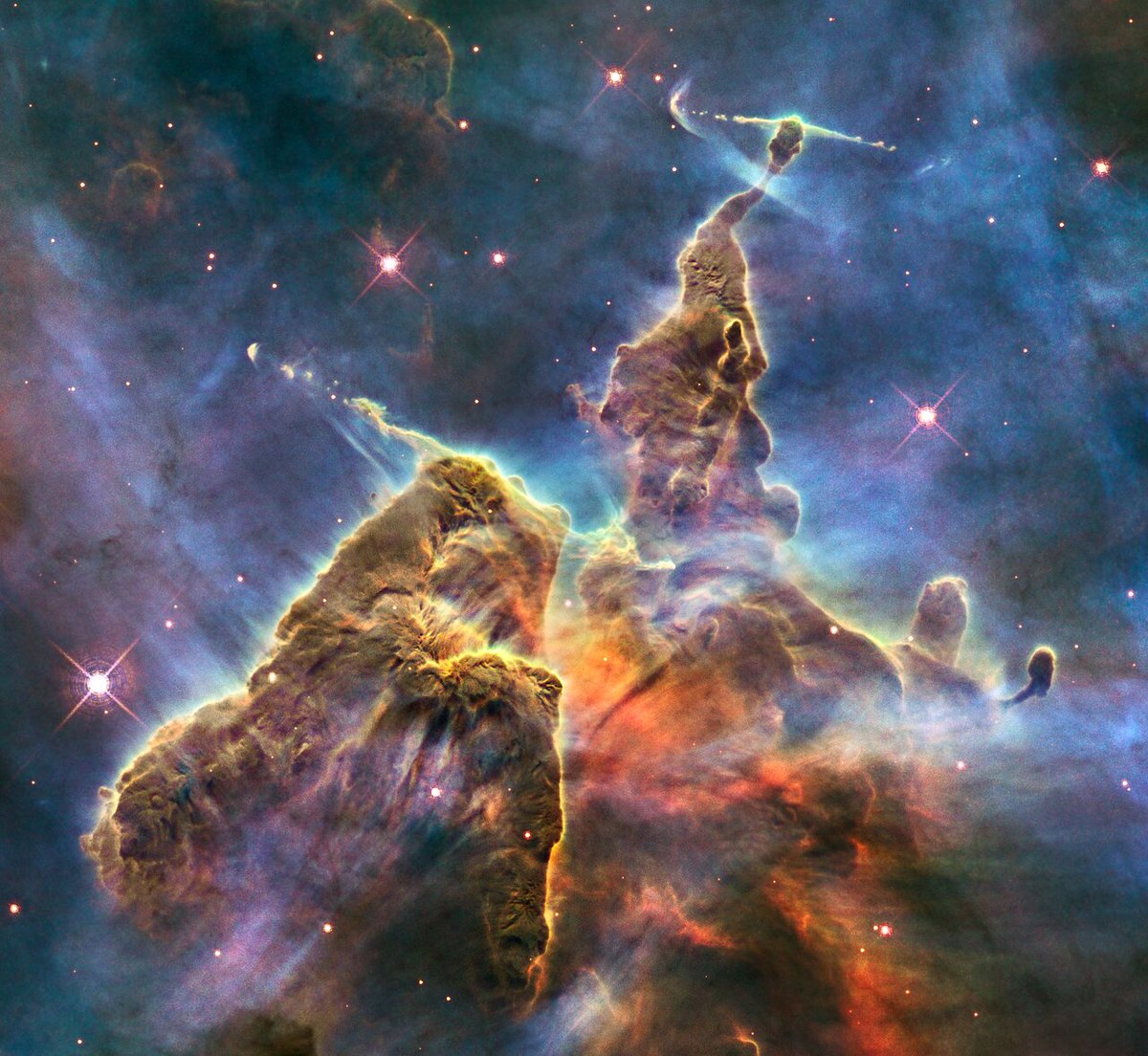
It is being worn away by the scorching light of nearby stars, but also pushed apart from within, as infant stars buried inside it fire off jets of gas. These can be seen streaming from the nebula’s peaks like arrows through the air 🏹
Read more: https://t.co/H4T1jlNYdz
📷 @NASA , @ESA , M. Livio and the Hubble 20th Anniversary Team (STScI) 2/2
Our #HubbleTopImage features the Carina Nebula!
This image highlights a small portion of the nebula, one of the largest observable regions of starbirth 👶⭐ in our Milky Way galaxy. Here, we see the top of one of a pillar of gas and dust, three light-years tall. 1/2
In the 2026 ESA/Hubble and ESA/Webb calendar, the month of July features the famous Sombrero Galaxy! Viewed nearly edge on, the galaxy’s bulge and disc resembles the crown and broad brim of the Mexican hat for which it is named 🇲🇽
Ready to print .pdf here: https://t.co/bncvSGOgAs
📷 @ESA / @Hubble_Space , @NASA , K. Noll
Our #HubbleTopImage features a cosmic question mark ✨❓
NGC 4696 is an elliptical galaxy with a difference. Lacking the complex structure and active star formation of spirals, elliptical galaxies are usually little more than shapeless collections of ageing stars. 1/2
Our ESA/Hubble Picture of the Month features a starry chandelier 💡
This is the globular cluster NGC 6723, also known as the Chandelier Cluster. Each of its ‘lightbulbs’ is an individual star 27,000 light-years away in the constellation Sagittarius (the Archer) 🏹 1/3
Globular clusters contain some of the oldest stars in our galaxy 👴⭐ with some clusters nearly as old as the Universe itself! Exactly how globular clusters form is not yet known...
... but observing programmes using Hubble have revealed clues to the history of globular clusters like NGC 6723, which appears to have undergone two periods of star formation. 2/3
Our #HubbleTopImage features masses of star formation ⭐🏭
This view of the star formation region N11 was captured by Hubble in 2010. N11 is the second largest star-forming region in our neighbouring galaxy, the Large Magellanic Cloud, and has produced some of the most massive stars known!
Close up, the billowing pink clouds of glowing gas make N11 resemble a puffy swirl of fairground candy floss 🎡 but from further away, its shape led some observers to nickname it the Bean Nebula. The dramatic and colourful features visible in the nebula are the telltale signs of star formation.
Read more: https://t.co/oYjGyUmZfI
📷 @NASA , @ESA , and Jesús Maíz Apellániz (Instituto de Astrofísica de Andalucía, Spain)
Alongside Hubble, astronomers also used observations from @esa_webb (near-infrared light) and the @ESO Very Large Telescope (visible light).
Read more: https://t.co/OrdbsrPqon
📷@NASA , @ESA , STScI, I. Goovaerts, M. Rafelski, A. Koekemoer (STScI). Image Processing: A. Pagan (STScI) 3/3
🆕 Hubble has watched an early galaxy transforming its neighbourhood!
The galaxy MXDFz4.4 existed at the end of the Era of Reionisation, a period in our Universe during which the ‘fog’ that filled space 😶🌫️ became transparent or ionised.
Astronomers are still trying to understand how this happened. 1/3
MXDFz4.4 contains tightly clustered young stars shining with ultraviolet light capable of ionising this opaque gas. This suggests that similar galaxies in the early Universe were responsible for the Era of Reionisation! 2/3
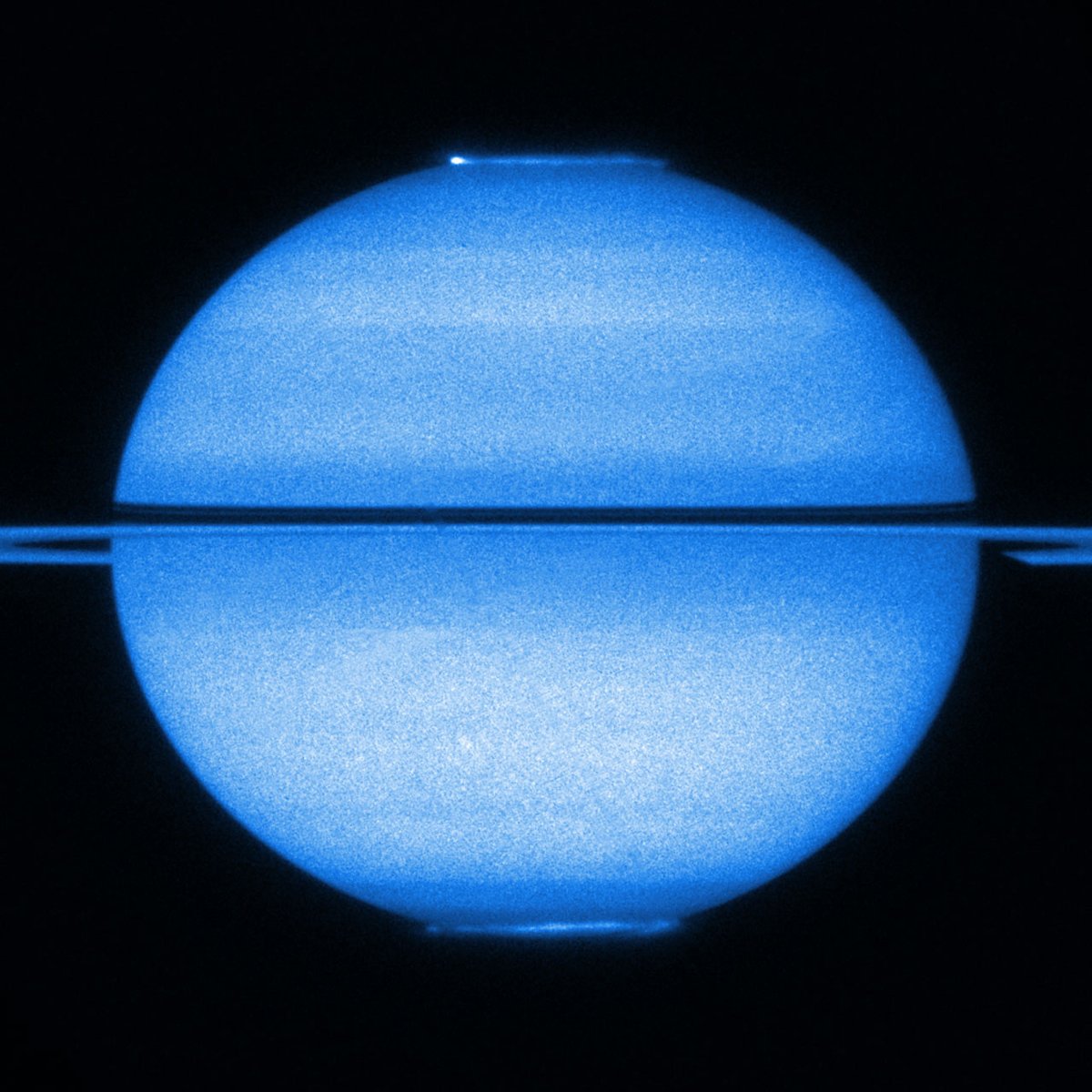
Created by the interaction of the solar wind with the planet's magnetic field 🧲 Saturn's aurorae are analogous to the more familiar northern and southern light on Earth.
Read more: https://t.co/WjqoTGSMVz
📷 @NASA , @ESA , and Jonathan Nichols (University of Leicester) 2/2
Our #HubbleTopImage features Saturn 🪐
This one-of-a-kind Hubble image from 2009 features Saturn with its rings edge-on and both poles in view, offering a stunning double view of its fluttering aurorae! 1/2
Billions of years ago, similar primordial clumps spread out and merged to form the Milky Way’s bulge, but Terzan 5 remained intact, like a lump in an otherwise well-mixed cake batter! 🍰
Read more: https://t.co/AuSy6abkZP
📷 @NASA , @ESA , @csa_asc , STScI, G. Zullo (University of Bologna), F. R. Ferraro (University of Bologna). Image Processing: A. Pagan (STScI) 3/3
Located in the bulge of our Milky Way galaxy, Terzan 5 resembles a globular cluster 🪩 a dense ball of ancient stars. However, observations from Hubble and the NASA/ESA/CSA James Webb Space Telescope have revealed that it contains four distinct populations of stars.
This makes it the prototype of a new class of object: a ‘bulge fossil fragment’. These are remnants from our galaxy’s early formation. 2/3
Our #HubbleTopImage features gravitational lensing 🔍 in Abell 1689!
This Hubble image from 2010 shows the galaxy cluster Abell 1689, with the mass distribution of the dark matter in the gravitational lens overlaid in purple. The mass in this lens is made up partly of normal matter and partly of dark matter.
Distorted galaxies can be seen around the edges of the gravitational lens – their appearance depends on the distribution of matter in the lens, the relative geometry of the lens and the distant galaxies, and the effect of dark energy on the geometry of the Universe itself.
Read more: https://t.co/3p65vwGNSd
📷 @NASA , @ESA , E. Jullo (JPL/LAM), P. Natarajan (Yale) and J-P. Kneib (LAM).
Messier 88 does have a supermassive black hole at its centre, but its path towards the centre of the Virgo Cluster is more determined by the entirety of its mass interacting with the massive galaxies at the centre of the cluster all taken together, rather than just its black hole.