@schreiber84507@Perowinger94 Dunkelflaute ist, wenn die Straße von Hormuz schließt. Teuer wird‘s, denn der Gaspreis den Strompreis bestimmt. Sieht man gerade deutlich im EU-Ländervergleich.
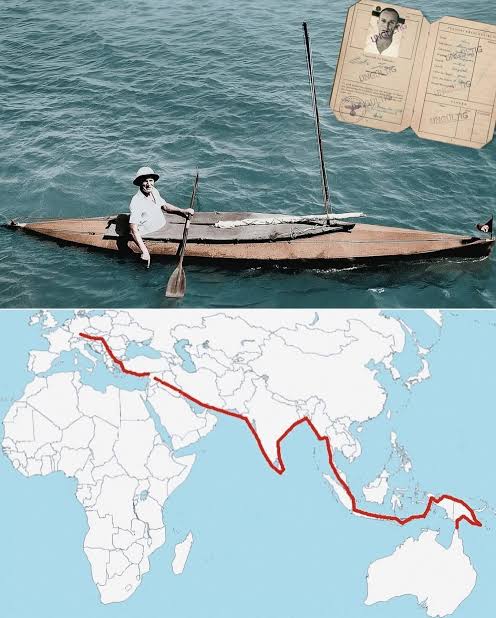
In 1932, Oskar Speck left Germany in a folding kayak, not as a famous explorer, but as an unemployed electrical contractor looking for work. His original plan was much smaller than the legend that followed. He intended to paddle from Germany to Cyprus, where he hoped to find a job in the copper mines. But once he reached the Mediterranean, the journey kept pulling him farther east.
Over the next seven years, Speck paddled through rivers, coastlines, storms, heat, hunger, and dangerous waters. He traveled through the Middle East, India, Southeast Asia, New Guinea, and finally toward Australia. By then, the world had changed around him. Germany had gone to war, and a lone German man arriving by kayak was no longer seen simply as an adventurer. He reached Australian territory in September 1939, just after World War II had begun.
After one of the most unusual kayak journeys ever recorded, Speck was greeted, congratulated, and then arrested as an enemy alien because he was traveling on a German passport. He spent the war years in internment camps in Australia and was only released after the war ended. Instead of returning to Germany, he stayed in Australia, later working in the opal trade and building a new life there. His journey began as a search for work, but it turned into a seven-year accidental epic across half the world.
#drthehistories
Wir sind zu langsam. Das neurechte Modell der Thielisten träumt vom Eurasischen Machtklops made in Moscow: RU-Rohstoffe, Petrogeld und Atomraketen, von Wladiwostok bis Lissabon.
So wächst zusammen, was zusammengehört. Das verstehe ich an Gotthardt und seinen Fans in der Union am wenigsten: Sie machen genau das, was Putin will. Warum?
Es wird übrigens immer klarer, dass beim Thema Strom genau das gleiche passieren wird wie mit dem Internet: Die Länder, die ihr Netz schnell, smart und gut ausbauen, gewinnen. Die Länder, die das nicht tun (looking at Katherina Reiche) werden zurückfallen. Das kennen wir ja.
@simpatico771@DmytroKuleba Letting tectonic movements doing the job might be a quicker way to bring Ukraine closer to Moscow.
In the meantime, Ukraine wins by not losing and Moscow loses by not being able to win while the whole setup is quite unsustainable for all parties involved.
@MullerBoje Unsere weltweite Umsetzung von Trickle Down als wörtlich genommenes ökonomisches Modell ist der wahrscheinlich teuerste practical Joke der Wirtschaftsgeschichte.
@Rick25German@HelmPeter Wenn man mit 180 den Porsche an die Wand fährt, bloß weil man nicht mit diesen pieseligen VWs und Dacias links abbiegen möchte.
In the late 1940s most Poles or Jews didn't think they could trust Germans for generations either.
It took decades of effort by Germans to restore trust with societies Nazi Germany had annihilated.
Are Russia's state and society capable of a similar effort after Putin is gone?
@MarkGaleotti Melnyk is a troll disguised as an ambassador. It worked back then quite well in a Germany of 5000 helmets fame.
And now his foul mouthing makes sense in the UN as well. Just remember the wimpy letter after RU attacked UN helpers and then openly bragged about it.
@MartinRK99@AnatoliUkraine Why would a united Europe inexorably lead to a war? And would a less-united Europe lead to no war? Not sure I understand your line of reasoning.
@christianmiele Eine konservative Spur des Schreckens. Seit der mutwillig ausgebremsten Digitalisierung ging es Schritt für Schritt konzeptuell bergab. Ideologisierte Bestandsverwahrlosung statt Investitionen in die Zukunft gibt halt nur Culture Warrior-Punkte zwecks Machterhalt, sonst nix.
Underrated.
Core human is adaptability. Not only individually, even more so on a societal level.
A fish out of water will die. Throw humans into water, some will learn to swim, others to dive, to fish or to sacrifice some unlucky neighbor to the earth shaking god of the seas.
Yeah but that 99% of time was a period of extremely low population
So if we were factoring basic human experience by population rather than time, we'd get a different picture
My point is that there is no basic human experience. The key point of what makes humans thrive is our adaptability to living in different environments and having varied diets.
Variability and diversity is basic human experience, not whether someone cooks their own food or not
@HubertAiwanger Lieber Ebenfalls-Hubert. Laut meinem mindestens genauso prähistorischen bayerischen Abitur sind wir alten Deppen einfach zu viele.
Ob der faule Franzl jetzt rumflezt oder buckelt ist da nur mehr ein Fliegenschiss auf Bismarcks Büttenpapier, wo Generationenvertrag drübersteht.