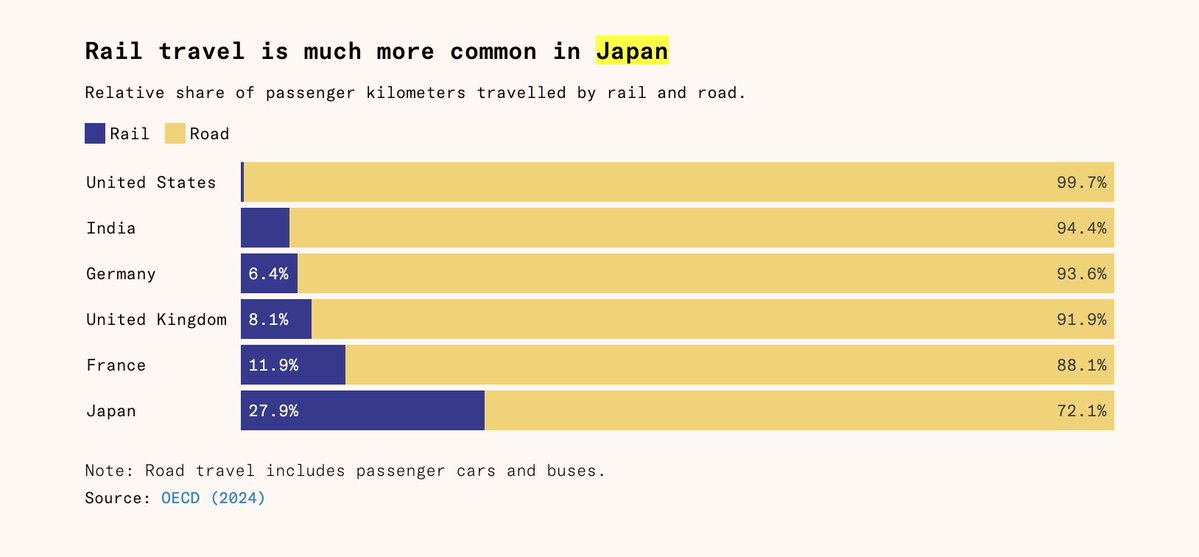
Japan has the world’s best railway system. 28% of Japanese passenger-kilometers are by rail. Germany manages 6.4%, and the USA manages 0.25%. Just one Japanese company, JR East, carries more passengers than China’s entire railway system, and four times as many than Britain’s.
What is the secret of its success?
https://t.co/rLumhzU3of
Part of the answer is that Japanese railway companies don't just operate trains. They run hospitals, supermarkets, department stores, amusement parks, office complexes, and retirement homes around their railway stations. One of them co-built Tokyo Disneyland. Another owns a baseball team. A third created its own all-women musical theater in 1914, which is still running today.
The logic is elegant: a railway increases the developable value of land around its stations, but normally that value accrues to landowners, not the railway operator. Japanese railway companies captured this value by owning and developing the land themselves.
About half of the revenue of Japanese railway companies comes from ‘side businesses’ like these. Allowing railway operators to capture more of the value they created meant that more lines were profitable, making a far larger system financially viable.
This may sound like a radically novel approach. But in fact, an exactly similar system existed in nineteenth-century America. The success of Japanese railways does not lie in some unreplicable feature of Japanese culture: it lies in good policy. If they learnt the right lessons from it, many countries could replicate Japan’s success.
Read more (much more) in @Borners1's & @carto_graph's new piece for @WorksInProgMag Issue 23.
The history of economic development can be understood as a continuous chain of learning. This essay examines how wealthy nations leveraged pre-existing economic complexity, competent governance, and geographic advantages to absorb innovations from abroad.
https://t.co/Ln2Hqk7Rs6
If you *only* used SAT to admit to elite colleges, share of admits from top 1% income falls 15.8% → 9.9% and representation from <$200k rises by +8.8%, with no reduction in post-college outcomes.
It's 'holistic review' and 'ban SAT' policy that allows the most wealthy and powerful to virtue signal while getting an edge.
How has technology driven economic growth through the ages? 🔧📈 Dive into my latest Substack post to see how innovations—from water mills to the internet—have expanded markets and fueled development.
🔗 Read now: https://t.co/2c2nPn0vP9
#EconomicDevelopment#TechHistory
New content added. The ancient Greeks and Vikings traveled long distances by ship, connecting the entire Mediterranean and Northern Europe, respectively. Their voyages and trade created large markets that led to a surge in productivity.
https://t.co/Zlkl3xNRHC