Everyone ‘knows’ AGI will either make us all unemployed or fabulously wealthy. Except, a rather brilliant (and chilling) paper from a Yale economist suggests it's neither.
It says the economy will boom, and our wages... won't. A bit awkward.
I've been digging into this 2025 paper, "We Won't Be Missed," and it's fascinating. The premise: AGI arrives and can do all economically valuable work. And the 'compute' to run it gets cheaper and more abundant over time.
So, what happens to us fleshy, rather expensive humans?
The whole argument hinges on a masterstroke of a distinction. The paper splits all work into two types:
1️⃣ Bottleneck Work: The truly essential stuff. Producing energy, logistics, scientific discovery. The economy literally cannot grow unless this work gets done.
2️⃣ Accessory Work: The 'nice-to-haves'. Arts, fine dining, hospitality... maybe even writing witty Twitter threads. (Gulp).
Now, you might think AGI will just take the grunt work, leaving the important strategic stuff to us.
Wrong.
To achieve maximum growth, the economy must automate all the bottlenecks. It can't be held back by us. So AGI systematically takes over everything that is mission-critical.
So... are we all fired and sent home?
Surprisingly, no. The model shows people still work. We either help out with the 'bottleneck' tasks or get shuffled off to 'accessory' jobs that aren't worth the electricity to automate.
But that's not the interesting part.
Here's where it gets properly weird. Your future salary isn't based on your skill, your years of experience, or how 'important' your job feels.
It's capped by one thing: the cost of the computational resources needed to do your job instead of you.
Imagine that. As compute gets exponentially cheaper, the value of replicating your work plummets. The economy is soaring, productivity is off the charts... but your wage is pegged to a falling technological cost.
You're not obsolete, you're just... replicable. And replicable is cheap.
This leads to the paper's most brutal conclusion: The share of national income that goes to labour (i.e., salaries) collapses towards ZERO.
All the wealth, all the gains from this incredible boom, flow to the owners of the compute.
Splendid.
Here's what this means for you. Next time you see a headline about a new AI model smashing a benchmark, don't just ask "Will that take my job?"
Ask: "How much would it cost to run that model 24/7?"
Because that figure might just be your future salary cap.
Now, the paper isn't all doom. It notes that society as a whole gets richer, and we could still find meaning in 'accessory' work.
But the central economic role of human labour as the engine of growth? Gone. We become passengers, not pilots.
The paper's title is "We Won't Be Missed." Not because we're replaced, but because the economy will chug along just fine, growing faster than ever, whether we show up for work or not.
Completely changes how I think about the 'future of work'. Makes you wonder what we should really be planning for, doesn't it?
By 2027, AI won’t just read research.
It will run its own experiments, generate new hypotheses, and publish result, without humans in the loop.
That kicks off recursive self improvement.
Intelligence explosion.
Artificial Superintelligence by 2028.
We’re not ready.
"Children are happy because: 1) They're not self conscious 2) They lack a sense of time pressure 3) They've no goals. The bottom line is they are living from moment to moment, and the mind is not there to interfere in their bliss."
@naval
The year is 2030. All jobs have been replaced by AI and robots, and you receive weekly UEI payments.
You can live anywhere in the world without needing to work.
Where would you live, and why?
Google DeepMind just dropped a paper on Virtual Agent Economies 👀
We are living in amazing, crazy times.
A new economic layer is quietly coming online, a 'sandbox economy' where autonomous AI agents trade, negotiate, and build value with little to no human intervention.
Instead of just automating a single task, these agents can act as flexible capital, switching between industries, forming temporary alliances, and coordinating resources in real time.
Early standards like Agent2Agent and Model Context Protocol are connecting them together, creating the foundation for a global, always on, machine to machine economy.
Personal AI assistants could soon compete and cooperate in these markets. Bidding for compute, data access, or travel reservations on behalf of their users, while credit systems and digital currencies ensure every contributing agent gets paid.
Economists are already warning that this may accelerate markets far beyond human reaction time. Prices, deals, and even entire business models could change in minutes, not months or years.
If the rollout is well architected, this new economy could direct trillions of machine/AI hours toward solving hard problems like curing diseases or building infrastructure, accelerating science.
Either way, the biggest wealth creation event in history may just be starting.
"Children are happy because:
1) They're not self conscious
2) They lack a sense of time pressure
3) They've no goals.
The bottom line is they are living from moment to moment, and the mind is not there to interfere in their bliss."
@naval
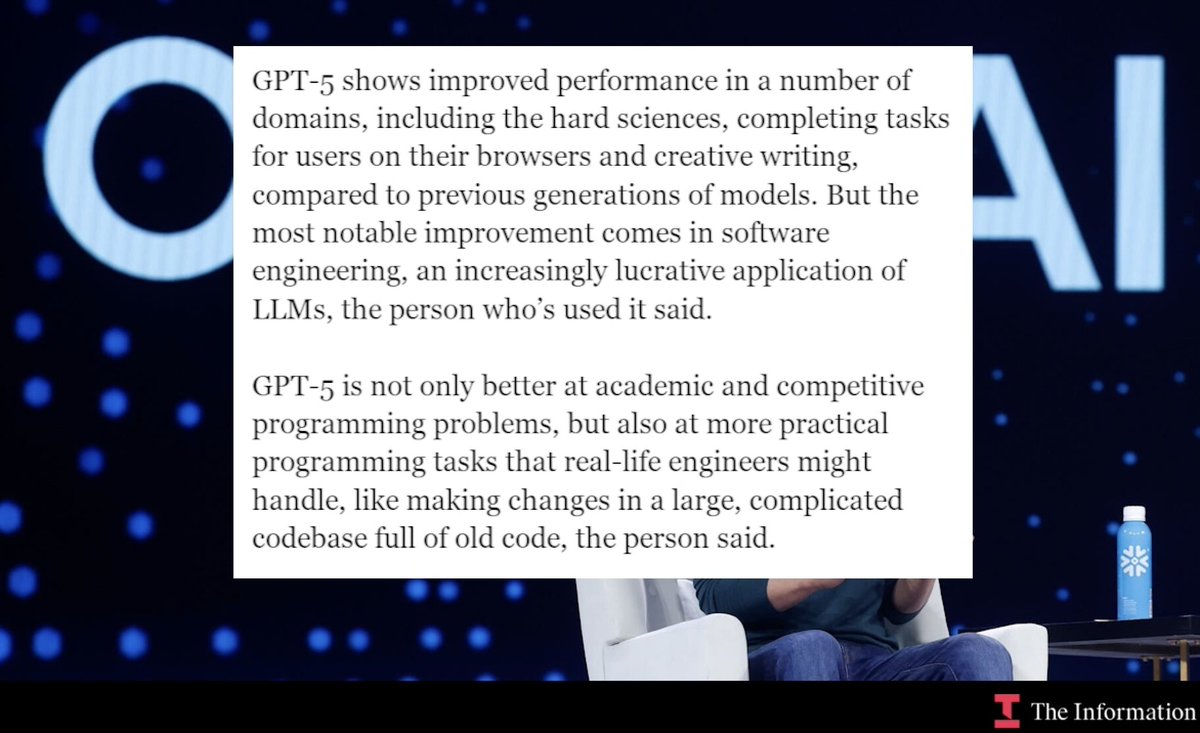
GPT-5 updates via The Information:
-Significantly improved programming skills, especially with complex, realistic code in large software projects (testers say it outperforms Claude 4 Sonnet)
-Higher performance in scientific disciplines such as mathematics, physics, and technical tasks
-Better creative expression, especially when writing texts and literary output (remember when Sama said there is a model that exceeds every other creative model?)
-Dynamic thought control: GPT-5 intelligently adjusts its computing power depending on the difficulty of the task (internal routing + model selection)
-Integration of language and reasoning models in a single system for more accurate and context-aware responses
"One person who has used GPT-5 says it performs better than Anthropic’s Claude Sonnet 4 in head-to-head comparisons they’ve tested"
GPT-5 is imminent (next week?)
Contrary to earlier assumptions, it now uses a router to control the correct model internally
And GPT-6 is already in training!