my persian course ended a couple weeks ago and I’ve been going through performances and recitations that made me interested in Persian and committed me to learning it. here are some of my favorites:
fascinating interview from 2022 (!) on Blank Street Coffee’s logic for automating the espresso so that the barista can focus on conversation. Blank Street Coffee is like a proto-AGI company, trying to find the market equilibrium between automated labor and human labor
"social contracts tend to get extracted from the powerful by the affected, not handed down from above to a public that has not yet decided what it wants."
buckle up!
My new research piece: what the politics of jobless prosperity might look like in an AGI world, why the real political backlash to AI hasn’t started yet, and how the labs should prepare.
1. The backlash to AI isn’t here yet. There is anxiety among American voters, but there is no populist backlash yet, because the job losses haven’t started yet—and we don’t even know if they ever will. AI is not in the top 20 issues Americans say they care most about, and the AI policy issue with the most energy right now, data center opposition, reflects not just AI but also NIMBYism, as @mattyglesias has pointed out.
2. Real backlash will happen if and when unemployment climbs by two percentage points, because that’s where data shows we tend to see meaningful electoral effects of unemployment. At that point, if we do not have a good inventory of smart policy ideas ready, we could be overwhelmed with bad ones.
3. The labs should focus more on measurement, and less on dreaming up New Deals. There is tremendous uncertainty about what kind of job displacement there’s going to be. Instead of attempting to write a new social contract from the top down before Americans are even asking for one, the labs should be helping us all get more intel on whether, when, and how job displacement is occurring—building from the helpful data sharing they’ve already started piloting. This will put society in a better position to design policies that make sense for everyone.
In doing the research for this piece, I came to two broader realizations.
First, there is way more uncertainty than I appreciated about how the economics of AGI might play out, and there is stronger evidence than I appreciated that job losses from AI have not meaningfully started yet.
And second, if AGI plays out the way the labs are predicting, the politics will be very hard to forecast, because it will be the politics of “jobless prosperity,” with jobs falling while the economy grows. We have very little experience with this happening at this kind of scale, and it will break our typical models of politics.
For both of these reasons, we should all be really humble in making pronouncements about the politics of AGI. I hope my piece will be read in this light, as an attempt to reason about something that is super important but also super hard to forecast accurately.
You can check out a lot more in the piece here:
https://t.co/JlwaF1fF8V
The AIs keep drawing more and more handsome illustrations of me. I would kill for that jawline. I guess that is my reward for helping to summon the machine god.
Anyway, if you’re in the Stanford area, come hang out!
openAI realizing that democratic legitimacy is a third constraint to the AI buildout. even if you can solve for more chips and cheaper energy, procedural and electoral democracy is still a bottleneck. affordability politics and NIMBYism will set their sights on AI infra
🚨🚨@sama tells me he feels such URGENCY about the power of coming AI models that @OpenAI is unveiling a New Deal for superintelligence - ideas to wake up DC
He says AI will soon be so mindbending that we need a new social contract
👇Altman's top 6 ideas https://t.co/CAm8zRKEat
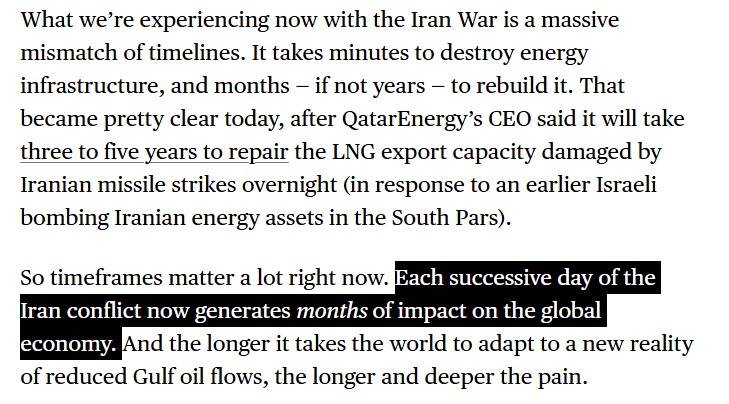
Every single day that this war goes on, the more the economic damage just compounds. This is the key line right here from @tracyalloway https://t.co/T6hrWxL1Op
Sobering to think about.
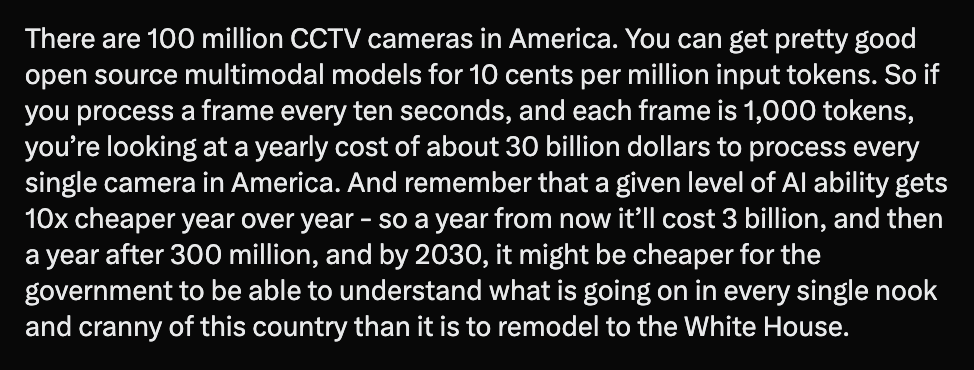
In a handful of years, it will likely only cost around $30-$300 million / year to process every CCTV camera in America through a multimodal AI.
@jwiechers@policytensor thanks! How much do you think IHL will actually matter? Pentagon was just gloating about sinking an efffecively unarmed ship in intl waters. Can’t see th Iranians caring about maritime norms right now either
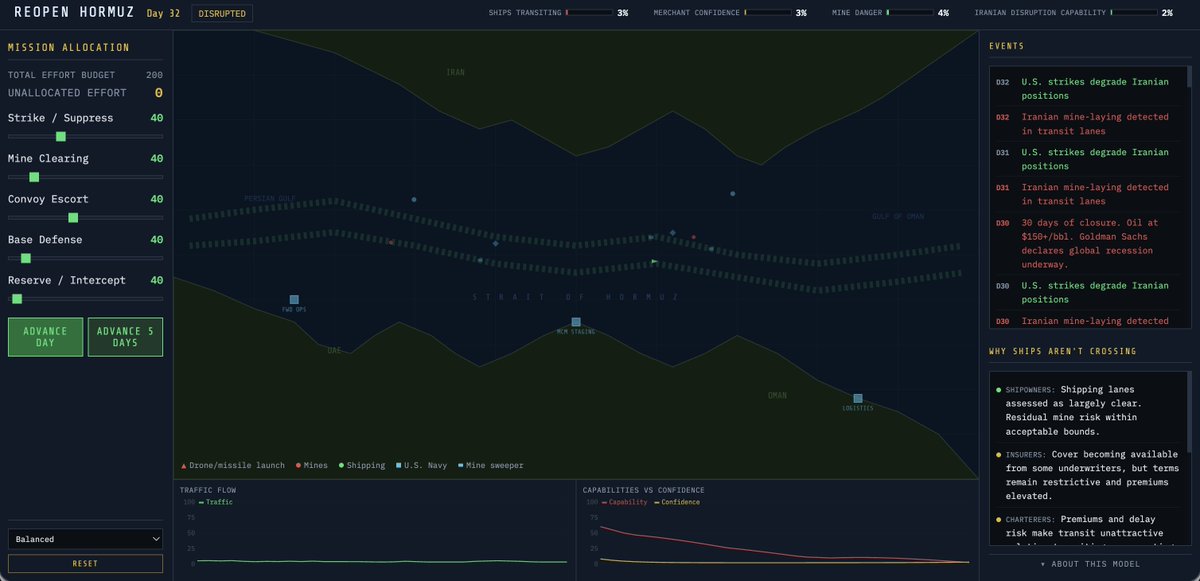
@policytensor basecase is that return of commercial activity lags tactical success.
reopening requires sustained suppression of fire (else Iran capability regenerates), then mine clearing, then escorts.
merchant confidence is difficult to initialize and easy to lose.
I built a toy model of the Hormuz reopening problem. It tries to show why restoring commercial shipping through the Strait is harder than just degrading Iranian capabilities. The logic draws on work by @ProfTalmadge and @policytensor. link below!