@BowTiedUM The NUMU NAD+ has been a great recommendation, and given me noticeable results within a few weeks
🙏🙏🙏
Would it be worth adding pyrilutamide to the stack? Or is that taking on too much risk of some spillover systemic anti-androgen effects?
🚨 Russian soldiers surrendered en masse to Wagner PMC in Voronezh.
Wagner now controls both Rostov (population 1.1 million) and Voronezh (also population 1.1 million). Wagner is now approaching Krasnodar (1 million) and Volgograd (950k) without any resistance.
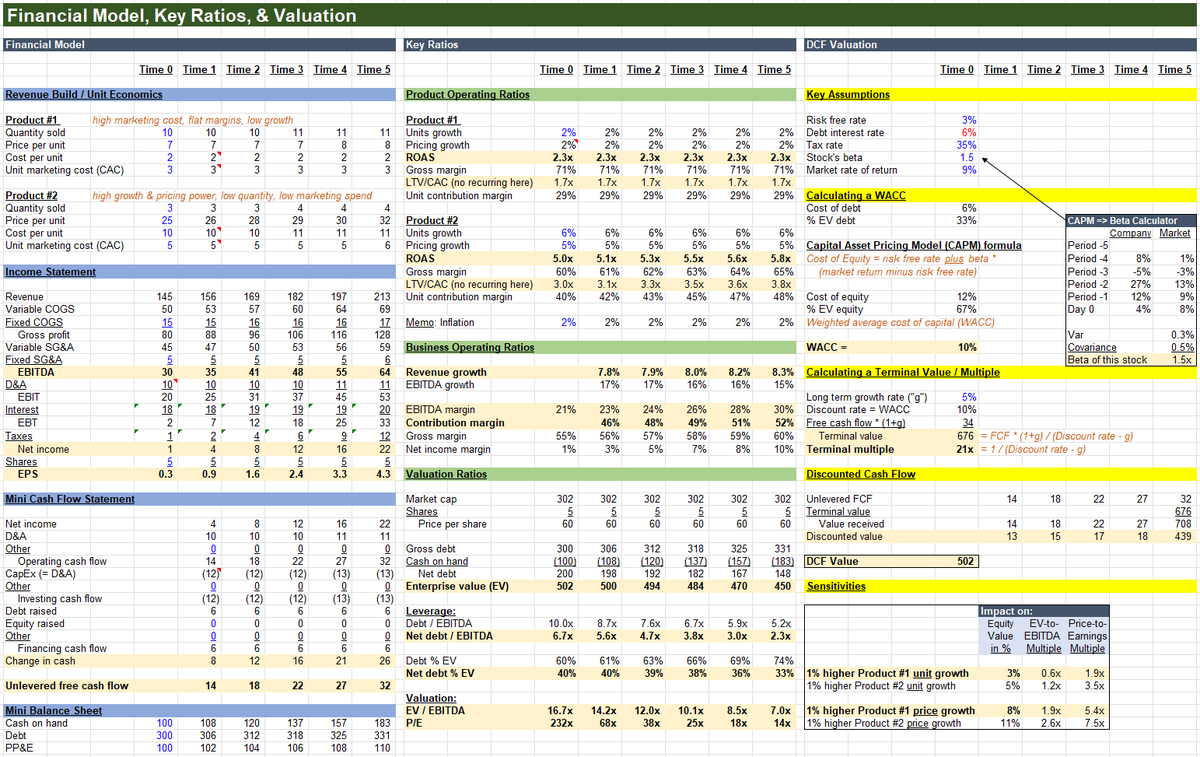
An entire MBA fits on one page.
But you better know the math cold.
Like & comment if you want the excel.
6 topics:
*1) Unit economics*
This builds from product-level unit economics to company financials.
Quantity per unit, growth in units.
Price per unit, growth in pricing.
Cost per unit, marketing spend per unit.
Get you return on ad spend (ROAS), customer acquisition cost (CAC), LTV/CAC, gross margins, unit contribution margins, and more.
This model sets up two diverging products:
A higher gross margin (GM), higher marking cost, low pricing power, low growth product.
Against a lower GM, better pricing power, better growing, lower unit market cost product.
To show how the dynamics of the two play out over time.
*2) Accounting*
Unit drivers flow into revenue, variable COGS, and variable SG&A.
Then to EBITDA, EBIT, EBT, Net income & EPS.
Simple cash flow statements & balance sheets reconcile D&A to inflation-adjusted replacement CapEx, debt levels, & GAAP PP&E.
You have to be fluent in accounting to look at public companies.
Not because accounting itself matters.
But because accounting can obscure what matters.
And your task it to translate GAAP into meaningful business logic.
*3) Operating ratios*
Unit drivers output financials, financials output overall business ratios.
Revenue growth, EBITDA growth, EBITDA margins.
Contribution margins (= change in profit over change in revenue).
Net debt-to-EBITDA, net debt % of EV.
*4) Valuation*
You can drive valuation on multiples or a DCF.
Which are equivalent:
The discount rate minus the growth rate determines the 'terminal multiple.'
Using a P/E instead of a DCF simply uses next year as the terminal value.
This model drives value from the DCF, and maps that to the multiples to show how they connect.
*5) Corporate finance & DCFs*
DCF math attached using the CAPM.
The summary is a beta from historical returns, add the cost of debt.
To get the WACC - the theoretically correct discount rate.
DCFs are extremely assumption laden - you can get out almost whatever you want.
But realistically.
Your banker (or analyst) will make the math work out to a 7-13% discount rate.
Depending on the risks, industry, markets - and what they want to achieve.
*6) Sensitivities & the hard part*
The last section sensitizes the equity value and multiples to unit and price growth.
Bringing unit drivers full circle to valuation outcomes.
Ultimately, the hard part isn't the math.
You have to be fluent in the math, its nuances and its limitations.
If not, you will lose out to those who are.
But once you are, you also have to shift focus.
To the hard part.
Which is always in filling in the numbers.
If you're investing, that means thoughtful views on unit drivers; on how, when, and why they shift.
And if you're building, it means making the numbers on the page happen.
That's all for now.
Like & comment if you want the excel.
1/
Get a cup of coffee.
In this thread, I'll walk you through "Gambler's Ruin".
This is a classic exercise in probability theory.
But going beyond the math, this exercise can teach us a lot about life, business, and investing.
Legendary investor Howard Marks just released a new memo.
“In my 53 years in the investment world, I’ve seen economic cycles, manias and panics, bubbles and crashes, but I remember only two real sea changes. I think we may be in the midst of a third one today.”
My Notes…
Japan will now allow 10-year yields to trade as high as 0.50%.
And while this seems like a minor policy change, it is likely to cause some serious market volatility.
Why?
A thread.
1/