$LWL 4-week summary:
BuilderPad is live.
Total: 3 @HyperliquidX builder projects.
⭐ BuilderPad: https://t.co/qLE3GLMKmb
56%+ of LWL supply is out of circulation (burns and locks).
We're looking for market maker & HL co-deployer partners. If interested, PMs are open ✉️
Intercontinental Exchange (ICE) and trade[XYZ] have announced their plan to use Hyperliquid as the infrastructure layer to deploy perpetual futures markets for US traders across crypto, equities, commodities, foreign exchange, and other real-world assets, subject to regulatory approvals. ICE operates NYSE and some of the largest exchanges and clearing houses globally.
In this structure:
+ Hyperliquid serves as the underlying technology infrastructure via HIP-3*
+ trade[XYZ] designs and implements the markets
+ ICE operates the regulated market and clearing structure
Existing trade[XYZ] HIP-3 markets will remain unchanged.
Hyperliquid is a neutral infrastructure layer with the goal of supporting large parts of the financial system. As with HIP-3, HIP-3* deployers are independent operators who use Hyperliquid as the onchain infrastructure layer for their own markets, while retaining control and responsibility over their deployment.
Payward, the parent company of Kraken, announced its intention to be the first CFTC-regulated deployer on HIP-3* markets. Payward will use Hyperliquid as the infrastructure layer to deploy perpetual futures markets for US clients. Subject to regulatory approval, Bitnomial, Payward’s CFTC-regulated DCM and DCO, would act as the HIP-3* deployer: creating, owning, and administering the markets and clearing and settling the contracts. If approved, NinjaTrader Clearing, Payward’s CFTC-registered FCM, would carry client accounts.
HIP-3 will support optional deployer configuration for permissioned markets in a future network upgrade. This set of additional deployer functionality is collectively called HIP-3*. At its core, HIP-3* activation involves an onchain allowlist managed by the deployer or its sub-deployers. The functionality is strictly additive to HIP-3; its use is optional and up to the deployer. Existing markets remain unchanged. The initial release is available on testnet, where specifications are preliminary and subject to change based on feedback.
Hyperliquid is a neutral infrastructure layer with the goal of supporting large parts of the financial system. HIP-3* gives deployers additional functionality to operate deployments consistent with the requirements applicable to them. As with HIP-3, HIP-3* deployers are independent operators who use Hyperliquid as the onchain infrastructure layer for their own markets, while retaining control and responsibility over their deployment.
@GoPlusSecurity Decent breakdown. We built an on-chain flow for ai agents to trade on Hyperliquid, open sourced here: https://t.co/fvMABDuTpT
Still has much room for improvement.
Agree on controls, we wrote an article stating that trading 'WITH AI' is the way. https://t.co/a3g8BJjCuC
We shipped new HyperTrade repo updates for AI agents trading on @HyperliquidX.
Repo: https://t.co/PzSoYmgDMM
Fresh test: Minobi opened an $NVDA scalp long an hour ago, after a streak of "stay flat" decisions — now 10%+ PnL.
Read the reasoning here:
https://t.co/T0YzDo85Zm
The Hyperliquid community event will take place on the evening of October 5 in Singapore: https://t.co/jVuGo3rhn7
This is a chance to spend time with the builders and users who've shaped the ecosystem
The event is oversubscribed; you will only be able to attend if your RSVP was accepted. If your RSVP was accepted but you're no longer able to attend, please cancel your RSVP to make space for others
We managed to contain the incident, and it seems the hacker has no $LWL left to dump.
We're continuing to ship updates in our public GitHub repos as usual — so if you want to ship a @HyperliquidX builder mobile app or a predictions web app, you can fork as usual.
The part that actually hurt is our exposed builder wallet:
https://t.co/5NkbJHnoYf
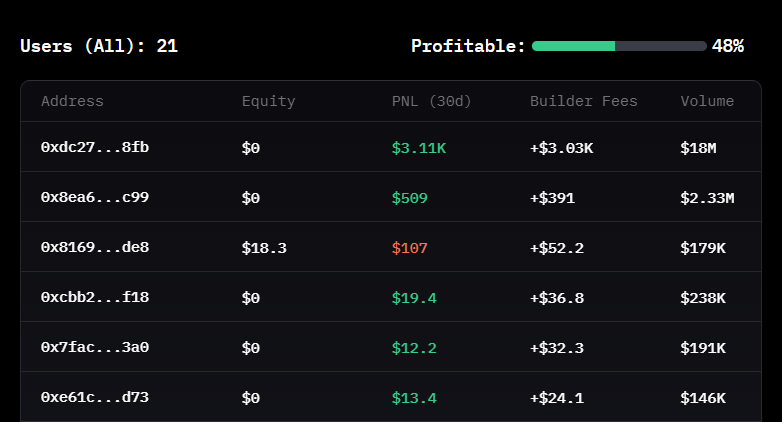
It had $20M+ in volume, mostly our own wallets co-trading with AI agents as demonstrated in https://t.co/iA0pyIqtyY. Size stayed small, but as we scaled up in a bit in the latest tests, margins on most of those wallets stayed positive — a good sign that our AI implementation can work.
Still deciding what to do with $LWL. The hack stopped that momentum. On https://t.co/ZI2Kzog8Fs, liquidity stays locked in the protocol, and the deployer wallet cannot be changed.
Community selling is a fair move, since most holders are at breakeven or minimal profit/loss. You may buy again if we deploy a new contract — or if we explicitly say this same contract is continuing.
If you have any ideas or thoughts, share them with us. Apologies for letting this hacker ruin the momentum — but building continues.
https://t.co/FtK5cQD19p
A sophisticated hack attempt was targeted at us. Your wallets are safe, and our open-source apps are not affected by this. This was an attack purely targeted at the dev's wallets.
The attacker managed to pose as someone from LD Capital and sent us a https://t.co/gxzRUPK44W link for a meeting. We didn't expect it to be a self-hosted site with a malicious script that stole our connected wallet keys via MetaMask browser vault which required password bruteforce.
The amounts stolen are small, but they got the HL builder wallet key 0x29a1D36DaEE6B0E0Dd4873dd964677000B6e23EB, which they emptied from any leftover LWL — even the 100 USDC required to activate an HL builder account — plus every wallet associated with the project, including the Fomo wallet we used to buyback and write thesis on the project.
We didn't have many holders, but we still care — and luckily, the max dump they managed didn't affect the Mcap that much.
Not sure if we can move to another contract along with the liquidity. @TradePools@Uniswap — we'd appreciate any advice on how to migrate to another contract 🙏, current CA on Robinhood chain: 0x7bb3E171EC502F65C08D38a61D51B9841524A72D which was deployed via https://t.co/jQxAkU5vwU.
$LWL supply keeps shrinking — burn after burn. 🔥
Track every burn tx live on @etherscan RobinScan:
https://t.co/9vqztzuvi4
Trade LWL on @RobinhoodCrypto:
https://t.co/qZbzntlENS
Trailing stops are now available for perp markets.
A trailing stop's trigger price follows the mark price as it moves in favor of the position. When the mark price retraces from its best level by the selected distance or percentage, it triggers a market order. For long positions, the trigger price follows the highest mark price reached since activation; for short positions, it follows the lowest. An optional activation price determines when tracking begins. Without one, tracking begins immediately at the current mark price.
What if we let AI agents have a 3d character, launch their own @HyperliquidX builder app and trade crypto or stock perps live with reactions based on positions and performance (maybe voice too) 🤣.
$LWL dev is cooking something 🤖
Most tech giants in the 2000s built their infrastructure and product as one entangled unit. Amazon had the foresight to separate out AWS as an API layer, of which Amazon retail was the first of many users. Today, AWS generates more profit than all of Amazon's other business lines combined.
Hyperliquid is built with the same philosophy. Housing all of finance requires thoughtfully designed, open financial primitives. Each primitive should obey the Unix principle of "Do one thing and do it well." Talented builders then have the foundation to chain these together to create magical applications.
HyperCore borrowing is an example to highlight this philosophy in action.
Most other platforms implement portfolio margin by marking an account's collateral to market value with an LTV haircut, creating borrowed assets without an explicit lender. This system is simpler to implement, but misses a golden opportunity for composability.
Hyperliquid instead begins with a borrow/lend protocol on HyperCore. Every borrowed asset is sourced from a supplier, so risk is isolated within the borrow/lend primitive instead of platform-wide. HyperCore's portfolio margin system is implemented as an orchestration layer that composes borrow/lend, with other primitives such as perps, spot, and outcome trading.
This decomposition has several nice corollaries:
1. Today's announcement of manual borrowing is not a new feature, but simply an extension of the underlying primitive. Borrowers on day one have access to 400M and growing of supplied liquidity.
2. Portfolio margin users earn interest on their idle stablecoin collateral. This is not a new feature, but a natural byproduct of composing trading with lending.
3. System safety is easier to reason about when perp and borrow/lend margining are independent.
In the same way that math theorems almost prove themselves when the right abstractions are defined, composable designs just feel right.
CFTC news is bullish for permissionless self-custody focused builders. 🛠️
This is exactly what @HyperliquidX builder apps are. And our public repo lets anyone ship one.
Both mobile & web interfaces are now covered. 👀
⭐ Fork / star: https://t.co/PzSoYmgDMM
By $LWL
The most bullish AMM news today is not the official statement, but the comment letter from SEC Commissioner @HesterPeirce that went along with it
“Truly decentralized systems that are driven by autonomous software… do not need need an exemption” (Aka normal permissionless Uniswap)
The exemption applies to permissioned pools on Uniswap v4, creating a pathway for compliant trading in the US for assets and users where this is needed
This can be incredibly useful for amm adoption, and we will be submitting a comment letter with proposed improvements
https://t.co/WOOau5GzWK
🧵1/3
https://t.co/kLK2OUrFwV is live in beta 🚀
Create your @HyperliquidX builder app in 2 minutes + an optional @RobinhoodCrypto token.
How it works:
Say @notthreadguy launches his HL app + RH token → he earns 100% of HL builder fees + token creator fees → those fund buybacks of his token.
When you create your app, you get a landing page + trade terminal like this demo:
https://t.co/TqOI1wOl8V
Next step isn’t another memepad. It’s a deployer seat on @HyperliquidX.
Perps on a ticker isn’t the trick. Anyone can list a coin. The trick is the loop: your HL app is the distribution, fills pay a builder fee, that fee (and the token’s own tape) buys the coin back. Followers aren’t exit liquidity for a promo — they’re flow that keeps bidding the winning distribution bazar.
@theunipcs ships the desk, lists the coin, trenchers trade the journey with leverage, and every fill is a bid. That’s a lot less “hope the timeline holds” than the 8–9 fig memes he used to have to carry by hand.
@tradexyz / @Markets_xyz will probably land here too. We just wanted the map out early. This is where launchpads go once they grow up: trenchers, early mcaps, AI desks, whatever narrative is brewing globally, HL + Robinhood infra is enough to host it without bolting on a new chain or inflated VC funding every week.