Between 1985--2023, MIT's faculty grew 9%. Administrative staff grew 189%. 📈 Why? In new @PNASNews paper, we use dynamical system model to show administrative bloat can emerge without empire-building--just from well-intentioned problem-solving gone awry https://t.co/MZgGkxilZ2
Take a moment to read Wallace Stevens’ deeply moving letter to his daughter: “Take my word for it that making your living is a waste of time. … Learn to live the good in your heart, although you may never speak of it, and devote your life to it.”
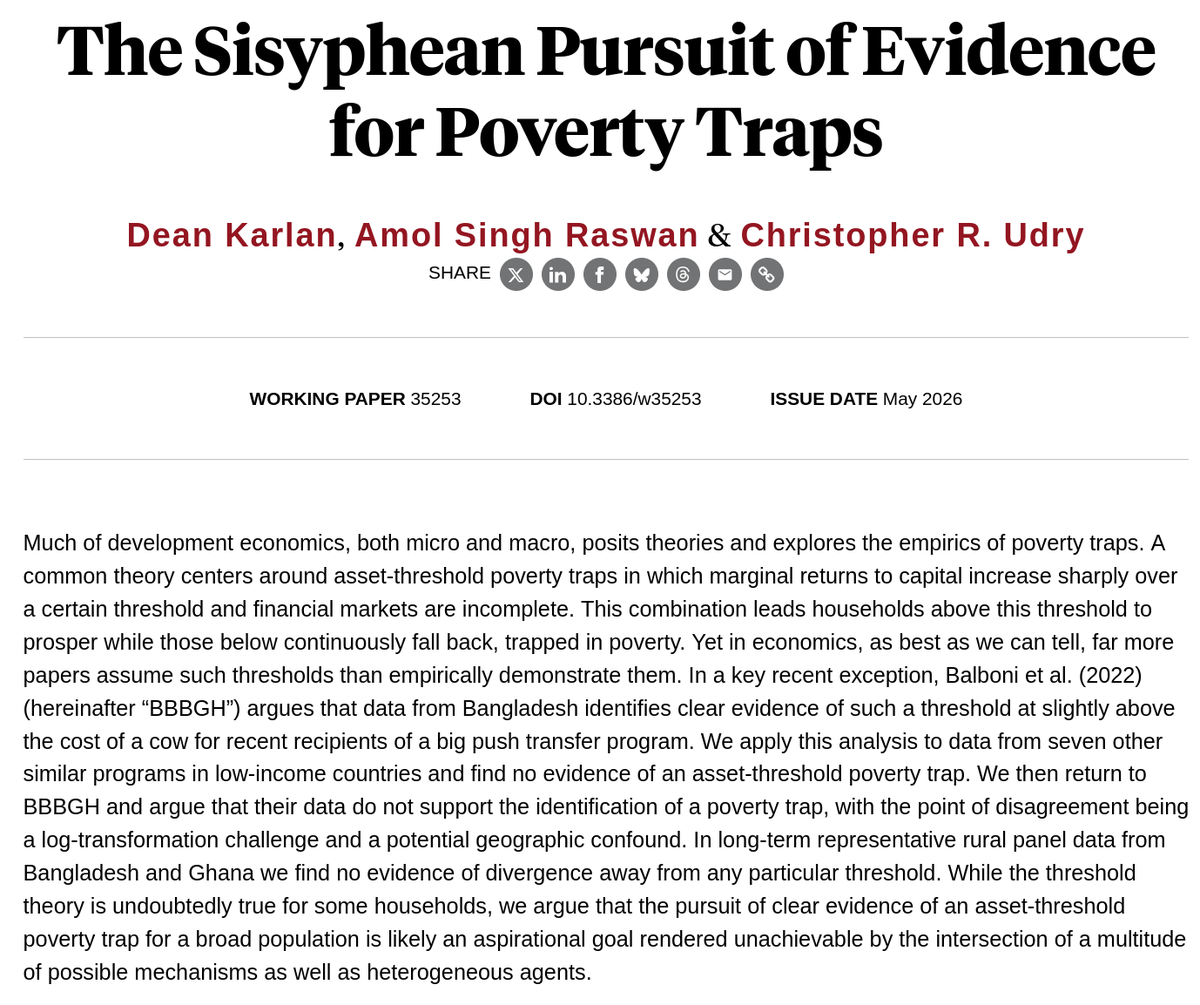
New working paper with @AmolRaswan and Chris Udry: "The Sisyphean Pursuit of Evidence for Poverty Traps."
A central idea in development economics is that poverty can trap people. We went looking for the cleanest evidence. Here's what we found – and didn't.
Undergrad papers in 2021: 10 weeks in, most students have an OLS regression, 1/20 has an interaction term or fixed effect.
2026: 3 weeks in, median student has a DSGE survival model with heterogeneous agents, spends rest of quarter working backwards to understand it all.
🎉Opportunity to work with Prof Rebecca Dizon-Ross (@RDizonRoss) (@umichECON) on projects in development economics and labor economics, including research on health, labor force participation, and the economics of education.
Initial review on 5/23 🏃♀️🏃♀️
https://t.co/JEsFsO17BX
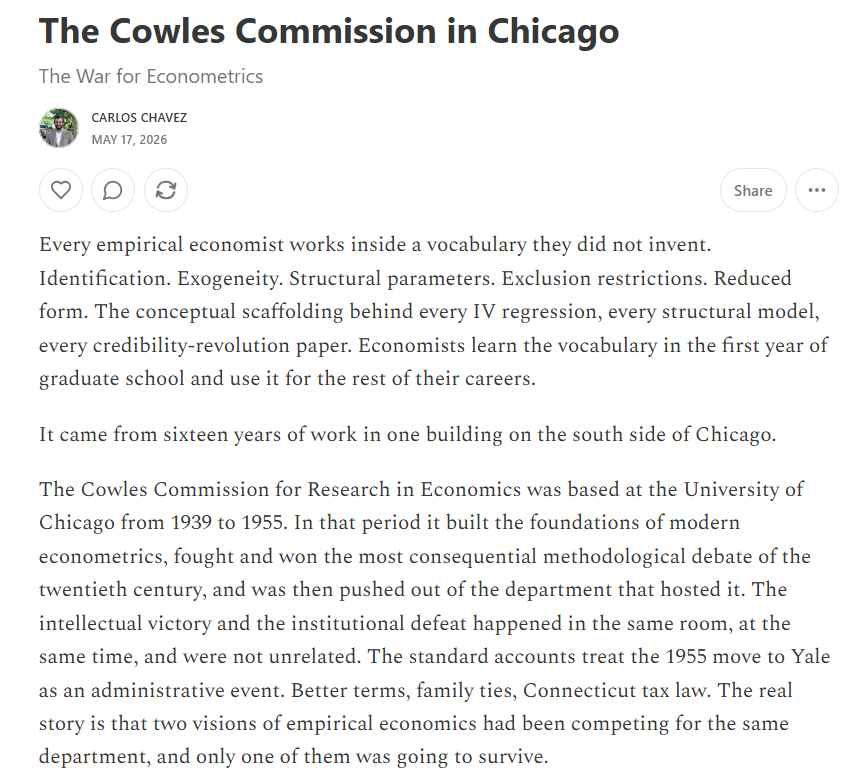
New essay on the Cowles Commission's sixteen years at Chicago. How identification was born, who fought it, and why Cowles had to leave the department it built modern econometrics inside of.
Link: https://t.co/pbvVRJJBnR
An Econ PhD student at the 20th ranked program who is working on stuff they are passionate about will have a better job market than one at MIT who's been doing nothing but phd-app-maxxing since undergrad.
People get confused by this because they don't observe *how* successful people came about their insane knowledge bases. It wasn't by relentlessly grinding away at stuff because they had to.
They look at Scott Kominers and say "if i grind and learn as much math as he did, i will be successful." You can't! *You* can't learn as much math as Kominers because he gets energized by configuration results for type ii lattices. You will burn out if you try to do it this way.
You cannot, through grind alone, learn more about the economics of cities than Glaeser, or about how to maximize a value function than Acemoglu.
Research careers are long. Most people give up and stop working on research (graph is share of elite PhD graduates with at least one publication in year X after graduation).
If you're starting a PhD, you're presumably doing it to have a successful 40-year research career. The number one factor in whether that happens is not which program you get into, it's whether you find a research angle that energizes you enough to push through the endless barriers an academic career throws in your path.
This is why a lot of the received wisdom around PhD applications is wrong. If you're 100% consumed by the predoc rat race already, it's going to be a long, hard road ahead.
Obv you still have to do admissions, you should study a lot for the GRE, sigh it seems like taking real analysis is probably worth it.
But spending time on the things that energize you about economics is a no-brainer, whether it's policy, or blogging, or whatever, you gotta do the things that light your fire and make you want to be on this road.
Check out this terrific opportunity to work on India and South Asia at the Council on Foreign Relations. (If you’re interested, please apply directly.)
https://t.co/hea2gpsM8C
We are hiring an RA in economics at Stockholm U for the academic year 2026/27. It’s a great opportunity if you have strong quantitative skills and are considering pursuing PhD studies. Please RT.
https://t.co/49Csn9eGxZ
🚨 Hiring alert 🚨
We‘re looking two positions
a predoc/junior researcher
a research manager
in our team at UZH & ETH designing innovative social and health policies in collaboration policy makers and evaluating their economic impact using large-scale RCTs
I’m hiring a full-time predoctoral research assistant at Stanford, starting Fall 2026, on projects in trade and development.
Great opportunity for students interested in research, policy, and PhD preparation.
Apply: https://t.co/8H2JZRVml4
Deadline: May 1, 2026
@econ_ra
⏰📆I'm looking for a pre-doc based @LSEEcon+@CEP_LSE starting Fall 2026 to support my @ERC_Research Grant agenda on the role of multinationals in development. If interested, apply by May 17 as advised here: https://t.co/FzKnZZcxat @econ_ra
@jmwooldridge Well then, this dude abides. Just wanted to make sure, because, see, nearly 25 years of IDE students have had to endure the pain of my drilling them on the distinction between a model/DGP versus an estimated equation, all because of you.
First of all, you got a shout out from @jmwooldridge and the dude doesn't even remember me from his MIT days (a by-product, perhaps, of not using my real name on this platform - it's Boozer, Jeff, Mike Boozer). Secondly, I guarantee you that in the counterfactual world in which you had never met me, you would have unquestionably achieved all that you have. I am just honored that I got to ride along for a small part of your journey. I hear Berkeley is a nice place......
It truly took a village, but I definitely wouldn’t be here without the unwavering support and generous guidance of my wonderful mentors Grant Miller, @IDE_Michael, and @michelacarlana.
Villagers near Hyderabad were surveyed by economists so many times that when another economist showed up & asked a question, an irritated villager said, “Is this for a PhD or M.Phil? I will accordingly make the answer long or short.”
I’m hiring a postdoc! Flexible in terms of details, but I’m looking for someone to collaborate with on research about labor market inequality. I’ll review applications as they come in and the posting just went up here:
https://t.co/ZkXKVfsQCF