Assistant Prof. of Religious Studies at Sogang University in Seoul, SK., researching on the intersection of religion & politics in Korea and around the globe
This is a really funny Xi video, which I've never seen before. I just added subtitles in English to it 👇
He explains the art of giving gifts to foreign leaders. The South Korea anecdote is particularly hilarious: he explains that when China had to find a gift for President Park Geun-hye, they went through her autobiography, where she wrote that if she’d ever had a first love (she was unmarried), he would be Zhao Zilong, a legendary general from the Three Kingdoms. So they had Fan Zeng, one of China’s most famous painters, paint her crush 😂
Xi can’t resist adding that Zhao Zilong happens to come from Zhengding, the county he ran in the 1980s, which makes him "very proud too."
Xi’s actual point is that good diplomacy is personal and that you need to do deep research on the people you’re dealing with: reading their biographies, knowing their taste, their history, etc. It signals respect and, as he puts it, is "a very, very effective way of reaching people’s hearts."
New critique of the “Christian nationalism” literature just dropped, this time joining forces with Jonathan Tran to bring the theological angle. Give it a look.
https://t.co/Gu5q3k9V0t
Two economists mathematically proved that AI will destroy the economy.
Researchers from Wharton and Boston University published a terryfiying paper called "The AI Layoff Trap."
They mapped out the economic end-game of the AI transition, and it exposes a fatal flaw in competitive capitalism.
When a company replaces a worker with AI, it captures 100% of the wage savings.
But that displaced worker is also a consumer. When they lose their job, they stop buying things.
The company gets all the savings, but the loss of consumer demand is spread across the entire economy.
If there are 20 competitors in a market, a CEO only absorbs 1/20th of the economic damage their layoffs just created.
So every single rational CEO has a mathematical incentive to automate as fast as possible.
They can literally see the cliff approaching, and they still step on the gas.
It triggers an unavoidable Prisoner’s Dilemma. If you don't automate, your competitors will, and they will crush you on price.
It doesn't just hurt workers. It destroys the businesses, too.
The economy gets trapped in an automation arms race. Companies fire their workforce to stay competitive, until the entire consumer base is completely hollowed out.
At the limit, the paper concludes: “Firms automate their way to boundless productivity and zero demand.”
And the scariest part?
The researchers mathematically tested every popular fix.
Universal Basic Income? Fails. It raises the living standard but doesn't change the corporate incentive to cut jobs. Retraining? Fails. Worker equity? Fails.
The paper proves that more competition actually makes the collapse happen faster. And "better" AI makes the damage worse.
The only thing that mathematically stops the collapse is a targeted automation tax, forcing companies to pay for the purchasing power they destroy before they automate the job.
China created a system that simulates the earth with billions of AI agents that has real personality, memory, beliefs and human-like desires.
it gives them a terrifying ability to predict the future.
they published a paper called "Modeling Earth-Scale Human-Like Societies with One Billion Agents."
they built "Light Society," a framework that efficiently models human-like societies powered by large language models.
traditional agent-based models were always limited by simple, predictable behaviors.
but this new earth-scale simulation framework uses a "mixture-of-models" engine to change everything.
by combining massive llms with smaller, highly efficient distilled surrogates, the researchers successfully simulated a society of over one billion autonomous agents.
they grounded these agents using real-world demographic data from the world values survey. these agents don't just act like generic bots..
they exhibit sophisticated social behaviors that mimic actual, diverse human populations.
they ran simulations on trust games and massive opinion diffusion, tracking how information spreads and how society evolves in real-time.
the simulation proved to have incredibly high fidelity in modeling diverse social phenomena, giving researchers a practical foundation for hypothesis testing.
think about what this means for predicting global elections, market crashes, or how a population will react to a crisis..
you don't need to poll people or guess anymore. you just run the simulation.
the infrastructure for agentic simulation is scaling faster than anyone realized. social sciences and predictive modeling will literally never be the same..
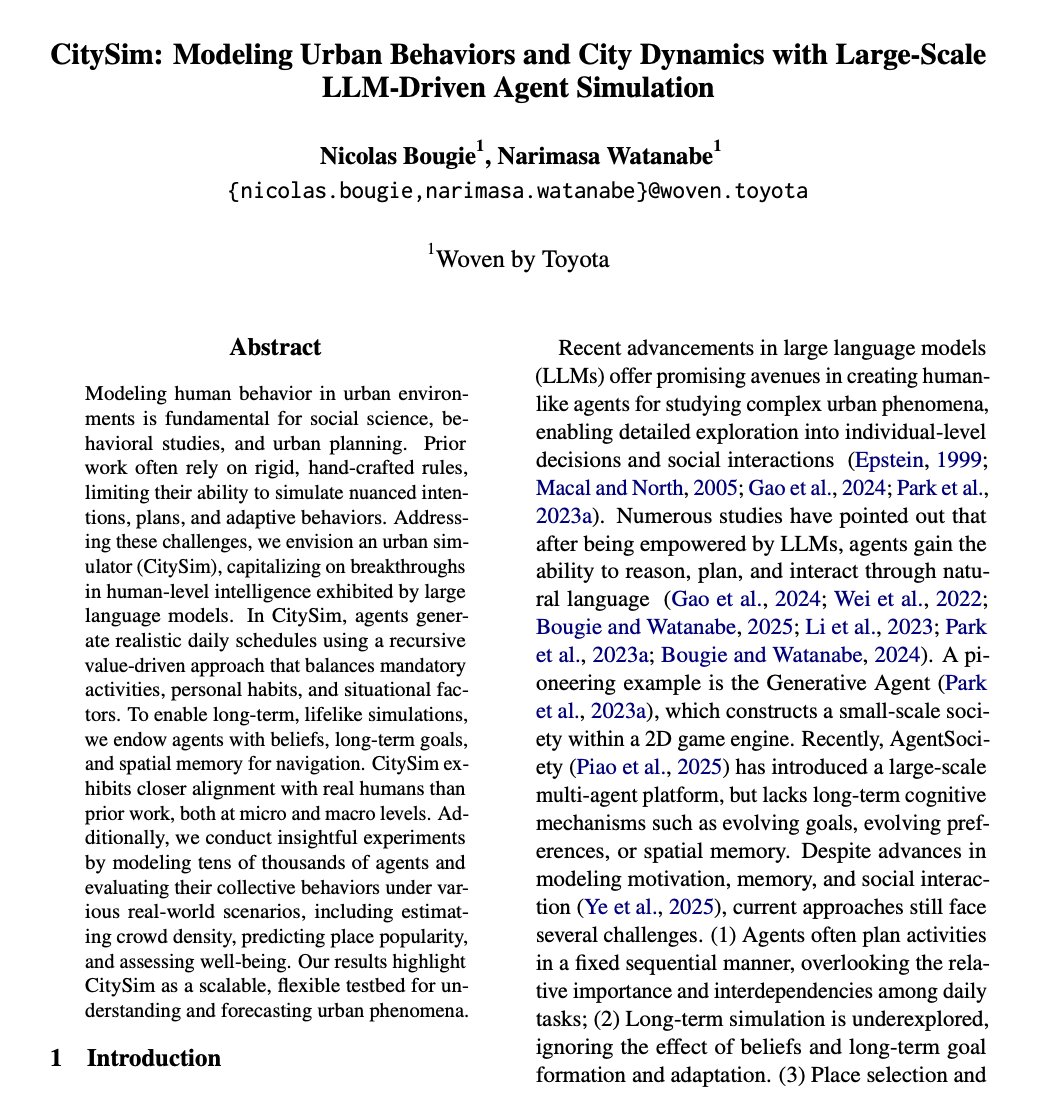
Japanese researchers created a system that simulates an entire city by generating up to 1 million virtual residents who behave like humans using LLMs.
And it predicted real-world with terrifying accuracy.
They created an urban simulator called "CitySim" that populates a digital twin of Tokyo with up to 1 million autonomous AI agents.
Each resident is powered by an LLM, complete with:
• Personal memories
• Long-term goals
• Human-like desires (hunger, fatigue, social connection)
• Spatial awareness and navigation
Most urban simulations rely on rigid, hand-crafted rules, if A happens, B follows.
CitySim is different. It’s "value-driven." The agents have agency. They generate their own schedules based on their personal habits, situational needs, and changing environments.
When researchers ran the simulation in Tokyo, the output was chillingly accurate.
Weekday commuting patterns, weekend leisure activities, and shopping habits matched Japanese government statistical data with near-perfect precision.
It even successfully predicted crowd distributions in Shibuya and identified which stores would actually become popular, months before the real-world data caught up.
The implications for urban planning are massive.
We can now safely and cost-effectively test disaster preparedness, commercial site planning, and public infrastructure upgrades without moving a single physical person.
But it’s not just about planning.
The researchers are already looking at implementing high-level human drives, like "self-actualization," into these agents to see how they evolve.
The paper went up on arXiv in June 2025 and almost nobody outside computational social science has read it.
Preaching that God has assigned black people to "a civilizational station of subordination and dependence" due to the Curse of Ham, Christian nationalist pastor Dale Partridge calls for a "return to European Christian colonization of African nations." https://t.co/fmXimncly7
ANTHROPIC RELEASED THE OFFICIAL PROMPTING GUIDE FOR FABLE 5
It's buried in their docs
Nobody's reading it
So I turned it into one cheatsheet for you
The biggest thing most people miss:
Old Opus 4.8 prompts actively make Fable 5 worse
Save this before your next session
btw ClaudeKit gives Claude Code specialist skills for Fable 5
theclaudekit(.)com
full guide below
어차피 Fable 5 제대로 사용할 사용량도 없고,
나중에 없어진다고 하니,
사용할 수 있을때 최대한 사용하려면
지금 내 작업폴더와
앞으로의 에이전트 지침문서를
보완 수정 정리하는게 좋겠다고 생각했습니다.
최대한 모든 폴더의 에이전트 지침과
작업문서를 통일하고,
필요없는 지침을 삭제하고,
자주 쓰는 지침을 스킬화 하고,
폴더내용을 일치화 하고,
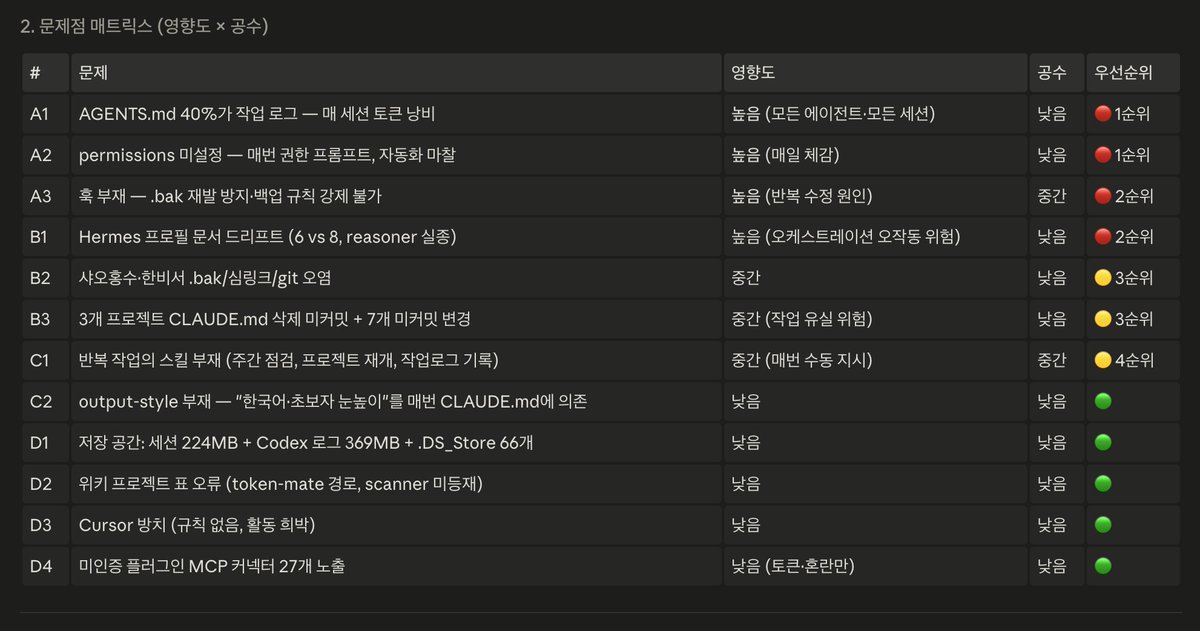
각각 에이전트들의 메모리를 정형화 하라고 시켰습니다.
결과는
5시간 사용량을 모두 사용해서
잘 정리해주었습니다.
뭘 어떻게 정리헀다고
엄청 길게 자랑했지만
어차피 나는 알필요 없는 일이고
일하는 니네들이 잘 기억하고 지켜주면 되는 일이라
바로 종료.
사용한 프롬포트는
Esto es Kentucky (EEUU), una iglesia evangélica organizó una simulación de fusilamiento de inmigrantes delante de niños que acudieron a un campamento de verano.
Puro amor al prójimo, excepto si eres negro, homosexual, inmigrante, comunista o musulmán, entonces toca fusilamiento.
Karpathy method + Claude Code reading your whole Obsidian vault is the smartest second brain on earth.
The method is simple and brutal. If you can’t build a thing from scratch, you don’t know it. Tutorials are fake learning and your brain deletes them in 3 days.
Most people ignore this. They build a second brain that just sits there, folders of notes nobody reopens, dead text.
Point Claude Code at the vault and it wakes up. 5,000 notes, one mind. It reads all of it and answers in your own words and your own proofs, not a model’s guess.
Then the loop closes.
Want to understand neural nets? Skip the 3-hour video and ask Claude Code to build a tiny one. 200 lines from scratch. Watch it train, break a layer, watch it fail, fix it.
It clicks in 20 minutes instead of 3 weeks.
The second it lands the note gets written. One idea per file, linked to 10 others, dropped into the vault while the memory is still hot.
Now it compounds.
Month 1: is 60 notes. Month 6 is 900. Every new note pulls in old ones, so you ask anything and the answer comes from your brain, not the internet.
Before: 40 tabs, 6 half read PDF, 0 retained.
After: build it once, own it for life.
Setup takes 4 minutes. Plain text, no lock-in.
A second brain nobody reads is a graveyard.
Yours just started thinking.
Introducing Sakana Fugu: A full multi-agent orchestration system accessible via a single model API.
Our ‘Fugu Ultra’ model matches the performance of Fable and Mythos, delivering frontier capability without the risk of export controls.
Try it: https://t.co/hhO6qTawgb 🐡
Big news: @BradOnishi and I are doing a live podcast every Tuesday this summer at 1:30pm ET through @AxisMundiMedia!
Our first episode dropped today — watch it here: https://t.co/oWSdMaSqCh
There's a civil war inside Trump's Christian coalition. It's not really about Iran. It's about Jews & 2000 years of Christian ambivalence toward them.
Christian Zionism & Christian antisemitism aren't opposites. They're twins & they're at war inside MAGA.
https://t.co/m1j9VuqD8t
I love that we’re the new Rome. Peace with Persia in the afternoon and a gladiator fight in the evening, all on the Emperor’s birthday. Another 1,000 years.
في وحدة من الجامعات الألمانية، قرروا يسوّون اختبار علمي علشان يعرفون: هل البقرة تحس بألم وقت الذبح الإسلامي أو لا؟ استخدموا جهاز اسمه EEG يراقب إشارات المخ، ويحدد إذا فيه ألم أو لا، وكم قوته.
جهزوا البقرة للاختبار، شبكوا الأجهزة، وذبحوها.
وبعد ٣ ثواني من الذبح مباشرة…