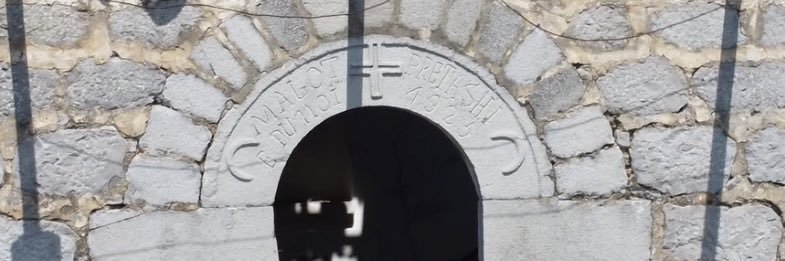
@BerishaShin What are your thoughts on Berishaj tribe from tuz? Do you think there’s any connection to nikaj-mertur berish? Genetic testing proves paternally they’re not the same ancestor and some oral history says we’re from there, but it’s all kind of up in the air
@diverticulum51 I guess you don’t know how paternal haplogroups and subclades work lol. That 23 and me is as broad of a test you can do with even broader results that shows you not 100% accurate results
According to the Diachronic Phonetic-Etymological Dictionary of Albanian (DPEWA), an ongoing peer-reviewed lexicographic project hosted by Ludwig Maximilian University Munich, the Albanian lexicon of approximately 5,000 documented entries reflects a layered etymological history: roughly 60% of the vocabulary is inherited from Proto-Indo-European through Proto-Albanian, while the remaining 40% consists of loanwords accumulated over two millennia of contact with neighboring languages and cultures. The largest loan stratum derives from Turkish (~16%), reflecting five centuries of Ottoman rule, followed by Latin and Romance (~10%), Slavic (~6%), and Greek (~1.5%). Available at: https://t.co/MILSB7HxgP
@barstark1556@vozhdot Nikollë/Nikola is a Christian name, same with English people with the name Nicholas, just because there’s different variations doesn’t make the name slavic/English/Albanian in origin.
@regelegorila I’m an Ethnic Albanian from America who visits Albania quite often, never have I once felt threatened or worried for my safety, but i have been to Austria, Germany, and Italy, where i had to keep my guard up constantly and look over my shoulder. Western Europe is DANGEROUS.
Ottomans left Albanian lands in 1912 with no roads, no railways. Brutally supressed the Albanian language and identity. Sold out Albanian interests to Greeks and Slavs. Set Albanian culture back centuries. But yeah, Ottomans built great stuff ... in Istanbul, with Albanian labor.
📚Recently I came across a book that, ironically, almost no one talks about, even though it is one of the most important documents about the tragedy our people endured: “Albania Golgotha” by Leo Freundlich, published in 1913.
Leo Freundlich was not Albanian. He had no connection to us whatsoever. He was an Austrian publicist and politician, who witnessed what was happening during the Balkan Wars and chose to document it with precision dates, places, names simply the truth as he saw it.
And what he describes is devastating:
According to reports from that time, around 25,000 Albanians were massacred in just the first half of the First Balkan War, in the
Vilayet of Kosovo.
Entire villages were wiped out. Houses were set on fire with people still inside, and anyone trying to escape was shot at the doorstep.
Women and young girls were systematically assaulted, some only twelve years old.
Children and the elderly were suffocated, drowned, or killed in their own homes far away from any battlefield.
In Lume, Serbian officers openly boasted about burning down dozens of villages and burning men alive.
European newspapers of that period wrote about the “extermination of the Albanian population” and reported mass killings in Prishtina, Kumanova, Ferizaj, and other towns.
Freundlich ends by saying that the number of victims was so enormous that every European government should have felt ashamed for ignoring it.
This is not legend, not nationalist storytelling. It is direct testimony, written by a foreigner, just a year after the events, when everything was still raw and undeniable.
If we want to truly understand what our people went through ...not just the dates but the pain, the injustice, the struggle for survival, this book is essential.
ℹ️You can find it also on PDF online. Download it. Read it. It’s heavy, but necessary.
Because a people who know their truth can never be erased.
#AlbanianHistory #AlbaniensGolgatha #LeoFreundlich #SerbiasGenocide #Kosovo #Macedonia #ExterminationOfAlbanians
#VilayetOfKosovo
@VjosaOsmaniPRKS@albinkurti@EU_Commission@kajakallas@aliciakearns@DorisPack2@FarCanals@agim_musliu@gurakuqkuqi@realDonaldTrump@POTUS@SecRubio@EP_President@eucopresident@DanielSerwer@AndrejPlenkovic@BajramBegajAL@elisaspiropali@UN@UNHumanRights@BBCWorld@FoxNews@nytimes@shkamberi@USAmbKosovo@AivoOrav@MartaKosEU
@BerishaShin Have you ever done any research into the Berishaj of grudes? We have a couple of theories but waiting for my WGS test results to understand fully where we actually came from
debunking the egregious claim that “90% of the Albanian vocabulary consists of loanwords,” a number repeated in an MA thesis (2010) by Ariola Kulla.
this thread uses direct screenshots from her thesis, core principles of historical linguistics, and internal contradictions in her own data to dismantle the claim. a systematic rebuttal:
there are peoples whose existence in antiquity and late antiquity is less attested than that of Albanians, yet there is never a chorus of pedants insisting they are invented. their continuity is treated as axiomatic.
with Albanians this becomes an obsessive ritual: strip away oral memory, culture, and demographic continuity, and declare them unreal on the basis of rules imposed on no other culture.
a plethora of material history, Byzantine and Vatican records, Ottoman defters, genetic evidence, and linguistic persistence are dismissed so that the argument can hinge on some antiquarian sophistry. how is this historical method? it is so obviously a program of selective erasure presented as scholarship, and no other European people is subjected to it so relentlessly.