https://t.co/i4GWpZJbJW
@impetusgrants applications are now open (1-31st of August)
If you are a scientist but you never worked on aging.
If you are a Ph.D. student with good ideas.
If you are a postdoc deciding on the direction of your future lab.
Come join the good pursuit. We don't look for credentials and direct experience in aging. Only excellent ideas and the ability to get things done.
https://t.co/Ke34I6tNHy - also wrote a note on the types of things that tended to succeed with Impetus in the past
Erdinc Sezgin @Sciezgin was not in the aging field when he came to us with an idea: test whether membrane fluidity, stiffness, viscosity and molecular organization could be measured together to build a biophysical clock of aging and resilience.
We funded him to pursue it via @impetusgrants. He has since produced three papers building what he needs to answer that question, including better probes for labelling cell membranes, software that turns images into biophysical measurements, and evidence that membrane properties distinguish cell states.
The longevity field is richer with people like Erdinc joining from other fields and bringing new expertise with them.
Read the papers here:
https://t.co/6LZqFixVam
https://t.co/g0qBV7rjux
https://t.co/4jYiPO8CJ9
“progress depends on the interplay of techniques, discoveries and new ideas, probably in that order” - Sydney Brenner
With @ImpetusGrants, we've supported and put several new tools into everyone's hands: from a cytokine on-off switch and RNA sensors to perturbation-sequencing techniques, an RNA-writing method, microfluidics-based lifespan profiling, and a system for discovering mTOR inhibitors using drug-sensitized yeast.
Time and again, a new tool is what tips a field into its next advance.
Read them here:
https://t.co/LNn9Y8H3Dc
https://t.co/WFZKkefHuc
https://t.co/MEBWrbD5jz
https://t.co/K55yTgcZoN
https://t.co/6IcrsCk8Zp
https://t.co/Y6vei5cdNt
https://t.co/96oI9pF7nZ
https://t.co/rjpeqOQs0d
This is true: biology is still craft-bound - especially at the physiological layer. We’re putting together the components that will transform aging biology from craft to industry:
We’ve organized around the need for validated aging biomarkers with the Biomarkers of Aging consortium @agingbiomarkers, we’re creating new clinical trial designs to test them (link below), and we’ve been thinking about new reward pathways for aging drugs in the market (https://t.co/xoF6qNfSgu). On top of that, millions in grants have been distributed to basic research on aging and tools with @ImpetusGrants.
Once the right pieces exist and interlock, output can start to compound. Like electrification and the semiconductor industry, whose pieces interlocked to give us universal tools that could be improved over and over.
This data scarcity applies to bio too.
The “bio needs more data” take is gaining traction. We agree, and we want to turn that into definite strategies for data collection.
We need datasets that reveal causal disease trajectories, how disease emerges, how interventions change it, and which measurements predict physiological benefit.
These are the next “Protein Data Banks”: foundational, AI-enabling biological datasets that may look unglamorous while they’re being built, but could become the substrate for the next AlphaFold-scale breakthroughs.
In longevity, we are enabling that with an @ImpetusGrants data for AI-focused round, read more here: https://t.co/pP5DenvlBr
Our Longevity Nexus members organize the field around ambitious research directions.
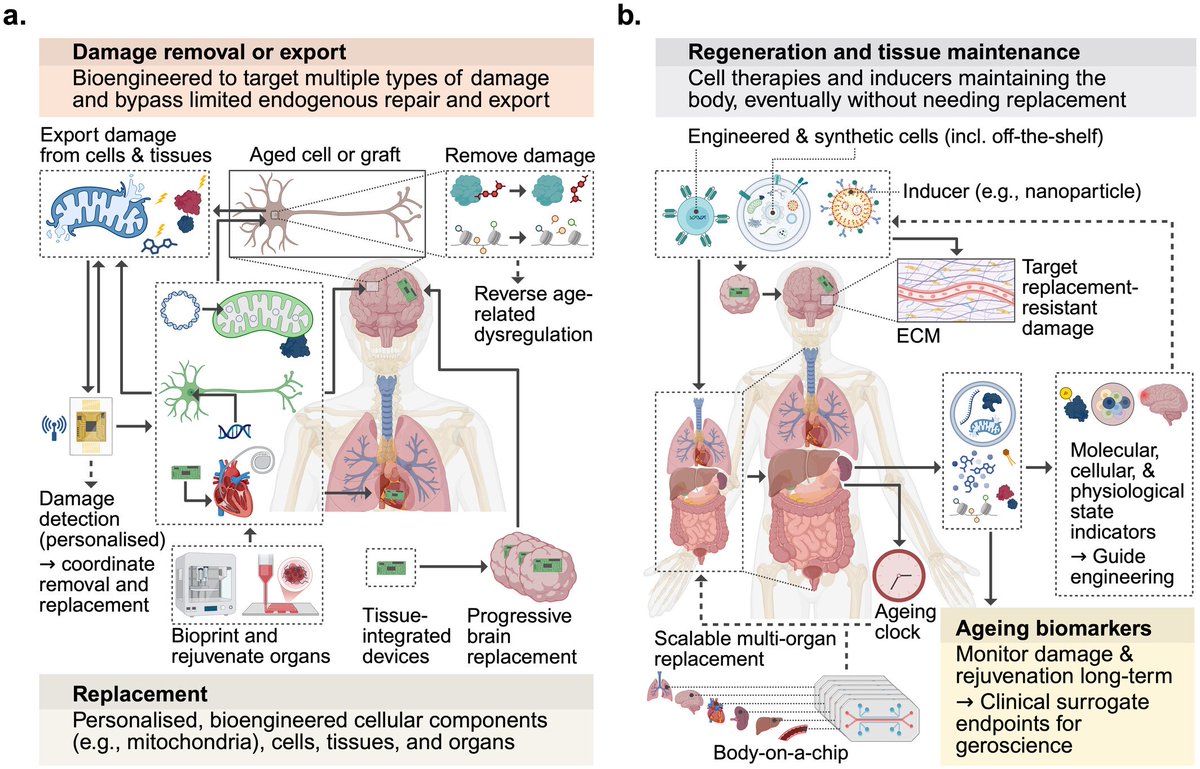
Bjorn Fraser Olaisen @BjornOlaisen is one of them. His new Aging Cell Perspective, based on the first Replacement in Aging workshop at ARDD 2025, helps turn an emerging area of longevity science into a field-shaping roadmap.
The Perspective gives researchers a shared way to think about replacement-based ageing interventions. It maps how replacement, regeneration, damage-removal technologies, and aging biomarkers could work together in the pursuit of systemic rejuvenation.
It also helps define the right problems to tackle, giving researchers a clearer path for making progress. Here, that means clarifying when replacement is the relevant intervention and asking what questions follow if longevity science moves beyond conventional therapeutics toward rejuvenation.
Read the Perspective here: https://t.co/PC8j6R7k9N
American science and technology became the best in the world because we made deliberate institutional choices that let exceptional people from everywhere come here, find one another, and build.
@NornGroup created Talent Bridge (applications open!) to increase the throughput of exceptional people into the US longevity ecosystem, where most of the field’s highest-leverage labs, companies, and funders are.
Talent Bridge is for people:
- whose main constraint is distance from the US
- who could do unusually good work with the right project, people, and path into America
- already working on longevity, in a neighbouring field, or ready to turn their skills toward aging
- who are ambitious and driven
We support projects aligned with adding healthy years to life, including scientific research, tool development, aging theory, policy work, Norn open calls, and other work that helps expand the truth-seeking capacity of the field.
Applications are reviewed on a rolling basis for candidate potential, project fit, and expected contribution to aging research. We reply within two weeks to applicants we are interested in sponsoring, and can help with visa and relocation logistics, network introductions, legal and housing connections, awards, and mentorship.
Apply with a project proposal aligned with Norn’s mission of adding healthy years to life.
More info on Talent Bridge: https://t.co/g7hKqgwkKg
Application form: https://t.co/Jhrdao00sW
For any questions, email: [email protected]
The payoff of longitudinal cohort studies is slow but inarguable.
The Framingham Heart Study began in 1948 with 5,209 adults from MA. Researchers collected repeated physical exams and lifestyle data, then followed participants for 66 years (!) as cardiovascular disease developed over time.
The study later followed the children and grandchildren of the original cohort, turning one local study into one of the most important longitudinal resources in medicine.
Framingham helped establish high blood pressure, high cholesterol, smoking, obesity, diabetes, and physical inactivity as major risk factors for cardiovascular disease. It also helped make the idea of a “risk factor” central to modern medicine.
Cardiovascular disease is the top cause of death in the developed world. In recent years, age-adjusted CVD death has been cut significantly in those countries. Much of the decline is due to reductions in risk factors which the Framingham Heart Study helped to identify.
No amount of money could recreate Framingham by next month.
Imagine having more Framingham-like resources for age-related diseases, or for aging itself: long-term cohorts that reveal which biomarkers predict future disease and functional decline.
Read more about Framingham here: https://t.co/UAqJ0C4GpE
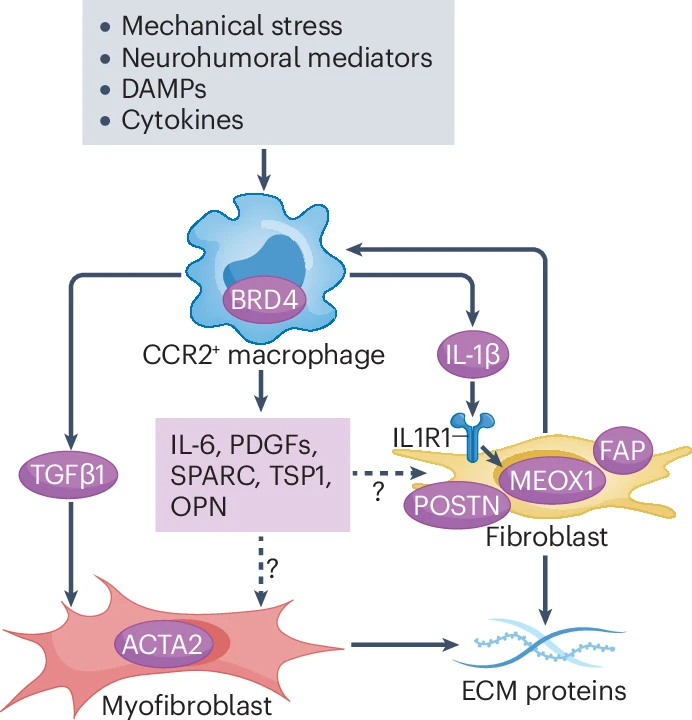
A key route into heart failure fibrosis runs through pathological communication between macrophages and fibroblasts.
With support from Norn Group’s @ImpetusGrants, Michael Alexanian’s lab @m_alexanian traced that route in @Nature by following a damaging immune-fibroblast signal from macrophage regulation to fibroblast activation, tissue fibrosis, and heart function.
The authors map a BRD4-dependent pathway in Cx3cr1+ macrophages that controls IL-1β, then show how IL-1β activates a RELA/MEOX1 regulatory program in cardiac fibroblasts.
They perturb the pathway several ways. Deleting Brd4 in Cx3cr1+ macrophages improved cardiac function and reduced fibrosis in mice. Blocking IL-1β for 30 days shifted fibroblasts away from profibrotic states, and deleting Il1b in Cx3cr1+ cells prevented stress-induced Meox1 expression.
The paper makes heart failure fibrosis more mechanistic by linking macrophage BRD4, IL-1β signalling, fibroblast MEOX1, tissue fibrosis, and cardiac function.
Published in Nature - read it here: https://t.co/WHP4Pp8N5o
We've started tackling one of the central bottlenecks in testing longevity interventions in humans: measurement.
Two @ARPA_H projects, THRIVE and VITAL-H, are taking on that problem from different sides.
THRIVE is developing the PROSPR Intrinsic Capacity score, a way of measuring the functions people need to keep living well as they age, including cognition, mobility, vitality, and sensory function.
VITAL-H is testing whether Intrinsic Capacity can serve as a functional endpoint for aging trials, while also testing rapamycin, dapagliflozin, and semaglutide as possible interventions to preserve function with age.
Together, they are an attempt to move toward a longevity field with better truth-seeking capacity, enabling more and better trials of interventions that add healthy years to life.
Read more on THRIVE and VITAL-H here:
https://t.co/9tEkai1BKc
https://t.co/HeSlIFXdq4
Another example of the compounding value of longitudinal biobanks:
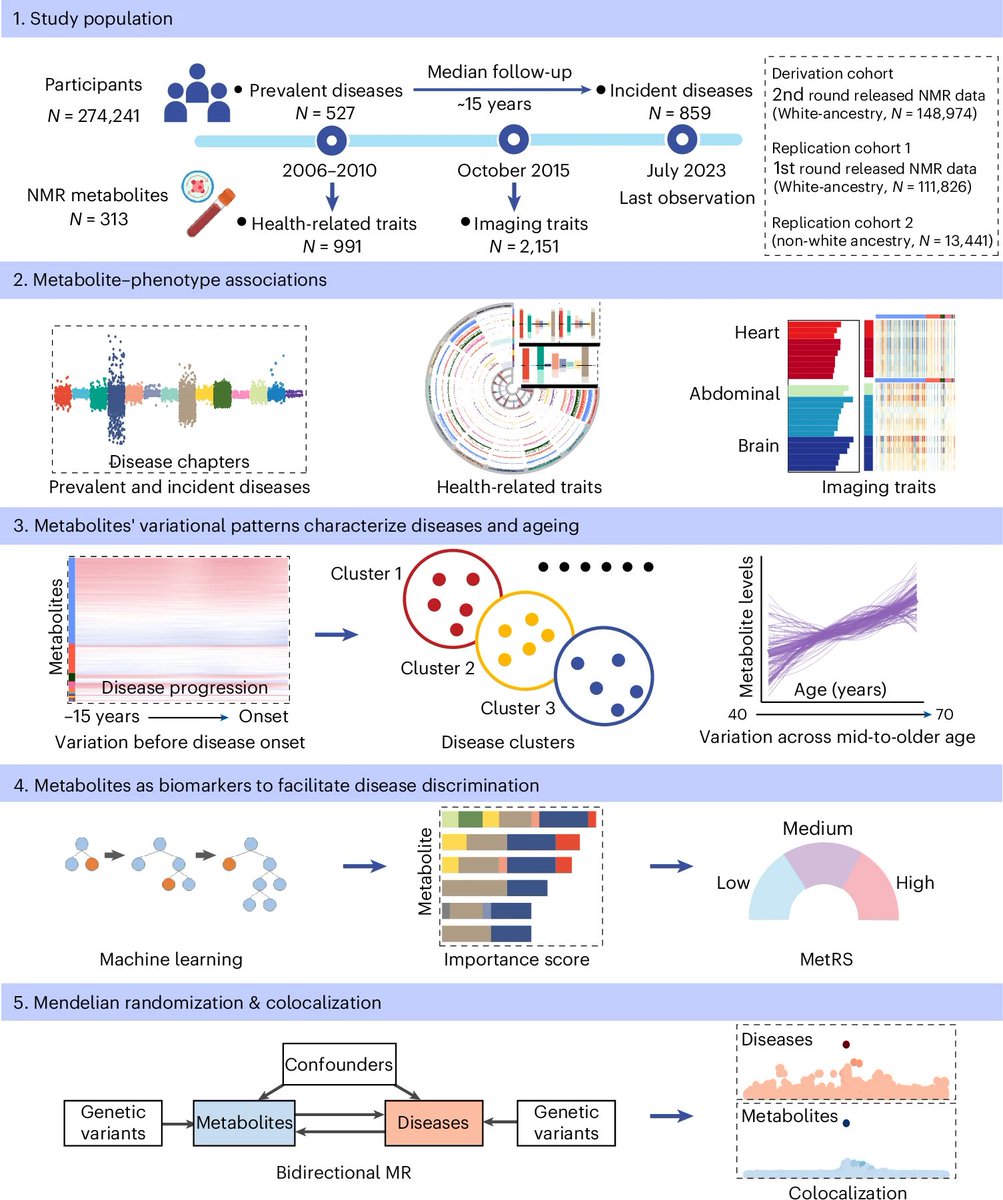
A recent Nature Metabolism paper links 313 plasma metabolites in 274,241 UK Biobank participants to 1,386 diseases and 3,142 traits (median follow-up 14.9 years) https://t.co/O2kow9RAuq
More than half of metabolites showed detectable variation over a decade before disease onset (!)
Shows why such biobanks are so powerful: they let us ask which metabolites, measured while people are still apparently healthy, already contain signals of diseases that will appear years later, creating a path toward earlier biomarkers and better disease prediction.
We should be starting more of them now, to benefit our 2030s selves.
Single-cell sequencing is starting to be used in more interesting ways: to ask causal questions inside living tissue.
We funded Xin Jin @xinjin through @impetusgrants to advance Perturb-seq in the brain, a method that perturbs genes and reads out the consequences across many individual cells.
In their Cell paper, the team scaled Perturb-seq in vivo in the brain, linking genetic perturbations to cell-type-specific transcriptional responses in native tissue. They screened 86 AAV vectors for fast in vivo expression and paired AAV-SCH9 with a hyperactive piggyBac transposon system to sustain gRNA expression and improve recovery of each cell’s perturbation identity.
In a proof-of-principle cortical development screen, the platform profiled 50,075 cells after primary quality control and showed that Foxg1 perturbation had highly specific effects in Layer 6 corticothalamic neurons. These effects were not seen in other cell types from the same lineage and cortical layer, underscoring why cellular context changes the interpretation.
This is useful for brain rejuvenation because in vivo perturbation experiments preserve the cell-cell contacts and tissue physiology that shape how brain cells respond.
Read the Cell paper here: https://t.co/K55yTgcZoN
Hibernation is linked to unusually long lifespans, but natural torpor bundles lower metabolism, lower body temperature, reduced food intake, and inactivity. Causality has been hard to isolate.
We funded Sinisa Hrvatin's @hrvatin_sinisa lab through @ImpetusGrants to make progress on that front.
In their paper, they induced a torpor-like state in mice by stimulating preoptic-area neurons, then repeated torpor-wake cycles for months.
Blood epigenetic aging slowed by 36.9% over 9 months, and the mice showed improved frailty measures. But when the authors separated lower metabolism from lower body temperature, only the low-temperature condition reproduced the aging effect.
That points to hypothermia, not hypometabolism alone, as the key driver of slowed blood epigenetic aging in this model.
On our map of the field’s bottlenecks, this sits at mechanism discovery,: a way to move from “hibernation is linked to longevity” to controlled tests of which torpor features causally affect aging.
Read the paper here: https://t.co/ByL5ZkOzyb
The compounding value of multi-dimensional biobanks is extremely mind blowing.
UK Biobank recruited ~500,000 people between 2006 and 2010, collected baseline measurements and biological samples, and continued linking participants to health records as diseases developed over time.
The interesting findings about disease and survival now coming out of it depend on that cohort having been tracked for fifteen-plus years.
Like this Cell paper using it to connect 2,920 plasma proteins in 53,026 people to hundreds of diseases and health-related traits. That produced hundreds of thousands protein-disease and protein-trait associations from one longitudinal resource. The authors also identified 37 drug-repurposing prospects and 26 potential targets with favorable safety profiles. https://t.co/GqXse1bWWN
And there will be more.
Longitudinal time is a non-substitutable input, as we've written about (link below). No amount of money could recreate UK Biobank by next month.
Scientists have known for a long time that moderate cold can extend lifespan in animals, and we are now starting to figure out the mechanism.
We funded the David Vilchez lab through @impetusgrants because to study whether proteostasis mechanisms can be used to slow aging and protect against age-related pathology.
In this case, the answer points to proteostasis: moderate cold appears to switch on PA28γ/PSME3-induced proteasome activity, a route that helps remove aggregation-prone proteins.
Their work was published on @NatureAging, where the authors tested this PA28γ/PSME3 proteasome mechanism in worms, human cells, and patient-derived motor neurons.
In worms, shifting adults from standard temperature down to 15°C increased PA28γ/PSME3-linked proteasome activity, and PSME3 was required for cold-induced lifespan extension.
In human cells, a 1°C temperature drop activated a similar cleanup axis. More importantly, increasing PA28γ/PSME3 directly was enough to reduce disease-related protein aggregation even at 37°C.
That opens the possibility that PA28γ/PSME3 could be targeted at normal body temperature, though its effects on the wider proteostasis system still need to be understood.
Read the paper here: https://t.co/ey0Ea8UaE8
Nature Aging's research briefing here: https://t.co/JLCVZSB2aW
Two decades of longevity experiments in more than 30,000 mice have created ground truth for a future of progress.
The NIA’s Interventions Testing Program is a multi-site mouse lifespan testing project. It has so far evaluated >50 compounds linked to aging, becoming gold-standard infrastructure for truth-seeking in the field.
Longevity needs this because it attracts hype so easily. Resveratrol is a good example. It had some early evidence, plus a major supplement market. Then the ITP found no general lifespan benefit in genetically heterogeneous mice.
Rapamycin went the other way. The ITP strengthened its anti-aging signal, and @impetusgrants-funded trials on rapamycin such as VIBRANT and RAPID show the brighter path from robust mouse data to potential therapeutics tested in humans.
It's evident that progress comes from robust truth-seeking infrastructure. The ITP already links interventions to hard lifespan outcomes. More progress would come from using that infrastructure more fully, adding lower-layer measurements and linking them to the hard outcomes that ITP-like systems can generate.
We wrote about this in our latest essay: how task-shaped ground-truth data could compound progress by making future AI more useful for longevity (link below.) It could help models learn from intervention-linked outcomes, validate aging biomarkers and clocks, and make mouse studies a faster loop for human-relevant questions.
Infrastructure for Maximum truth-seeking -> Plentyful Progress -> More Years to Life
With age, the immune system can start to look like an overworked security system. It becomes more reactive and sounds more alarms, but gets worse at catching real threats.
Restoring immunity in aging is hard because stronger activation can also mean more damaging inflammation.
We funded Korbyn Dahlquist @KorbynDahlquist through Norn Group’s Impetus Grants @impetusgrants to support work on this kind of aging immune bottleneck.
In this paper on @NatureAging, the authors tested whether PD1 blockade could restore useful CD8+ T-cell activity in old mice exposed to normal microbial experience. Treated old mice lived longer than controls, with survival extending to day 30 in both prevention and intervention settings. Their CD8+ T cells showed restored granzyme B responses, a marker of cytotoxic capacity.
Just as important, the treatment did not broadly amplify acute inflammatory gene expression.
On our map of the field’s bottlenecks, this sits at immune resilience in aging, at the preclinical mechanism-to-intervention stage.
Read the paper here: https://t.co/s5A4lJoy4O
The trajectory of AI for bio is becoming clear for those with the eyes to see:
Biology is moving toward a combination of large foundational datasets and closed-loop systems where AI generates hypotheses, designs experiments, and self-improves based on the results.
@ARPA_H's Intelligent Generator of Research (IGoR) program is a sign of that. It aims to combine AI with experimental biology to enable verification at scale.
But how? https://t.co/iKMs7FlI0w