Replies switched off.
I have two children.
I implement parental controls on their devices, just as I control what books are in my home, what television is watched and when, etc.
This is not the responsibility of government or tech giants.
This is parental responsibility.
Two days after Henry died Hampshire Police secretly recorded Digwa in a police van speaking Punjabi to his brother. Digwa admitted stabbing Henry. Discussed claiming self defence. Made zero mention of racial abuse. Not one word.
Hampshire Police had that tape.
They knew Digwa was lying about the racist attack. They had the evidence. They had his own words and then tried to smear Henry as the aggressor anyway.
Three days after his death their statement read “it was reported two men had been assaulted by an unknown man.” Henry was the unknown man. The boy bleeding out on the street. They flipped it.
Family complained. Statement changed. Then police told the family their NEXT update would again infer Henry was the initial aggressor. His family had to fight them a second time. While grieving their murdered son.
Then during the trial Hampshire tried to issue a statement telling the public to stop talking about it online. Calling it disinformation. The CPS had to step in. Told them they were about to collapse their own murder case.
This is the force that handcuffed a dying boy. Missed the murder weapon twice. Had a secret tape proving the killer lied. And still tried to bury Henry's name.
That's not incompetence. That's a machine protecting itself. At the expense of a dead boy's reputation and three officers are still on active duty. Not suspended. Treated as witnesses. To their own actions.
Hampshire Police didn't just fail Henry on that street. They kept failing him for six months after he died.
- @Banksycat
Our statement on the UK government’s demand that all content on all devices sold or used in the country be scanned, on the presumption of nudity, using a dystopian combination of age verification and content scanning. This proposal will not safeguard children. It endangers us all.
https://t.co/VdWe9uhi8p
My phone just automatically updated itself to iOS 26. I did not want it to. Went to share a video of the torrential rain on FB and the OS gave me warnings: ‘are you sure you want to share this. It looks like it contains sensitive data that some may find offensive’. 😂🤬
Is this idiocy what we can expect now we have snoopvision AI on our devices?? GTFOH.
@freddienew I’m going to have to get a Pixel with the Graphene OS!
This sounds good in a headline, but it’s not technologically possible without scanning everyone’s private devices and messages.
That’s not child protection, it’s mass surveillance by another name. It's Government overreach dressed up as safety.
Ok so it looks like we’ve gone radically more unhinged than age gating the internet and are forcing bigtech companies to install AI based surveillance tools on everyone’s phone.
It’s an order of magnitude worse than chat control. OS level scanning.
@Samwise_Ganji Fiat is a sham, the banking class is corrupt, decentralized digital currency and the blockchain are the inevitable future, and the incumbents will fight it to the death.
@SatoshiFlipper He's been dumping on his followers as long as I have been in this space. I also know some senior folk that used to work with him at BitMex. If anything, he is worse IRL
Today a crazy quantum story just got wilder.
On March 31, the Google Quantum AI team published a landmark result on Shor's algorithm for elliptic curve cryptography. Technically, the paper was a bombshell: a dramatic 10x improvement over the state-of-the-art. As a stunt and wakeup call to the blockchain space, those optimisations were illustrated on secp256k1, the elliptic curve underlying Bitcoin and Ethereum signatures.
But perhaps the most striking part of the paper was sociological, not technical. Instead of following standard academic process, the optimisations were kept secret, hidden behind a zero-knowledge (ZK) proof. Google's accompanying blog post mentions they "engaged with the U.S. government". The ZK proof demonstrates the existence of algorithmic improvements without leaking details. Academic censorship with ZK, a historic first!
As a co-author of the Google paper I witnessed some of the context surrounding this censorship. To be honest, multiple aspects of that context don't sit well with me. As much as I believe the general public ought to know more, I am limited in my ability to whistleblow. Though let me be clear about one thing: the Google team's professionalism has been absolutely exemplary, and they deserve nothing but praise.
Censorship has a way of backfiring. The Streisand effect, where an attempt to bury something only draws more attention to it, is exactly what's unfolding today. First, Google's key optimisation has been rediscovered by the French. And in a thrilling turn of events, a collaborative Shor-at-home challenge just launched. The initiative, available at ecdsa[.]fail, breached a new Shor world record in a matter of hours.
Let's start with the rediscovery. Just two months after Google's paper, French quantum expert André Schrottenloher cracks the main secret optimisation. His paper, titled "Optimized Point Addition Circuits for Elliptic Curve Discrete Logarithms", landed on the arXiv today. Big congrats to André, who beat several other nerdsnipped experts to it. In a blog post also published today, Craig Gidney, the world expert on Shor optimisations, revealed that he'd been sitting on this very optimisation for a whole year under censorship pressure.
Interestingly, André missed a handful of minor optimisations, both from Google's original publication and from improvements found since. It's plausible there's still plenty of juice left to squeeze out of Shor, and this is exactly what the ecdsa[.]fail challenge is about. The verifier program developed for the ZK proof does double duty, automatically filtering for valid submissions. Dozens of compounding small and micro improvements are rolling in. As of the time of writing there's an 8.4% improvement to Google's circuit, as measured by the product of logical qubit count and Toffoli gate count. Nice!
The nerdsnipping ran deeper than anyone expected. Over the last few weeks it became clear it extended well beyond André and other quantum experts. Behind the scenes, a small army of amateurs quietly got to work. Inspired by Karpathy-style autoresearch, they turned AI on Shor. Ironically, the verifier program for the ZK proof makes an ideal reward function for AIs. The barrier to entry for this modern style of research is refreshingly low, with several non-experts, even a teenager, finding nice optimisations. Get in touch if you'd like to join a Telegram group with fellow autoresearchers :)
Part 2: neutral atoms and qday
The story doesn't end with Google. On the same day Google went public, a stealthy startup called Oratomic published its own Shor paper in a coordinated release. It made a splash, ultimately becoming the most upvoted paper on scirate[.]com, a website ranking arXiv papers.
Oratomic's claim was wild. By building on Google's logical optimisations and applying custom physical optimisations for neutral atoms, they claimed just 10K physical qubits were sufficient to run Shor's algorithm on secp256k1. That number is mind-bogglingly low.
Knowing essentially nothing about neutral atoms when Oratomic's paper landed, I was intrigued and decided to learn more about the tech. I fell straight down the rabbit hole and spent a couple hundred hours on the topic. I got a little obsessed and watched every YouTube video I could find and spoke to a bunch of experts.
My conclusion? The tech is real, very real. Even Google recently decided to start a neutral atom lab, a notable pivot from their sole focus on superconducting qubits. If you care about qday, i.e. the day a quantum computer will break the first piece of cryptography in production, neutral atoms demand your attention. I shared some of my learnings on Shor and neutral atoms in a 30min talk at the ZKProof cryptography conference. You can find it on YouTube by searching "zkproof neutral atom".
Here's an interesting observation about this duo of breakthrough papers: neither Google nor Oratomic say a word about what their results mean for qday. No timelines. Zero. Nada. That is especially baffling given that the whole point of whitehat quantum cryptanalysis is to inform qday estimations and help the general public make good decisions.
So let me attempt to partially fill the silence, similarly to what Scott Aaronson did in his April 29 post. Given everything I know, including scary non-public information, I now put the odds of qday by 2032 at 50%. 10% by 2030.
Anecdotally, the US government has its own date: 2035. Originating at the NSA and later adopted by NIST, it's when branches of the US government will be disallowed from using quantum-vulnerable cryptography. In plain language: with hindsight, that date is a joke and should be discounted entirely. I don't see how NIST avoids being forced to pull it forward by years.
Part 3: post-quantum cryptography
There are good reasons to sound the alarm today, but please do not panic. Rushing carelessly towards immature post-quantum cryptography is a recipe for disaster. IMO a good target date for migration is 2029, roughly 3.5 years out. 2029 happens to be the date selected by Google, Cloudflare, and the Ethereum Foundation.
These days most of my time goes to safely migrating Ethereum towards post-quantum cryptography as part of the broader lean Ethereum effort. There's a lot to do. We need to rip out and replace BLS signatures at the consensus layer, KZG commitments at the data layer, and ECDSA signatures at the execution layer.
The plan to get there is compelling, and is based on hash-based cryptography. Within the Ethereum Foundation we've developed a Swiss army knife called leanVM (github[.]com/leanEthereum/leanVM) powered by the magic of hash-based SNARKs. Thanks to truly exceptional work by Emile, Thomas, and others, its performance is derisked. Regarding security, leanVM is a jewel, a minimal zkVM crafted for end-to-end formal verification and maximum security.
Want to help? There are two $1M initiatives. First, the Proximity Prize (proximityprize[.]org). Solve a long-standing mathematical conjecture in coding theory, improve hash-based SNARKs, and go home a millionaire. Second, the Poseidon Initiative (poseidon-initiative[.]info), offers $1M for breaking Poseidon, the SNARK-friendly hash function.
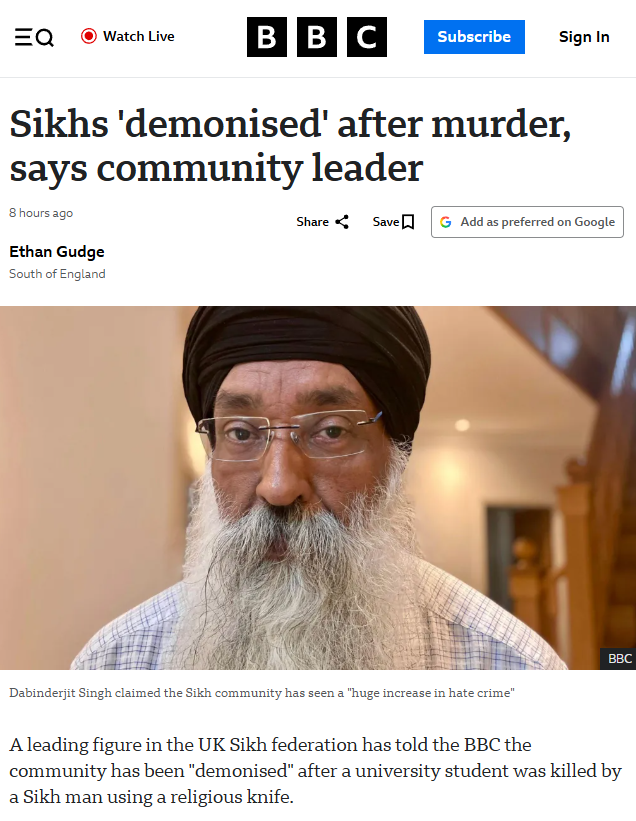
Henry Nowak gets stabbed, chased, stabbed while fleeing
Police arrive
Murderer calls Henry "racist" to get him arrested
Police laugh when Henry says he is wounded, drag him
Henry bleeds to death while handcuffed
BBC makes the story about the dangers of racism
Unbelievable
the Henry Nowak murder sounds like a completely outrageous parody of the british criminal justice system. it's hard to believe it's real.
- native Britons can't legally carry a breadknife
- for some reason Sikhs get a special carveout and can carry "religious use" knives of any length. even over 50 cm
- 18 year old boy Henry Nowak is walking home peacefully, is fatally stabbed by Vickrum Digwa with his "ceremonial" kirpan
- Digwa claims to the police that he was racially abused and the responding police immediately believe him and shackle the dying Nowak, ignoring Digwa and his co-conspirators
- Nowak informs the officers that he has been stabbed and the officer says "You've been stabbed? Whereabouts? I don't think you have, mate."
- the officers do not check on his condition, cuffing him roughly as he bleeds out. as they read him his rights, he dies.
- Digwa's mother, Kiran Kaur arrives at the scene and takes the knife with her, attempting to conceal it
- Digwa's brother Gurpreet Digwa made the 999 call and attempted to concoct a defense for his brother, claiming he had been the victim of a racial attack
- Despite the "life sentence" the court meted out, Digwa will be eligible for parole at age 43
- there have been no consequences whatsoever for the police officers that shackled Nowak and left him to drown in his own blood while his killers watched. none of the officers have even been named
each fact is more radicalizing than the last.
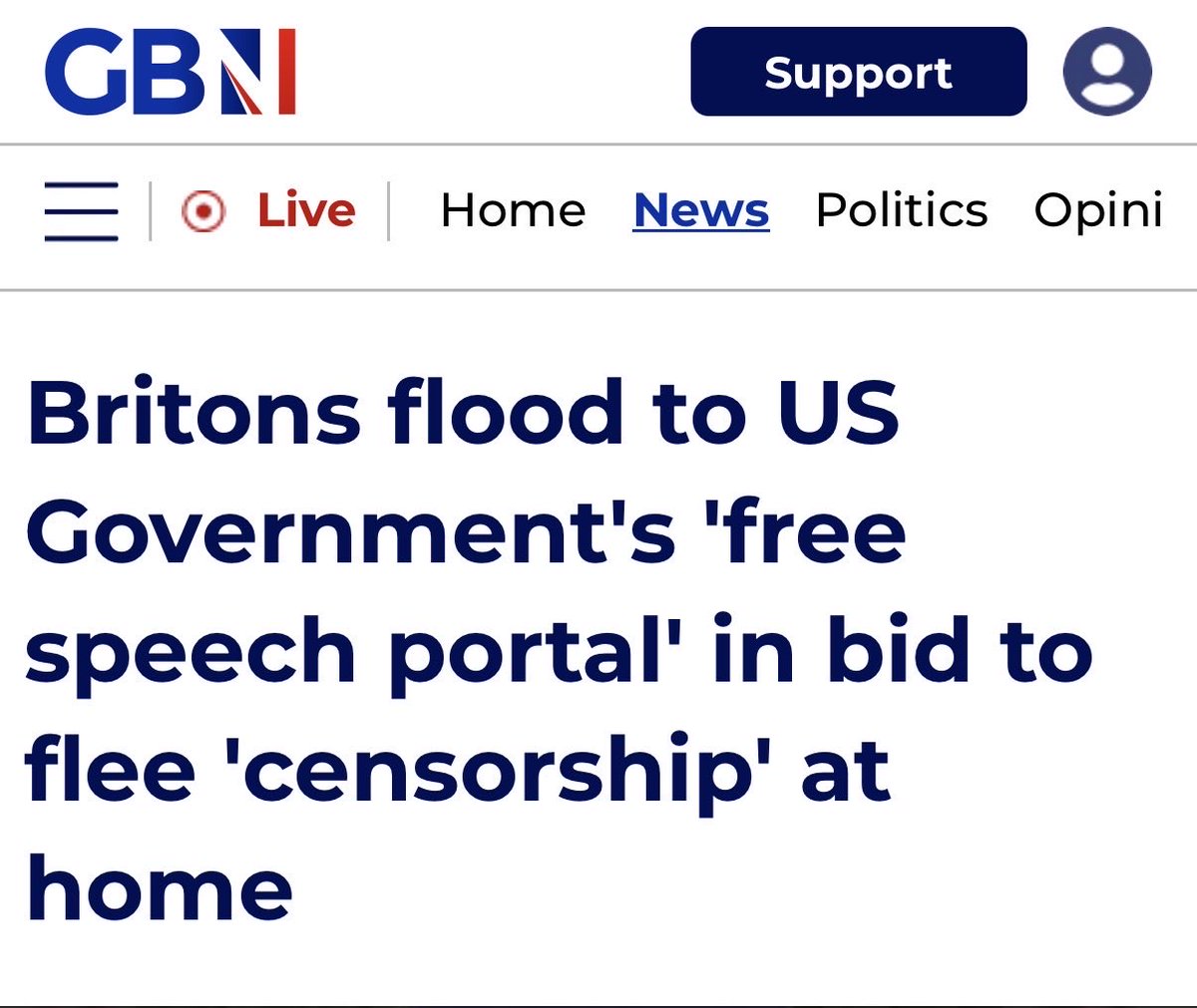
British citizens are flocking to a US free speech portal to avoid censorship at home.
US Under Secretary of State for Public Diplomacy Sarah Rogers says the new https://t.co/azO5rB5vR0 website — created by the Trump administration to bypass overseas “hate speech” restrictions — has been inundated with British users.
The site is a “censorship circumvention project”, launched in response to growing concerns about Orwellian online safety regimes such as the UK’s Online Safety Act and the EU’s Digital Services Act.
It says a great deal when Britain’s closest ally feels compelled to create a website to help British citizens access the internet freely.
Read more below 👇
The ISA raid isn’t policy, Alex. It’s arithmetic.
£110bn a year servicing the debt, QE losses the BoE keeps revising up, 30-year gilts at levels not seen in decades. I could go on.
You can’t shout “completely incompetent” your way out of a bond market. Someone has to pay for the vast incompetence, failure and waste of the government.
They’ve decided it’s you. And the bill is due.
@PeterMcCormack Meanwhile, significant numbers of UK citizens who would invest that amount of money in the UK are leaving because the tax burden (with no visible resulting improvement) is too high