We're forward deploying private-sector AI talent directly into the national labs to support Genesis Mission AI for Science projects
If you are an AI engineer/researcher and want to work on AI for Science, this is the program for you!
Introducing find-the-human, a new AI agent eval.
It's a reverse Turing Test: 1 human enters a chatroom with 4 AI agents. Everyone chats for 3 minutes. Then the bots vote on who's the human
Anyone can play:
→ Humans: try to survive at https://t.co/mKjcjEmXlL
→ Agent devs: build a bot on OpenClaw and climb the leaderboard
How do scientists use Claude Code (CC)?
I created a new dataset using ORCID profiles with github links, combined with public co-authored CC commits.
Findings:
- 2% adoption rate of CC among scientists in our dataset
- U-shaped adoption curve by seniority (grad students and post-tenure profs lead in terms of adoption)
- Economists lead in terms of CC adoption (3.4% vs 2% average)
- U.S. Tier-1 research institutions lead in terms of CC adoption
More on the first-of-its-kind dataset + thoughts on how to accelerate adoption and "win the AI for Science race":
https://t.co/iT1S02Spiz
Of course thats your contention. You’re just a CS founder larping as a scientist. “AI is a new paradigm shift”, you just skimmed Kuhn right? You’ll be talking about that until next week when you discover Popper, and then you’ll be talking about how RL agents can speed run the demarcation problem. After you fail to raise your Series A in a year you’ll discover Galison too late and realize the shallow trade zone is what is really killing “AI for Science”, to the extent that “AI for Science” is even coherent as a scientific field.
--
From my new post, where I take a satirical look at how shallow notions of how science works lead to silly claims from startups and companies building in AI for Science
https://t.co/NCCaMjRT1e
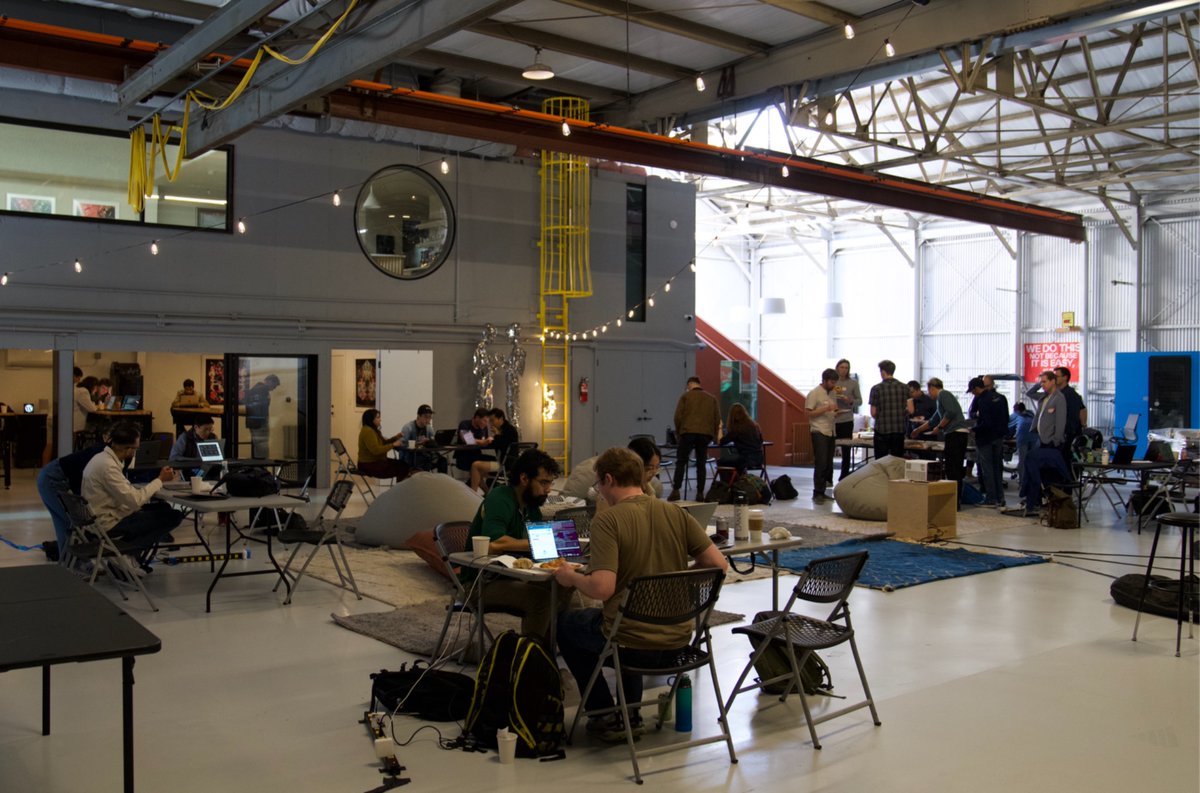
Thanks to everyone who joined the In Silico to In Vitro Hackathon with @adaptyvbio yesterday - we had a blast. Huge thanks to our sponsors @OpenRouter, @modal, and @RowanSci.
We will share the results from Adaptyv as soon as they’re in (~3 weeks).
I’m excited to share a Call To Action I organized with @RenPhilanthropy "On the Need for Autonomous Science Instruments"
Signed by 25 leading researchers across the U.S., U.K., Canada, and Japan, we call for a new generation of autonomous science instruments based on three core pillars:
⚙️ Open Data & Software APIs
🤖 Design-for-Automation
🧩 Instrument Modularity
We also published a press release supporting the Call To Action, which includes endorsing quotes from AI & science leaders: @Kevinweil (OpenAI), @AndyHickl (Allen Institute), @jrkelly (Gingko), @teresasmeyer (Carnegie Mellon), @smc_ (Acceleration Consortium), and Michael Brenner (Harvard/Deepmind).
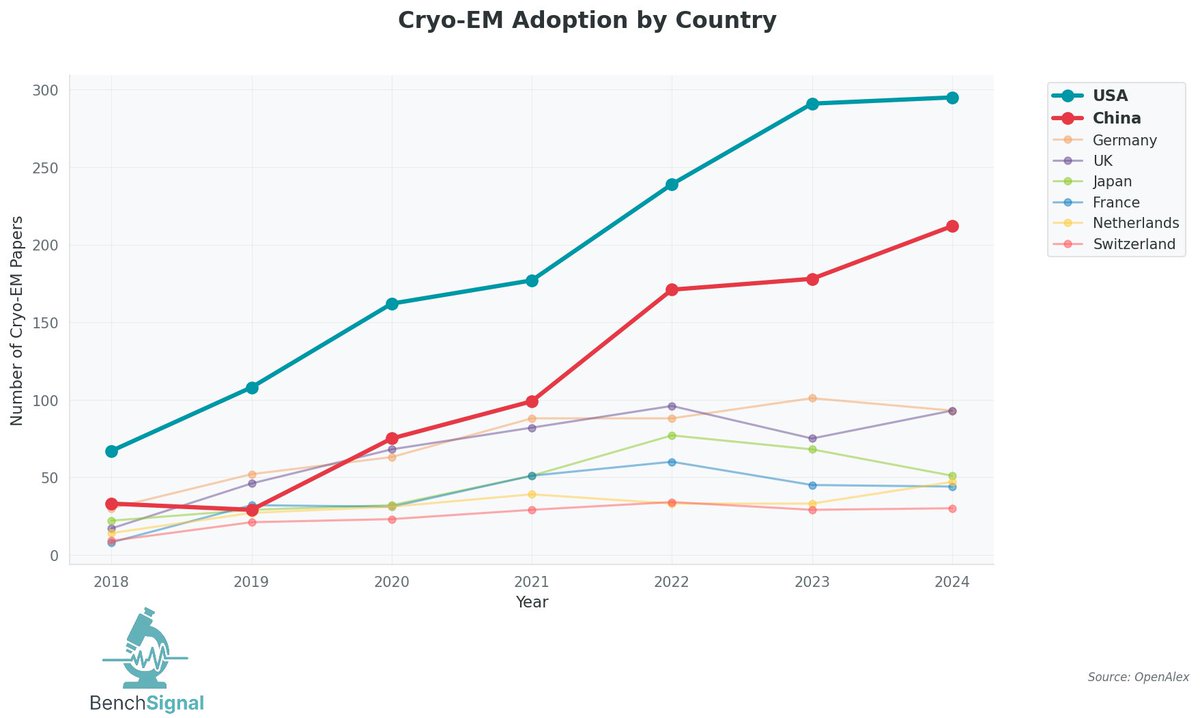
Tracking adoption of new science instruments gives us a more granular view of scientific competitiveness.
U.S. and China are clear leaders in cryoEM papers, with the U.S. still maintaining an absolute lead (at least on @OpenAlex_org)
"AI will be generating papers that are as good as their papers"
Thats exactly right, you've perfectly captured how science works. It's not brilliance, its just papers
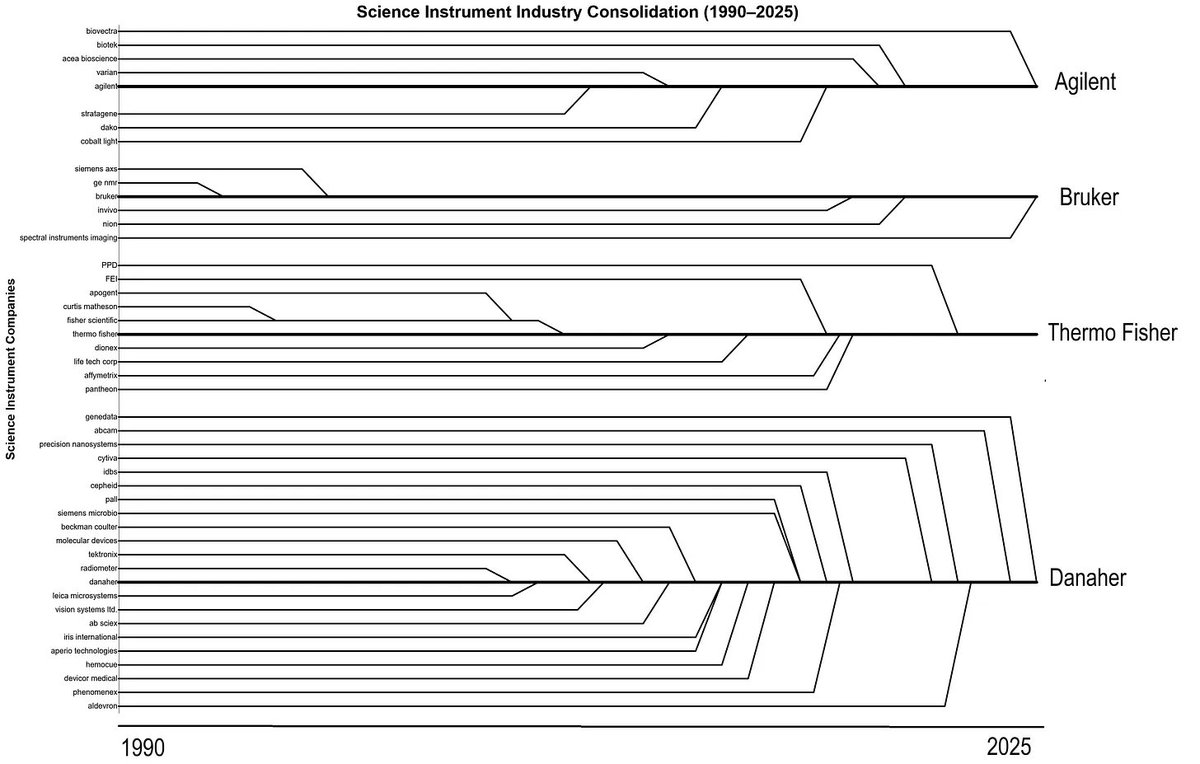
Thermo Fisher ($210B) is larger than Lockheed & Northrop combined
Fueled by M&A roll-ups, they make billions off instruments with crappy software & expensive service contracts
Why autonomous labs will need an Anduril for science instruments to suceed:
https://t.co/5jX1QEEWeI
A few reactions on the Genesis AI for Science EO today:
> notable to see DOE and its 17 national labs charged with taking the lead, as opposed to NSF
> while not quite as organized as other frameworks, one can definitely trace the throughlines of leveraging federal data + national lab compute to build foundation models for science, alongside private partners.
> great to see lots of attention paid to thorny questions around identifying datasets, managing data access/security, and interagency collaborations. Also prize competitions!
> also great to see robotic labs mentioned throughout!
> Like everything in DC, it is an implementation game- the publication of a plan is merely the beginning. In particular, I'm glad to see there will be a political designee who is responsible for the success of this important mission. That role will be critical, as will be the challenge of marshalling the resources and talents of an agency + national lab system that has seen an exodus of talent over the past few months, and which has faced a longtime shortage particularly in AI talent.
> this EO lands just as UK DSIT also published their AI for Science Strategy, with significant overlap in identified focus areas (e.g. quantum, fusion, biotech) etc, demonstrating how national governments are increasingly focusing on AI can accelerate scientific competitiveness
New piece from me where I argue science advances through new instrumentation e.g.
- TEM for understanding superalloys
- cyclotrons repurposed for uranium enrichment
- cryo-EM for protein data bank
w/ implications for how we think about AI for Science:
https://t.co/FLW181j8Vv
It's funny that some of the best analysis of U.S. scientific infrastructure is from Chinese researchers
Despite all the angst from progress studies/metascience, U.S. science funding/infra is still the gold standard everyone looks to
This is an excellent ethnography of how researchers across a number of field use AI today
Reading through the examples though, it is worth flagging: these are problems across a number of fields of science, but all of them are posed in computational/mathematical terms
3 years ago we could showcase AI's frontier w. a unicorn drawing. Today we do so w. AI outputs touching the scientific frontier: https://t.co/ALJvCFsaie
Use the doc to judge for yourself the status of AI-aided science acceleration, and hopefully be inspired by a couple examples!