Reputation is the currency your name gets priced in: it takes ages to build, and minutes to ruin.
"For as Cicero says, even those who argue against fame still want the books they write against it to bear their name in the title and hope to become famous for despising it"
Your reputation operates like a line of credit. Years of reliability allow people to trust you before every fact is available, forgive an isolated error, and place larger responsibilities in your hands. Repeated small defaults raise the interest rate until even your honest words require verification.
The corporate campus was the last desperate attempt to build a feudal keep without a standing army: they offered free lunches and ping pong tables to obscure the fact that they could not offer physical protection or permanent land.
Now the illusion is broken and the remaining workers are just mercenaries who haven't realized they need to negotiate ransom instead of a salary.
@theralkia How can they not? Social media is built around a cult of personality, and it takes quite an effort for anyone posting consistently not to get high on their own supply
You don't need discipline when you have no alternatives:
- When I'm studying, I'm in an empty room and can do nothing but study.
- When I'm writing, I only have Obsidian in full screen, with airplane mode on.
- When I'm working, only the work phone is on.
Discipline takes too much energy. It's way easier to just make whatever you have to do the easiest choice.
We like what’s easy to measure because it feels safe.
Big institutions often reward people who follow their rules and ignore people who don’t. But that maks the system fragile: it works in normal times, then breaks under real stress.
That's why the future of power will look like unnamed contractors, brokers, and middlemen taking value from institutions that are getting weaker, with little loyalty to anyone.
The old social contract is not there anymore.
You spend your entire life competing for a prize someone else defined just to ensure you never become a threat.
Ambition is the easiest leash to slip around a capable neck.
LinkedIn doesn't reward competence. It rewards competence theater.
The best operators I know post nothing, most don't even have an active account. The worst instead post daily "grateful and humbled" updates while their team quietly falls apart.
To win in corporate life, this is what you need:
- Internalize the mantra: "Not my circus, not my monkeys"
- Learn the "Art of Looking Busy"
Once these two are in place, how long you stay (and how enjoyable it is) depends entirely on your social skills and your ambitions.
We’ve built defense systems around signals, satellites, and models, and we miss what happens offline.
But do our enemies use a smartphone? I believe they would rather use couriers, handshakes, and family ties that software can't map.
And if the grid goes down or the data gets manipulated (real risk), the edge is the people who can read a room, build trust quickly, apply pressure, and control physical space.
A good portion of managers could be fired tomorrow without any short- and long-term negative effect on the top line. If anything, they are a good first attempt at implementing UBI.
What are you afraid of losing, when none of it was ever truly yours?
We spend borrowed time gathering temporary things, learning the rules mid-game. Eventually, we’ll push our chips in and leave the table. Someone else will take our seat and reach for what we once called ours.
The friends I know making real money have CVs a headhunter would toss in the trash.
Meanwhile, my friends in Milan work 60-hour weeks at prestigious firms, earn just enough to cover rent, and save nothing.
But when you point this out? "I'm in finance."
As if prestige were a currency you could hand to your landlord.
Here's what nobody tells you about chasing logos:
You don't need discipline when you have no alternatives:
- When I'm studying, I'm in an empty room and can do nothing but study.
- When I'm writing, I only have Obsidian in full screen, with airplane mode on.
- When I'm working, only the work phone is on.
Discipline takes too much energy. It's way easier to just make whatever you have to do the easiest choice.
game theory fix for lack of willpower:
eliminate choice entirely.
hernán cortés burned his ships so his troops couldn't retreat.
you don't need more discipline. you need a commitment device, a constraint that makes backing out mathematically impossible.
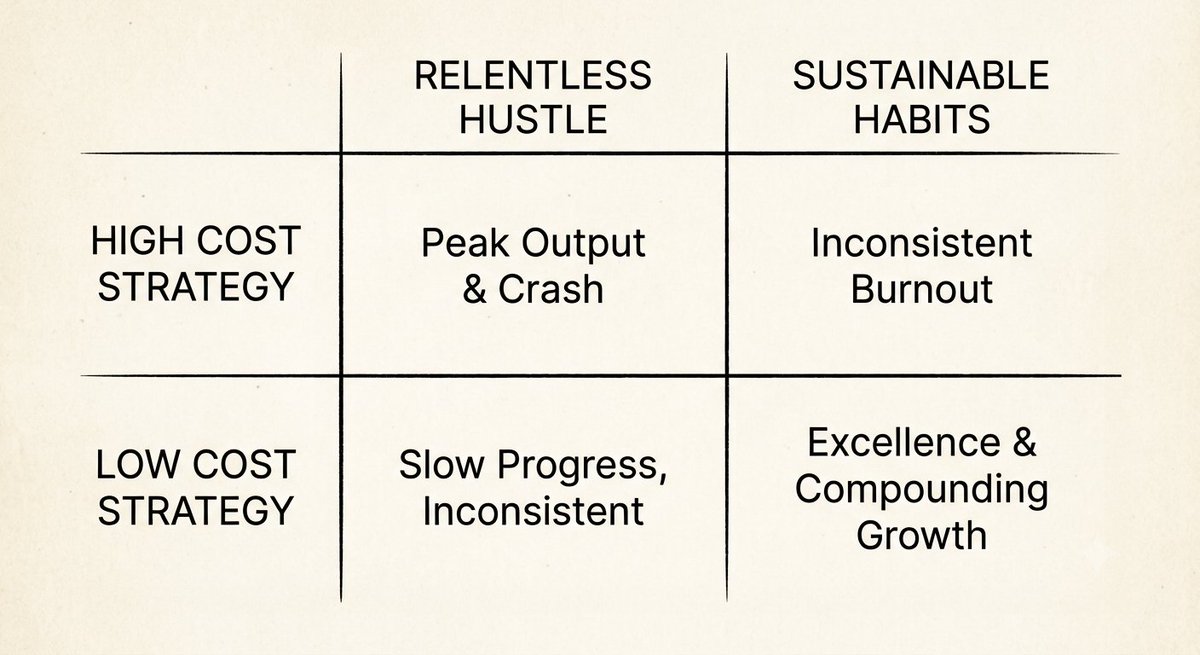
Game theory explains this well: people treat success like a single-stage game instead of an iterated one.
- A massive burst of effort is a high-cost move: it feels productive but depletes your resources (burnout).
- Consistency is a low-cost, repeatable strategy.
The trap is "hyperbolic discounting": we are biologically incentivized to chase immediate payoffs and quit when rewards are delayed.
Fix: design a system where your daily actions are too cheap to skip.
@VibesPatrol Most of the time you get defensive because within, you feel a lack that just got exposed.
You may not even be conscious of it.
Easy example: the manager who treats badly the junior who's more competent than him.