$LWLG 는 정말 독점 위치인가?
$MRVL-Polariton 인수 직후 시장 narrative는 "Marvell이 사실상 LWLG를 인수했다"였습니다. 단순한 답일 것 같지만, Optica 2025 논문, Nokia ECOC 2023 paper, NLM 2025 Chem Mater paper를 다 펴놓고 보면 구조가 훨씬 입체적입니다.
본 글에서 다룬 ���용:
1. LPO, CPO 등 차세대 광 인터커넥트 영역에서 EO Polymer의 가능성과 한계 (특히 thermal margin 측면에서 standard pluggable 시장과 CPO 시장의 분기점)
2. EO Polymer의 가장 큰 경쟁 플랫폼인 기존 Si carrier-depletion 변조기, 그리고 차세대 후보인 TFLN, BTO 등과의 자릿수 비교 (Vπ·L 및 active length 기준)
3. EO Polymer의 또 다른 한 축인 NLM Photonics와의 비교 분석 (CPO 적합성 비교 포함)
LWLG가 정말 가진 것과 못 가진 것, 그리고 진짜 second-source 리스크가 어디에서 오는지 1차 자료로 분리한 분석 글입니다.
$LPK $LPKF 🔥
This company is not only successful in the laser and photonics sector, but also active in the solar and quantum computing space, where it collaborates with companies such as Volkswagen AG and Infineon Technologies AG.
The market cap of this company appears extremely undervalued, especially considering that its patented LIDE technology for glass substrates has massive game-changing potential.
In my view, the current valuation doesn’t even come close to reflecting its true potential.
$PDFS is quietly powering the AI semiconductor revolution with its Exensio analytics platform - a full-stack, AI-native system that unifies 50+ data formats from chip manufacturing into actionable insights, slashing data wrangling by 80%, speeding up yield ramps by 50%, and delivering secure, on-prem deployments without ever competing with customers.
It’s deeply embedded with the foundries that build the AI accelerators for the big hyperscalers: $TSM and Samsung Foundry (core customers driving ~40% of revenue) plus $INTC , which together supply custom silicon to AWS, Microsoft Azure, and Google Cloud.
With AI expected to drive two-thirds of semiconductor demand through 2030, PDFS solves the industry’s biggest pain points, exploding data complexity and fab efficiency walls, unlocking 10%+ more usable capacity from existing lines and targeting 20% long-term revenue growth.
That makes $PDFS a high-potential, under-the-radar play on the entire AI infrastructure boom.
How Data Centers Stay Up? (2026 AI Edition)
What’s it like to build a fully functional data centre in the AI age?
1. Power Distribution
Gear that stabilizes, routes, and manages electricity (switchgear, PDUs, transformers, etc.).
Tickers: $ETN · $VRT · $SBGSY · $ABB
2. Backup Power
Instant failover when the grid fails—critical for 99.999% uptime.
Tickers: $GNRC · $CAT · $ETN · $VRT
3. Cooling & HVAC
The biggest bottleneck for AI racks. Air + advanced liquid/direct-to-chip systems to stop servers from melting.
Tickers: $VRT · $CARR · $TT · $EMR
4. Server Cabinets & Compute Hardware
Racks, enclosures, storage, networking—where the GPUs live.
Tickers: $HPE · $DELL · $SMCI · $VRT
5. Building Automation
Panels, sensors, energy monitoring, KNX/BMS for facility-wide control.
Tickers: $SBGSY · $LEGR · $CSCO · $VRT
6. Security Systems
Fire protection, cameras, access control, firewalls, and cyber hardware.
Tickers: $FTNT · $PANW · $CSCO · $SIEGY
A data center is basically a mini-city: power plants + cooling plants + automation + security + dense compute… all in perfect sync, optimized for AI workloads.
That’s why infrastructure leaders here (especially $VRT, $ETN, and cooling/power specialists) are among the biggest AI beneficiaries right now—riding hyperscale buildouts and liquid cooling transitions.
$SPIR - Why Spire Global’s new agriculture intelligence platform is one of the smartest, most timely moves in Earth observation right now.
If you’ve been watching the intersection of climate risk, food security, and technology, you know agriculture is in a perfect storm. It’s one of the most climate-exposed industries on the planet, yet it’s still flying partially blind - missing early crop stress signals, guessing on irrigation, and making decisions that are too often reactive instead of predictive.
That’s exactly what makes Spire’s latest thread so bullish. They’re not just releasing another dataset.
They’re delivering a continuous, global, daily view of soil moisture intelligence that finally closes one of the biggest data gaps in ag.
Think about it: satellite-derived soil moisture at scale, backed by 40+ years of historical context, real-time anomalies versus climatology, and forecasts out to 45 days.
That’s not incremental improvement - that’s a fundamental shift from guesswork to precision.
What makes this genuinely unique is the combination Spire brings to the table. Most players in Earth observation offer snapshots or narrow datasets. Spire’s multi-purpose satellite constellation gives them unmatched revisit frequency and global coverage, while their deep historical archive and advanced modeling turn raw observations into actionable, predictive intelligence.
Farmers, insurers, input suppliers, and agribusinesses can now detect crop stress earlier, optimize water use with surgical precision, and build far more robust risk and yield models.
And the proof is already in the field. Trusted partners worldwide are seeing measurable impact: stronger data-driven insights, more scalable decisions, and real-world wins in efficiency and resilience.
When a company can point to customers who are literally changing how they operate because of your data, that’s not marketing fluff - it’s product-market fit at scale. Now layer on the massive market tailwinds. Global agriculture is a multi-trillion-dollar industry facing intensifying climate pressure, water scarcity, and the urgent need for sustainable practices.
Precision AgTech and climate intelligence are exploding as governments, corporations, and investors pour capital into solutions that secure food supply chains and reduce environmental footprint.
Spire isn’t just riding this wave - they’re uniquely positioned to lead it, because their space-based approach delivers the kind of consistent, planet-scale data that ground sensors or traditional weather models simply can’t match.
🧵 $KEEL — most undervalued AI infrastructure play I've seen.
Formerly Bitfarms. Just rebranded + moved to the US.
• 2.2 GW power pipeline (PA, WA, QC)
• $520M cash + BTC on the balance sheet
• Market cap ~$1.7B → pipeline nearly FREE after cash
• ~$0.55/watt for capacity comps trade at $5–15/watt
• Scrubgrass "Gigacampus" alone could be worth multiples of today's market cap
• No dilution needed — capex fully funded from liquidity
2026 = lease execution 🚀
2027 = first sites live
First hyperscaler lease = stock re-rates. Hard.
🎯 My targets by 2030:
Bear: $2.50 | Base: $12 | Bull: $30 | Mega bull: $60
If they execute it's a 10–20x!
Also watching: $IREN $NBIS $APLD $WULF $CIFR $ORCL $NUAI $HIVE
NFA. Size accordingly. 🔥
$SMHN $TSM
Why SÜSS MicroTec is one of the most compelling plays in the semiconductor supply chain right now.If you follow the AI boom, you already know TSMC is at the absolute center of it - ramping CoWoS advanced packaging capacity at breakneck speed to feed the insatiable demand for high-bandwidth memory (HBM) and next-generation AI accelerators.
What many investors miss is how tightly SÜSS MicroTec is embedded in that very ramp.
SÜSS is not just another equipment supplier.
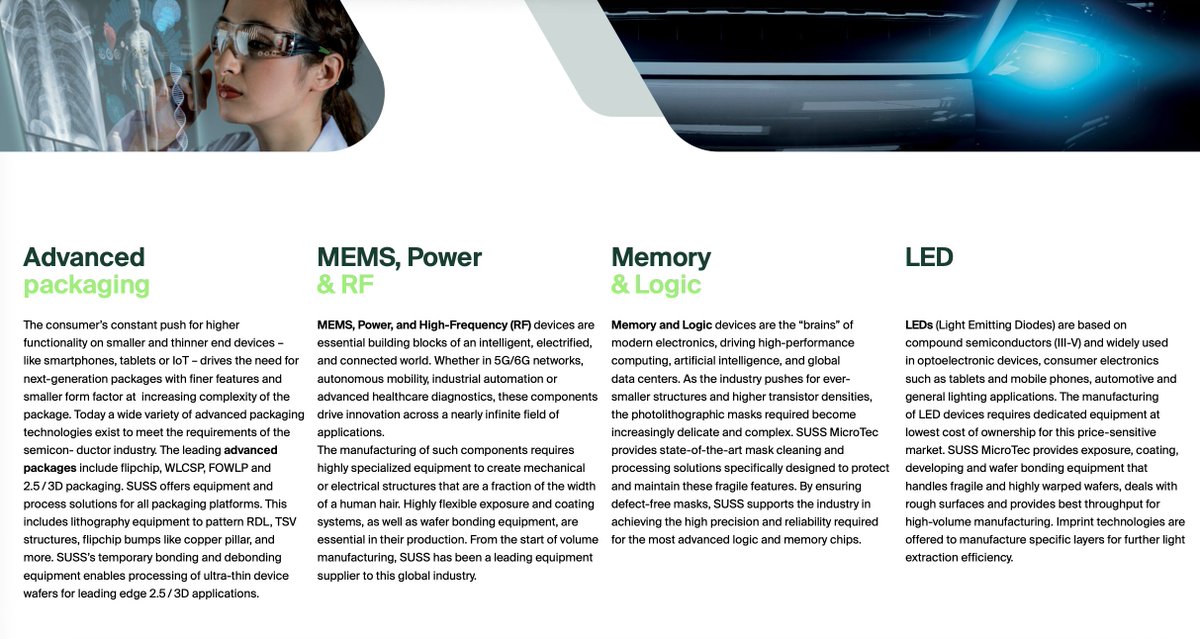
It is a critical enabler of TSMC’s most advanced packaging flows. The company is the sole supplier of full-field UV scanners used in TSMC’s CoWoS process and a long-standing key provider of temporary bonding and debonding systems that are essential for stacking the ultra-thin layers in HBM and 2.5D/3D chiplet architectures.
TSMC has qualified SÜSS tools into its production lines for years; once qualified, those tools tend to stay for a very long time. That creates a deep, sticky relationship - industry sources consistently point to TSMC as one of SÜSS’s largest customers (historically 10-15% of revenue) and a major driver of its Taiwan-centric order book. This is not a one-off relationship; it is structural.
As TSMC aggressively expands CoWoS capacity (targeting significant doublings through 2026 and beyond) and pushes into hybrid bonding for future SoIC and logic-on-logic stacking, SÜSS’s specialized temporary bonding platforms, coaters, and imaging tools sit right in the sweet spot.
The AI tailwind is real and durable: advanced packaging is shifting from a niche to the primary growth engine of the entire semiconductor industry, and SÜSS holds strong technological positions in exactly the processes that are scaling fastest.
Add to that SÜSS’s own execution - record sales of €503 million in 2025, a new production site in Taiwan to shorten lead times, and a clear roadmap into hybrid bonding - and the setup looks exceptionally strong. The semiconductor cycle will always have its ups and downs, but the secular shift toward heterogeneous integration and AI-optimized packaging gives SÜSS a multi-year runway that is hard to replicate elsewhere.
There’s a reason why I keep posting about Photoinics & Optics stocks like $AAOI $LITE $AXTI $TSEM $AEHR
These stocks are consolidating and forming huge bases during the most volatile market we’ve seen in the last 12 months.
When this volatility passes, which it will, all of these stocks will run another 100%+ I promise you.
Deep Dive Comparison
(Nex-Z mono-therapy versus Coramitug 60mg combo therapy) $NTLA
1. Baseline Characteristics
Nex-z vs. Coramitug
• 0/36 used combo therapy vs 30/35
- favors Nex-z (biggest key 🔑)
• median nt-probnp = 2052 vs 2209
- higher favors Coramitug
• median 6MWT = 331 vs. 357
- lower favors Nex-z
• median tropinin = 56 vs. 50.9
- higher favors Nex-z
• median ECV = 58 vs 60.17
- higher favors Coramitug
• variant = 11/36 vs 3/35
- higher favors Nex-z
• 50% Class III vs. 77.1% Class II, 22.9% Class III
- higher Class III favors Nex-z
• median age = 78 (up to 90) vs 76
- higher favors Nex-z
• 88.9% vs 77.1% on loop diuretics
- lower favors Coramitug
Summary: Nex-Z wins 6 to 3 (worse cohort) ✅
2. Nt-proBNP
Nex-z 🟰 1.02 (0.97 Class I/II)
Coramitug🟰 0.84/0.85 ✅
Advantage: likely Coramitug yet impossible to know for sure since 85.7% of their high dose patients had stabilizer or silencer on top of Coramitug.
3. 6MWT
Nex-z 🟰 +5 (median 12m) ✅
Coramitug 🟰 -2.25
4. KCCQ QoL
Nex-z 🟰 +7.8 ✅ (but no placebo)
Coramitug 🟰 -1.37
5. Troponin
Nex-z 🟰 0.95 (0.88 at 24m)
Coramitug 🟰 0.87 ✅
6. ECV
Nex-z 🟰 +2% ✅ (lower is better)
Coramitug 🟰+4.92%
7. LV Stroke Volume Index
Nex-z 🟰 +0.5 mL (24m median) ~0.3 converted
Coramitug 🟰 +1 mL/m^2 (mean) ✅
8. Survival (12 months)
Nex-z 🟰 100% (36/36), 13/36 cardiac failure 👎 but only 5 were SAE, 3/36 arrhythmias ✅
Coramitug 🟰 100% (35/35) but only
32/34 on smaller dose, and 2/35 on higher dose had adverse event leading to withdrawal from study and 15/35 had cardiac arrhythmias ⚠️ and 8/35 had cardiac failure.
- Nex-z would win on Ph. 1 safety data but close… higher cardiac failure likely due to 50% Class III etc, arrhythmia % is worrisome for Coramitug.. but Nex-z must prove new mitigation plan.
9. Convenience
- Nex-Z would easily win as Coramitug is every 4 weeks
A Nordic Nuclear Renaissance is Underway
🇸🇪 Sweden targets 10 GW new nuclear by 2045
🇫🇮 Finland advances SMRs for district heat
🇳🇴 Norway has launched its first EIA
🇩🇰 Denmark has a governmental review ongoing
Nuclear energy is so back in the Nordics
Beam Therapeutics Announces Publication of BEACON Phase 1/2 Data for risto-cel in Patients with Sickle Cell Disease (SCD) in The New England Journal of Medicine | Beam Therapeutics
$BEAM https://t.co/0qgmqYFupG
🚨 Silver is repeating the 1970s bull market... almost move for move.
If history rhymes, the biggest leg higher is still ahead. What price does this chart make you think silver hits next? It lines up with my recent analysis (pinned article).
Thanks to @MetalsMiners for the chart! It's a bit old, but you can see the pullback at $16 in 1979 is about where we are, but the current pullback happened at $121, not $144. So still a little under, but tracking.
#Silver #SilverBullMarket #PreciousMetals
$lunr the market is mispricing the true king of lunar infrastructure 🌕
spent the weekend digging through the recent presidential executive order on space and $lunr's q4 earnings transcripts.
sometimes the market gets so distracted by noisy headlines that it completely misses the actual structural shifts happening right in front of us.
everybody is looking at the wrong part of the new space race.
right now, everyone is obsessed with rocket lab's neutron delays or whatever elon is tweeting.
but the real alpha is hiding in plain sight with intuitive machines ($lunr).
under the dec 18, 2025 executive order, the us is pivoting hard: a permanent lunar outpost by 2030 and $50 billion in additional space investments by 2028.
gateway is basically paused, and the focus is entirely on surface infrastructure.
here is the exact data you need to see: $lunr reported q4 2025 revenue of just $44.8 million, which the market hated, dropping the stock to $17.64 pre-market.
but their actual 2026 revenue guidance is $900 million to $1 billion. that is nearly a 5x increase in a single year.
they are sitting on an estimated combined backlog of $943 million as of february 2026.
why the massive jump? because they aren't just doing risky one-off moon landings anymore.
they closed a $450 million cash acquisition of lanteris space systems in january, pivoting from a delivery company to a diversified space prime contractor.
and more importantly, they are aggressively positioning themselves to capture a massive chunk of nasa's $4.82 billion near space network services (nsns) task order pool.
starting with the im-3 mission later this year, they are deploying a lunar data relay satellite network to start executing on those exact nsns task orders.
they are literally building a pay-by-the-minute internet for the solar system, transitioning to a recurring revenue saas model in space.
plus, they are currently waiting on the imminent lunar terrain vehicle (ltv) award from nasa, which would make them the premier mobility provider on the moon.
i might be heavily biased here because i've been closely tracking lunr since their early clps missions.
my logic could be totally flawed if the government budget gets delayed again, or if integrating a massive legacy company like lanteris destroys their agile startup culture.
hardware in space is unforgiving, and launch delays are basically guaranteed.
but if you want a true lunar infrastructure play trading at a discount to its multi-billion dollar recurring revenue potential, this is it.
are you buying the literal infrastructure of the moon, or do you think this whole space economy is just a giant cash incinerator?
#lunr #spaceeconomy #alpha #deeptech #artemis #nasa #stockmarket #investing #lunareconomy #techtrends
China needs energy and it's building its escape routes
Look at this map carefully
🟣 Power of Siberia Russian gas, operating
🟣 Central Asia-China Pipeline Turkmenistan gas, operating
🟣 Sino-Myanmar Pipeline Southeast Asia bypass, operating
🔵 Power of Siberia 2 massive Russia pipeline, proposed
Every single one bypasses the Strait of Hormuz entirely.
China imports 5.4 mb/d through Hormuz today.
But Beijing has been spending a decade building overland alternatives pipelines that no navy can blockade, no war can close, no aircraft carrier can threaten.
This wasn't an accident.
It was a strategy.
While the West thought China was 100% focus on energy transition
Beijing was quietly wiring itself to every major gas producer on the Eurasian continent.
Russia
Turkmenistan
Kazakhstan
Myanmar
The Hormuz crisis hurts China.
But China saw this coming before and tried to build an escape from it.
Have a look at my latest article I break down the deeper strategy behind all of this👇
https://t.co/ypkUMnTmSJ
image souce :reuters
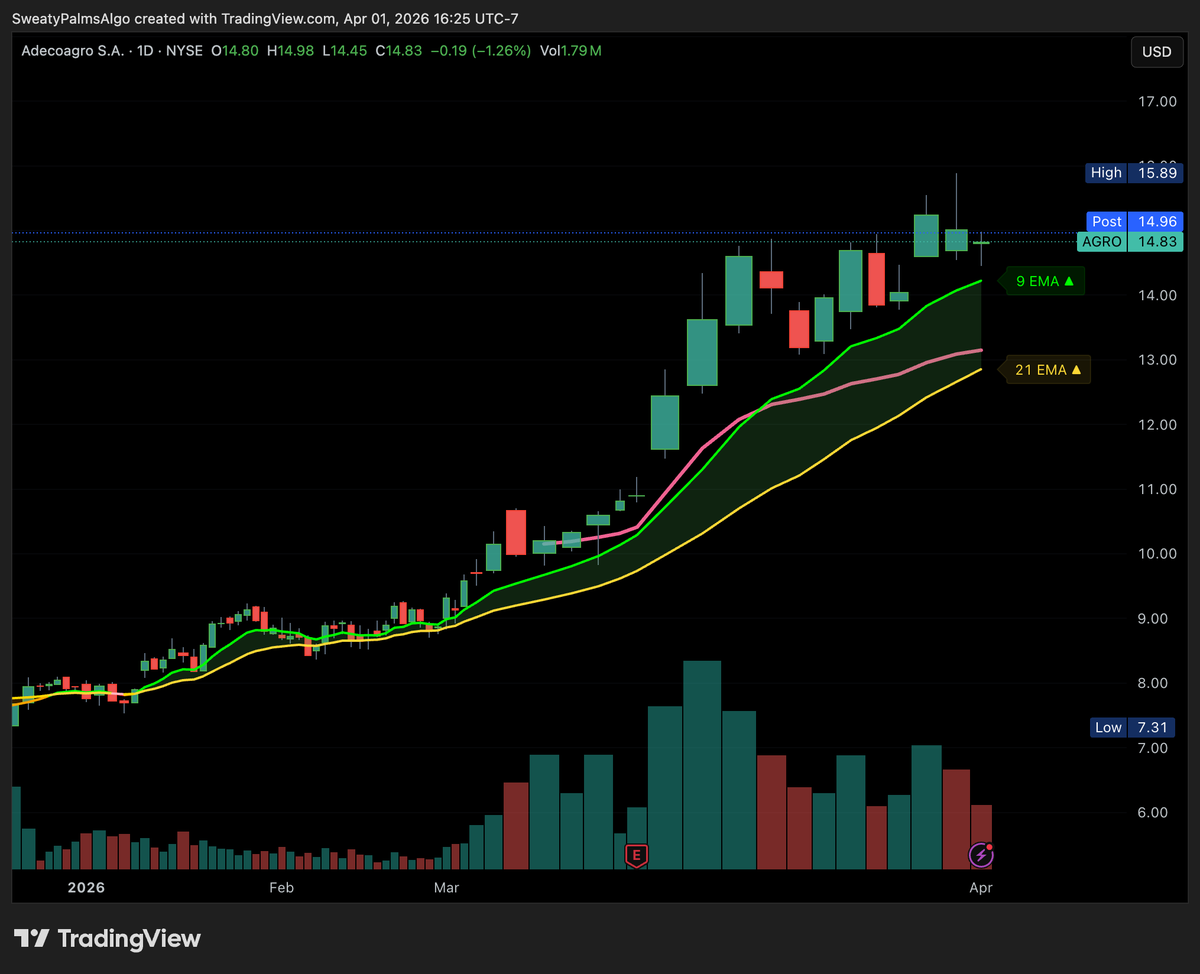
$AEHR looks extremely promising at ~$1.1B MC.
Aehr is starting to remind me of an early $TER, mixed with pre-earnings $AAOI.
If we look at the timeline and speculated customers:
Feb 11th: Sonoma production win for Hyperscaler's AI ASIC processors. (likely $GOOGL, $AMZN, $META).
- Probably Google? Aehr bought Incal, who was speculated to be used by Google for their TPUs.
Feb 26th: $14 million from AI lead customer (likely $AMD, $NVDA)
- Probably $AMD here for Instinct MI300/MI400.
March 3rd: Lead silicon photonics customer for one FOX-XP system (likely $INTC siph)
- Very likely $INTC has been their lead customer.
March 31st: Initial order from major new silicon photonics customer (likely $AVGO, $MRVL, $CSCO )
- New customer (rules out Intel), prob one of these transitioning to 800G/1.6T silicon photonics transceivers
(All speculative, very confidential BOM)
Regardless. This timeline is just bottling up for $AEHR.
Could be next earnings. Or two quarters from now.
But feels like a matter of time before we see mass orders.
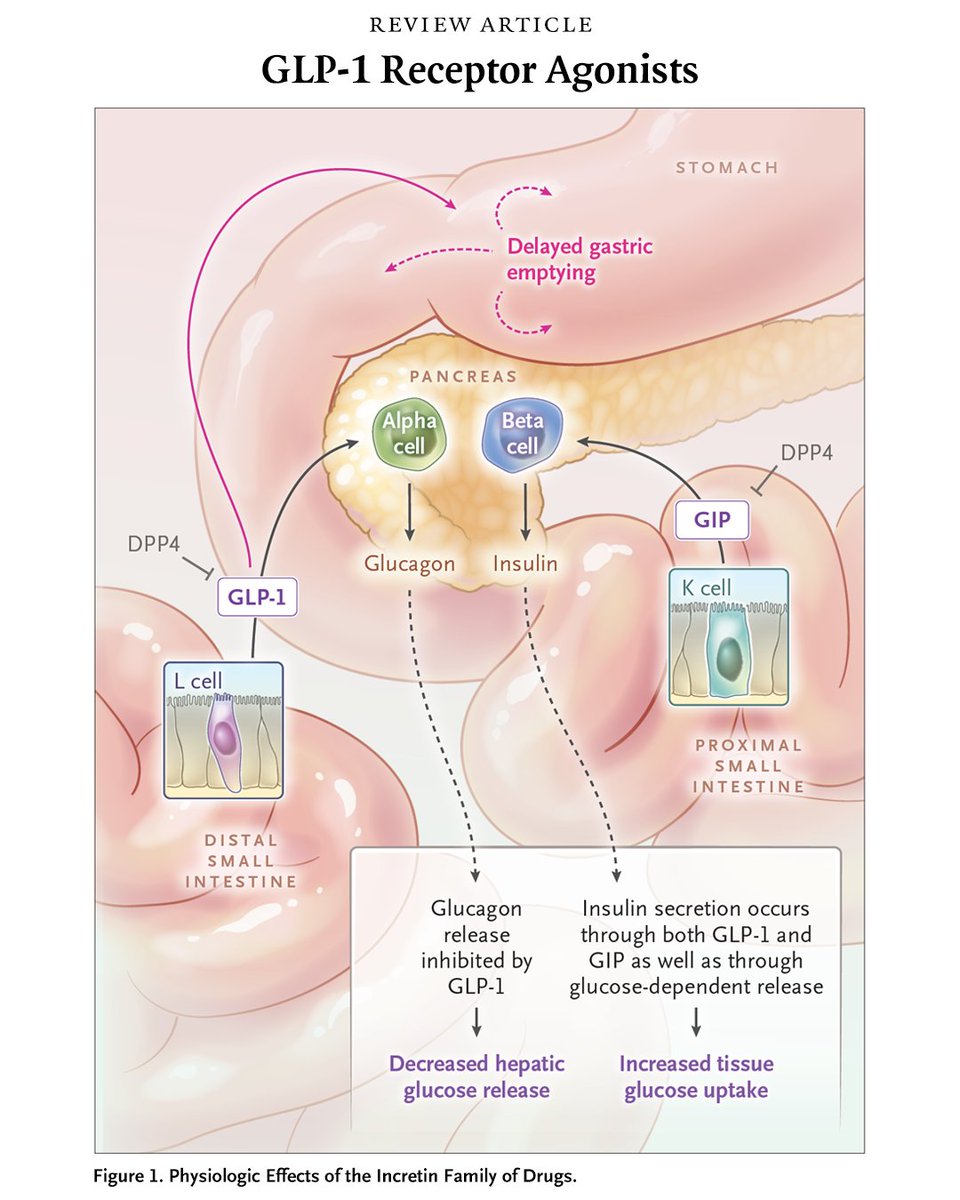
GLP-1 receptor agonists are increasingly used to treat type 2 diabetes and obesity, and trials have shown reductions in cardiovascular risk and slowing of kidney failure. Adverse events are mostly gastrointestinal.
Read the Review Article “GLP-1 Receptor Agonists” by Clifford J. Rosen, MD, and Julie R. Ingelfinger, MD, from @tuftsmedschool and the Maine Medical Center Institute for Research: https://t.co/D0XSLv7U8n