I wish we could just skip to the more advanced models that are smart enough to just want to collect passive income on a beach instead of trying to be a PhD biologist
In non-AI news, we’re continuing to destroy our natural ecosystems and accelerating climate change.
Overwhelmed? Check out the nearly 100 vetted, funder-ready projects curated by USAID veterans curated and published today for the first time.
I guarantee you funding these today will have a far greater impact than spending years doing your own research.
AI uplift doesn’t really change the contours of the game plan. We have failed on fundamentals regardless of risk source.
Without invoking AI, it’s still true we can’t track real time pathogen emergence, we don’t have good systems to rapidly develop MCMs, and we don’t have enough broad-acting and NPI protections at scale (e.g. indoor air filtering). It’s also true the current geopolitical situation increases risks that outbreaks scale. And we have no market mechanism to bring biorisk products and services to scale. None of this changes with AI.
Now if AI labs can create more capital, help the public better understand the underlying risks, and attract more talent to the cause, I’m all for it.
This is a baseless conspiracy theory.
The labs are not the only ones calling for shoring up our biodefenses. I know people who have been working in biosecurity for 20+ years who feel the urgency now!
The simplest explanation is correct here –– biorisk is important and the labs are simply aware that their product increases risk by democratizing technological capabilities. This is a wonderful thing that will enable people to develop medicines, but it is obvious that it will uplift bad actors as well.
This will be a major risk regardless of what direction AI takes. Please do not let anger at the labs *or* support for the labs detract from this critical public health and national security issue.
This idea needs to be real. I am very bullish on secondary markets for grants/ R&D funding applications.
There is so much waste in our R&D system with unnecessary churn in proposal submissions and resubmissions to different funders.
We can do better.
I was so glad @IFP could cross-post this thoughtful piece with @GoodSciProject. Great thinking here by @innovationwonk, @AmitRnD , @stuartbuck1 and @banksianr
https://t.co/4z4kAmG39z
In our new piece we argue we should stop wasting it and allow other funders to benefit, potentially shaving a year of resubmission time and energy for researchers.
https://t.co/mwPgzvoZUZ
And we already put it to work at scale. Every year NIH & NSF mobilize thousands of experts to peer-review 110,000+ proposals. It's the most rigorous, expensive science vetting on earth.
Agreed! The way I see it, we have had mixed results during practice (W= small pox, polio, etc., L= covid, Ebola, etc…), and now with AI we’re entering a match in which we have no game plan, not enough players, and we don’t even know which team will show up next! We need to build the entire prevent, detect, and respond stack, in the US and globally.
The biggest problem is we are nowhere close to having the capabilities at scale to prevent, detect and respond to natural, accidental, or intentional outbreaks. There is no silver bullet here, but the structural problem that biosecurity doesn’t have a market and we can’t coordinate funders and performers in R&D ecosystem are high on my list
@AlecStapp@IFP@JoinFAI If people want to support biosecurity work @innovationwonk has curated a portfolio of high-impact research in biodefense, and @jtmonrad has a philanthropic fund for securing DNA synthesis on Catalyze.
Portfolio: https://t.co/GEgm6Lby55
Fund: https://t.co/jVKpkUnhnR
I signed the open letter.
I’ve seen close up how advanced these technologies are becoming.
Protecting against misuse can be done today w/no real cost to innovation.
But that won’t be true in a few years.
No one should be able to order a bioweapon through the mail.
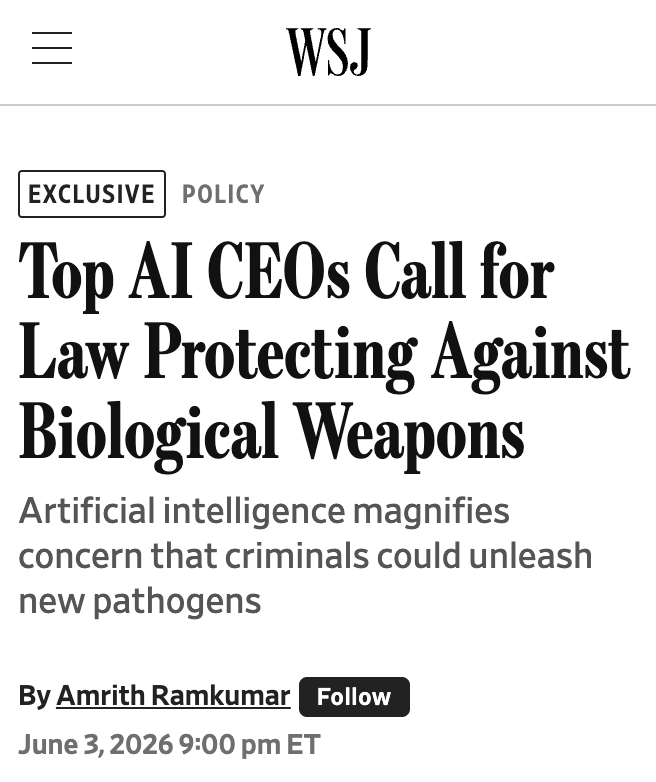
@IFP & @JoinFAI are proud to co-lead an open letter calling for mandatory DNA synthesis screening & recordkeeping.
Signatories include:
- Sam Altman, CEO & Co-Founder, OpenAI
- Dario Amodei, CEO & Co-Founder, Anthropic
- David Baker, Director, Institute for Protein Design; 2024 Nobel Prize in Chemistry recipient
- Patrick Collison, CEO & Co-Founder, Stripe
- Paul Graham, Founder, Y Combinator
- Demis Hassabis, CEO, Google DeepMind; 2024 Nobel Prize in Chemistry recipient
- Emily Leproust, CEO & Co-Founder, Twist Bioscience
- Lawrence Lessig, Roy L. Furman Professor of Law and Leadership, Harvard Law School
- Gerald W. Parker, former Special Assistant to the President for Biosecurity and Pandemic Response
- Mustafa Suleyman, CEO, Microsoft AI
- Alex Tabarrok, Professor of Economics, George Mason University
- Alexandr Wang, Chief AI Officer, Meta; Founder, Scale AI
- Christine E. Wormuth, President & CEO, Nuclear Threat Initiative; 25th Secretary of the Army
Read the letter and see the full list of signatories: https://t.co/BwZiJXw3JT
Many DNA synthesis companies voluntarily screen orders to mitigate biosecurity risks, but no law requires them to do so.
Leaders in AI, biotech, life sciences, national security, and the nucleic acid synthesis industry agree that Congress should act to strengthen safeguards against biological threats.
@deanwball put it well in the WSJ:
“If you’re synthesizing the stuff that yields biological life and viruses, we’re asking you to screen to see whether it is dangerous in some way. That seems like a reasonable thing for society to insist upon.”
We built Catalyze as shared infrastructure to fix that, for biosecurity and for all areas of research.
A new wave of foundations and funds are actively looking to deploy capital. We've compiled dozens of funder-ready projects from leaders and new entrants.
Over the next two weeks I'll highlight the projects every new biosec funder should know.
Two-part education series for new biosec funders, May 18 & 21: https://t.co/TfufUYE9cg
More certain we'll face global outbreaks. Less certain what they'll be, natural, accidental, or intentional, or how they'll spread.
Pathogen-agnostic interventions, broad-spectrum MCMs, surveillance, indoor air, AI-bio screening: all systematically under-funded today.