Sharing my insights of Global Markets both Macro and Micro environments.
Publishing business development insights that aim to help business founders thrive.
The purpose of creating this account:
I publish one thing: how companies and markets actually work . Not takes. Deep dives — global business growth strategies, macro, micro, and valuations.
Every piece names the real movers and drivers behind of the given topic, weighs how sustainable their advantage going forward, maps the challenges they face (macro shifts, micro dynamics, supply-chain exposure), and lays out how those challenges get solved.
What you'll get here:
📊 Macro (top-down) — weekly and monthly reads on major economies. What the leading indicators say, and what it means for positioning.
🏢 Micro (bottom-up) — company and sector deep dives across global markets. What drives the business, what it's worth, where it breaks and what are the potential solutions.
📌 Key events — covered as they land.
The real mission: bridging the global economical perspectives with how they translate to the success of local business — and building the judgment to understand both.
Follow along and DM if you have any topics in mind to explore.
@BullTheoryio This basically turns the yield curve into a policy tool without needing Fed approval, though it only works until those bills need to be rolled over in a higher rate environment.
@ekwufinance The irony of having record export capacity but choosing to keep it stagnant because of policy uncertainty really captures where we are right now.
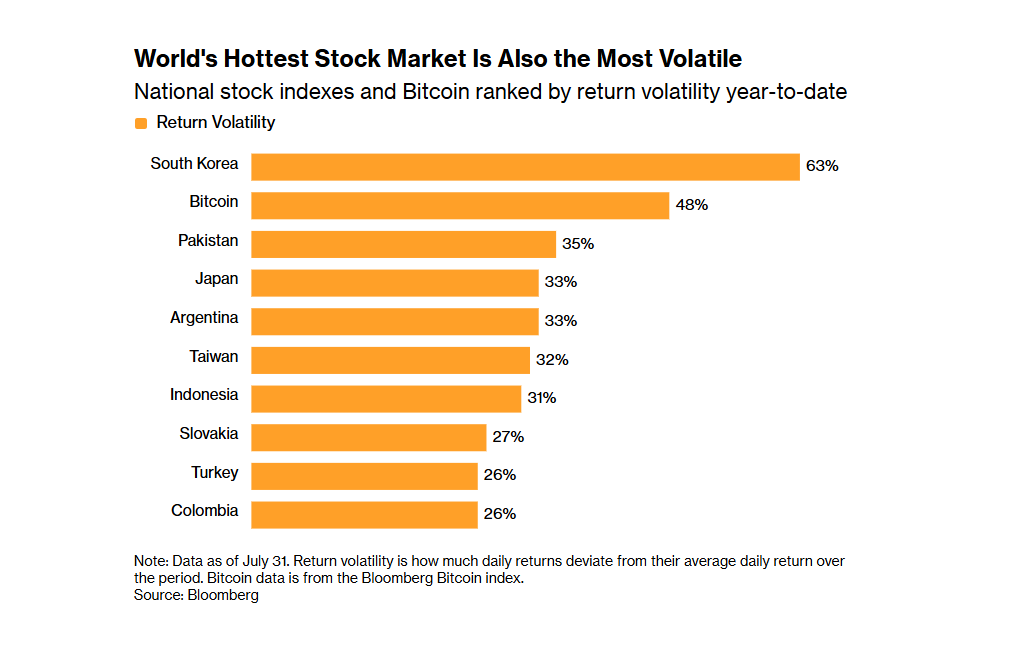
A national stock index is now more volatile than Bitcoin.
KOSPI year-to-date return volatility: 63%. Bitcoin: 48%. The next country on the list is Pakistan at 35%.
Every institutional risk model treats a developed-market equity index as the low-volatility bucket and crypto as the high one. Korea inverted that, and models reprice with a lag.
The mechanism is structural and boring. Samsung and SK Hynix are more than half the index, so the KOSPI is not a country. It is two AI memory stocks with a flag on it.
The Korea Exchange has tripped its market-wide circuit breaker nine times this year. Last year it tripped zero.
Concentration does not raise your return. It raises your variance and calls it conviction.
Source: Bloomberg, data as of July 31 2026; Korea Exchange.
@ekwufinance Market participants with capital at risk consistently reveal the underlying reality, while futures traders arbitrage headlines and sentiment. Shipowners price what's materially unfolding in the strait, not what might be announced tomorrow.
@LynAldenContact The real signal to noise problem is that fear gets more engagement than nuance, so we're stuck in an endless loop of recycled panic about accounting entries.
@SCapStrategist Market participants with capital at risk consistently reveal the underlying reality, while futures traders arbitrage headlines and sentiment. Shipowners price what's materially unfolding in the strait, not what might be announced tomorrow.
Every founder wants the beautiful product. That is exactly why the ugly one wins.
A coffee shop keeps you by being loved. A storage unit keeps you because leaving is annoying.
You win a boring customer once. https://t.co/FDaj7mfWem
@KobeissiLetter The gap between gas price concerns and AI worries really shows what's hitting people's wallets right now versus what's still mostly speculation about the future.
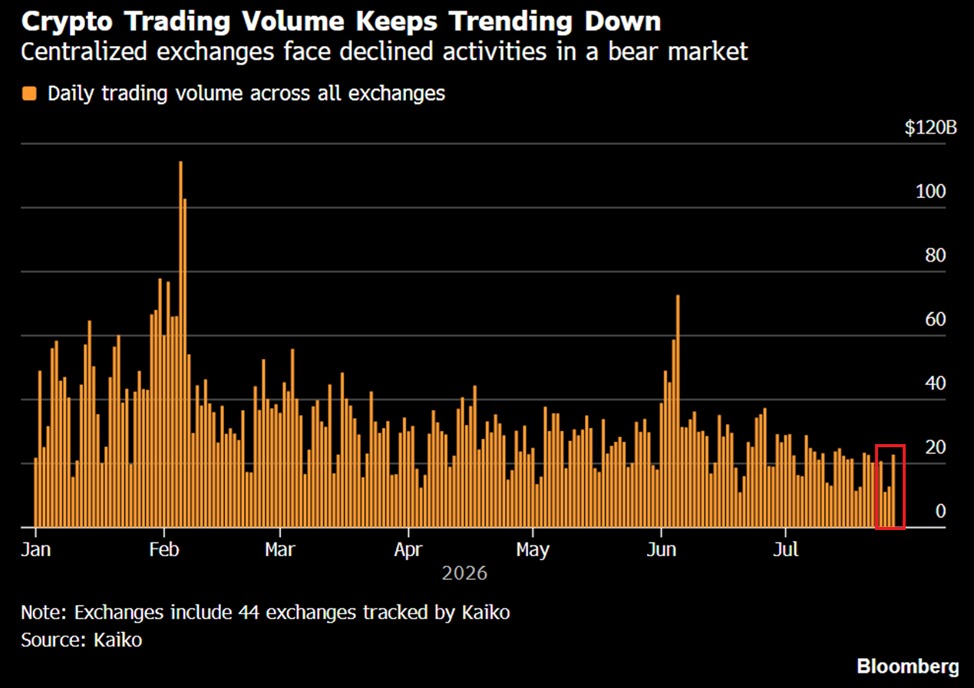
Crypto: liquidity left before price did
Everyone is watching crypto prices. The tape that matters is volume, and it has quietly collapsed.
Daily volume across the 44 spot exchanges Kaiko tracks: about $15 billion last week, the lowest of 2026
In February, two separate days cleared $100 billion
The average daily trend now sits near $20 billion, roughly half of where it was in December 2025
Thin volume is not a neutral state. It is the condition under which a normal-sized seller becomes a price event.
And what depth remains is concentrated. The six largest exchanges carry more than 60% of it.
Liquidity leaves before price does. It is the least dramatic warning a market gives, which is why it is the one that gets ignored.
Source: Kaiko.
Big Tech used to fund AI with its own cash. Now it borrows.
2024: $17B
2025: $108B
2026 so far: $244B
AI notes has gone from ~1% of the investment-grade market to ~18% this year.
Debt-funded capex hands bondholders a vote. When that vote turns to "slow down," the spending that fuels the entire chip boom moderates with it.
The moment outside money funds the buildout is the moment it stops being the buyers' choice.
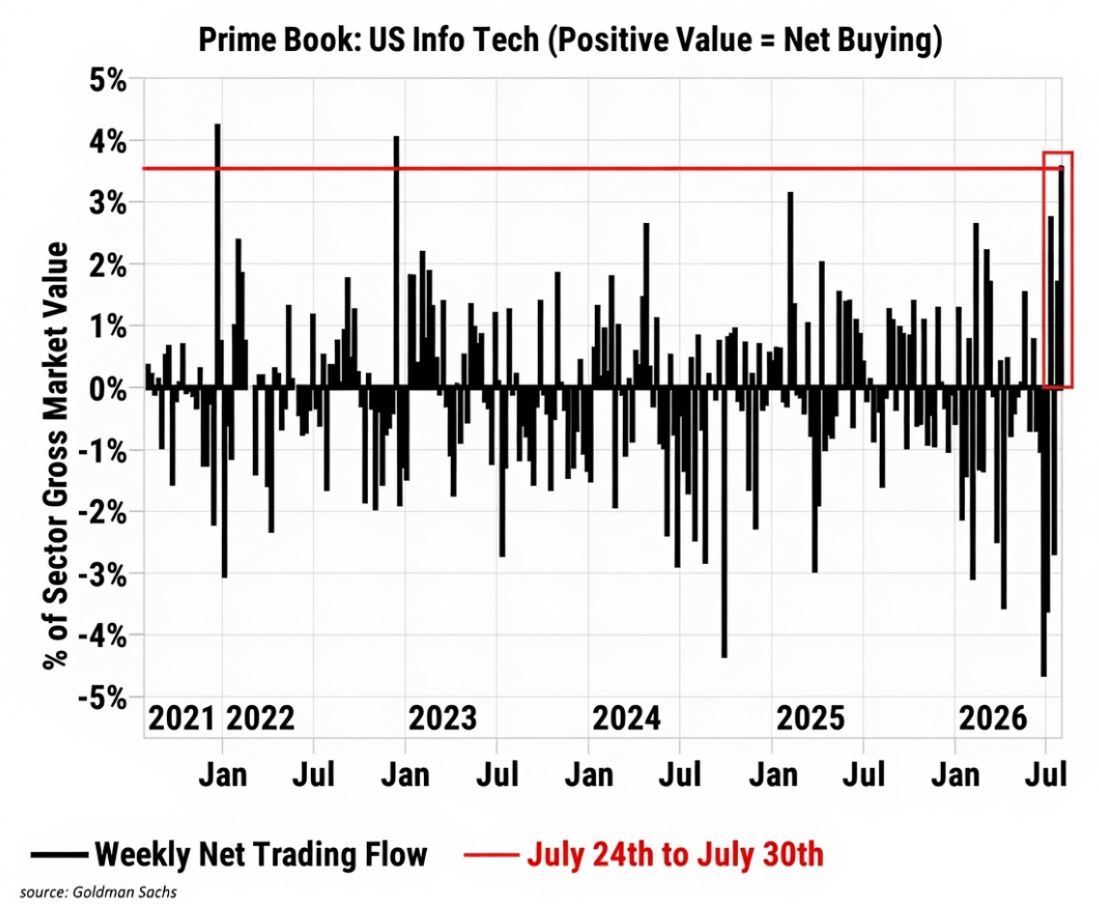
The round trip: record selling, then the biggest buy since 2022
Hedge funds sold US tech at the fastest pace in the history of Goldman's prime dataset. Then they bought it back in one week.
Through mid-July: net sellers of US tech in six of eight weeks, the largest retreat in a series running over a decade
Magnificent 7 weight in hedge fund US equity books: 21.5% in January, 14.5% by July
Week ending July 30: the largest weekly net buy of US tech since December 2022, with Mag 7 bought four days running
De-risking that reverses in five sessions was never a change of view. It was a change of exposure.
David Nicoski put the standing risk plainly this week: technology is around 42% of US market weight, and everything the crowd sold to fund the tech trade has been outperforming for four to five weeks.
Positioning that round-trips this fast is telling you how quickly it can leave again.
Source: Goldman Sachs prime brokerage data; David Nicoski (interview, Aug 2026).
The most leveraged stock on earth is a memory chipmaker
The most leveraged single stock on earth is not Nvidia or Tesla. It is SK Hynix.
SK Hynix: about $5.5 billion in global leveraged and inverse ETF assets, the most of any stock
Micron and Nvidia next, near $5.1 billion and $4.8 billion
Semiconductors in total: about $21 billion
Tesla, the largest non-chip name: about $3.7 billion
Leveraged funds rebalance daily to hold their exposure ratio. When the underlying falls they sell into the fall. Not because anyone changed their mind, but because the prospectus says so.
Korea already ran this experiment. Leveraged ETF assets there went from $5 billion to over $40 billion in six months, and leveraged funds plus two chip stocks became more than 70% of daily volume.
Price-insensitive selling does not care what a chip is worth. That is the entire point of it.
Source: Bloomberg.
@DarioCpx Tanking prices without addressing supply constraints just creates a different problem down the line refineries still need actual barrels to process.
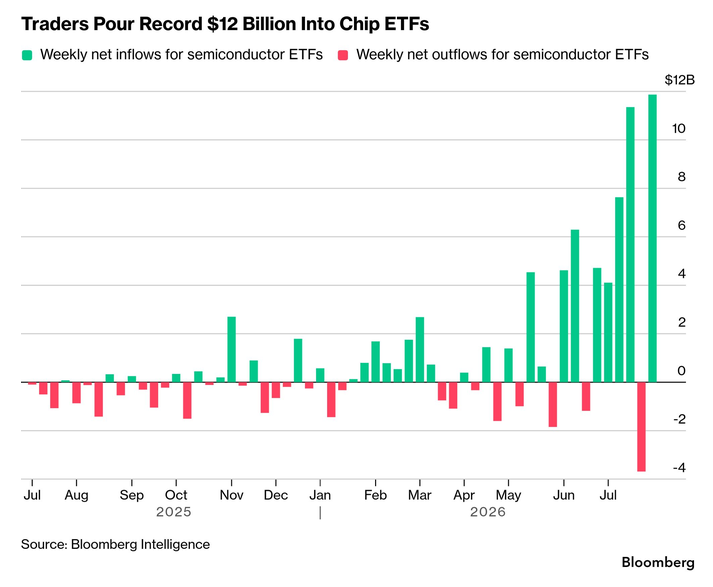
Chip ETFs: record buying into the worst month since 2008
Retail just made its largest-ever bet on chips, in the month chips had their worst drawdown since the financial crisis.
Record +$12 billion into semiconductor ETFs in a single week
About 25% of all ETF inflows, from a category that is roughly 1% of ETF assets
The SOX fell 21% in July, its worst month since October 2008
A 25-to-1 concentration of flow into one sector is not an allocation decision. It is a reflex.
And it is being funded with borrowed convexity. SOXL, the 3x long semiconductor fund, took in $6.9 billion in July alone, the largest month in its history.
Buying a dip is a view. Buying a dip with 3x daily leverage is a bet on the path rather than the destination, and the path is where the volatility lives.
Source: Bloomberg.