IO is a leading peer-reviewed journal on international affairs. Co-eds-in-chief @BAshleyLeeds & @LaynaMosley, associate editors @PeterRosendorff & @AyseZarakol
IO will not process new submissions from December 20, 2024 through January 2, 2025. During that time, we will continue to work on existing submissions.
How do people in a rising power view their country's global standing? My new paper in @IntOrgJournal finds significant national overconfidence in China and shows that misperceptions can be corrected and triumphalism mitigated https://t.co/8w3eh66RBW 崛起大国的过度自信及其校正
As part of a special issue of @IntOrgJournal Rebecca Cordell & I write a piece on the future of human rights amidst authoritarian resurgence.
See "Authoritarianism, Global Politics, and the Future of Human Rights" open access here: https://t.co/1pc5bIwPpG
NEW ISSUE from @IntOrgJournal -
The Future of Global Governance and World Order - https://t.co/4uKnjrySiS
International Organization - Volume 79 - Issue S1 - December 2025
International Organization will be on a winter break from December 22, 2025 through January 9, 2026. Manuscripts submitted after December 21, 2025 will be processed beginning on January 10, 2026.
#FirstView from @IntOrgJournal -
Pushing Back or Backing Down? Evidence on Donor Responses to Restrictive NGO Legislation - https://t.co/mHkiCIH7QT
- Lucy Right, Jeremy Springman & Erik Wibbels
Call for Submissions from @IntOrgJournal - Special Section on the Future of IR
In fall 2025, IO will publish a supplemental, online-only issue of the journal, focused on the Future of Global Governance and World Order.
Find out more - https://t.co/rV73EVvZ0e
@MEckerEhrhardt, @ProfDellmuth, and @JonasTallberg show that people view IOs as #ideological actors and accord IOs greater #legitimacy when they perceive these organizations as ideologically closer.
https://t.co/CMc7C0RzUZ
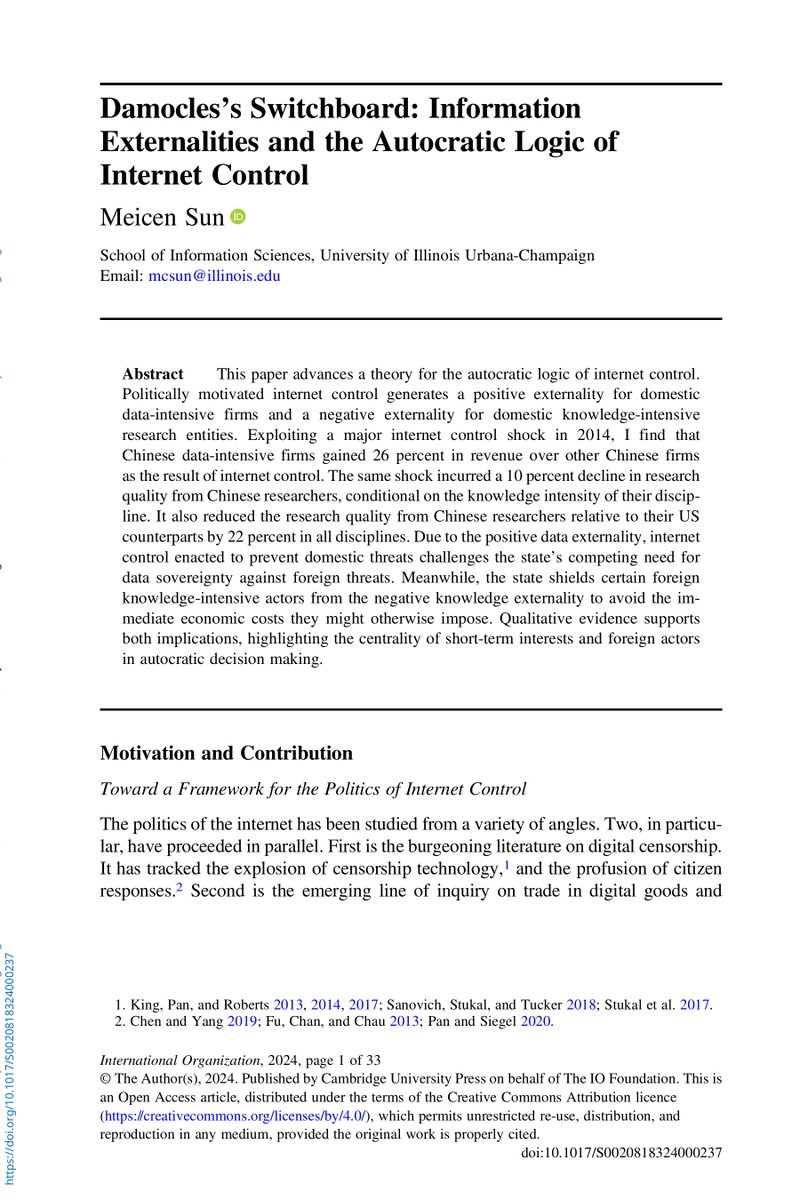
@MeicenSun finds that China's internet control, the "Great Firewall", has benefited Chinese data-heavy firms (+26% revenue) but hurt Chinese research quality (-10%) in knowledge-driven fields, widening the research gap with the U.S. by 22%.
For more, see the paper: https://t.co/hDNBc6g3FF
Also, this interview on the technology policy podcast, Two Think Minimum: https://t.co/4i6l7ptDxt
@StanfordPACS @StanfordCyber @MITpolisci@MIT_CIS@MITFutureTech@IntOrgjournal@iSchoolUI
Out now open access at @IntOrgJournal.
link: https://t.co/LmTaRHyXAO
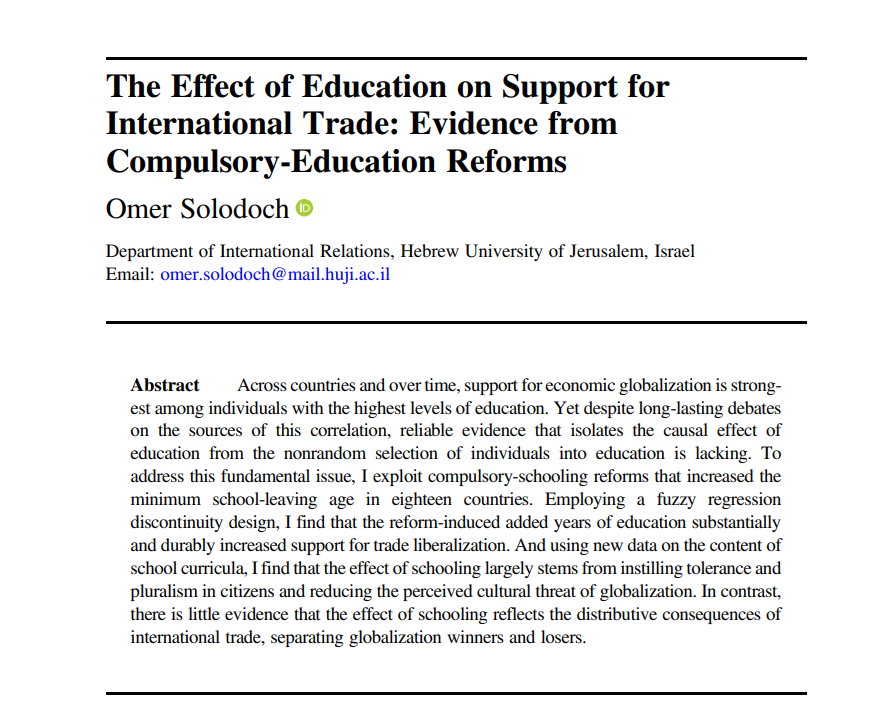
Education is one of the clearest lines dividing supporters and critics of economic globalization and international trade. But whether this robust correlation stems from nonrandom selection
1/5
#FirstView: @UCSDPoliSci's @m0joseph & @m_poznansky ask why some of the most radical innovations of the last century came from orgs shrouded in secrecy.
The findings have important implications for debates about tech, innovation, and US-China rivalry.
https://t.co/xqhWaIKQL7
Gendered selection into leadership can explain why some female leaders fight harder than male leaders in inter-group contests. Their decisions reflect their preferences, not just stereotyping pressures.
@StephenChaudoin@Sarah_J_Hummel@YonSooPark1
https://t.co/4bbyOyumRl
How does education affect support for trade openness?
@solo_omer leverages compulsory schooling reforms in 18 countries to find out (spoiler: education >>> support for trade liberalization).
https://t.co/0OfFb3SXYP
Black leaders hold the top positions in several international organizations.
Does this affect the legitimacy of IOs?
David Steinberg (@SAISHopkins) & @daniel_mcdowell consider this question using survey experiments in Kenya, South Africa and the US.
https://t.co/bRXsTvvFbl