@arik_g@zama@ethereum agreed, although I have my own opinion on which approach will win
will be interesting to see how it plays out
wish you guys the best of luck 🤝
this is exactly what I was talking about
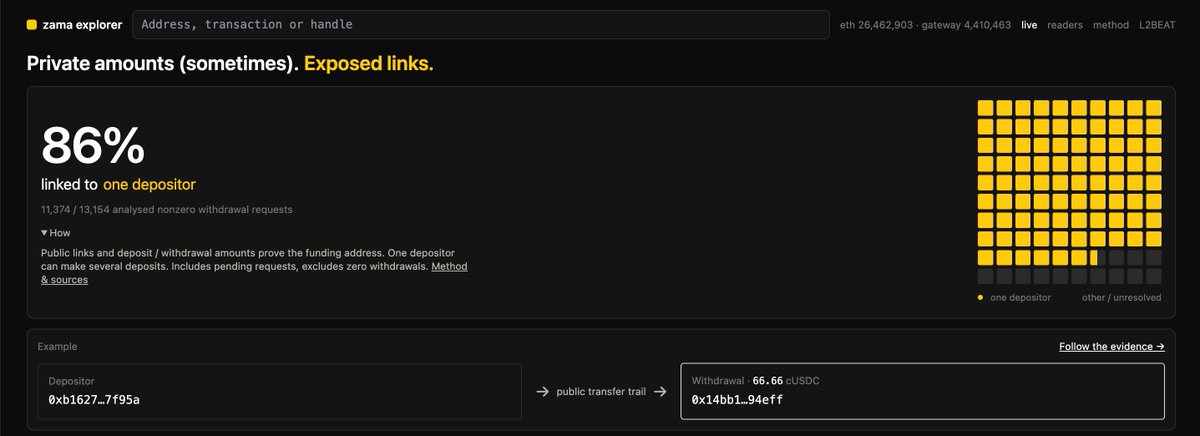
86% of analyzed withdrawal requests on @zama could be linked to a single depositor. just using public onchain data
and @ethereum wants to call this "HTTPS for blockchains"?
how can this become a privacy standard when we already have Aztec? decentralized network that protects not just transaction amounts, but also the links between users, with programmable private apps, no master viewing keys, and no committee of operators controlling access to everyone's financial data
encrypting amounts while exposing people's financial activity isn't real privacy. STOP SELLING IT AS ONE
Ethereum calling @zama "HTTPS for blockchains" is a joke
Senders and recipients are public. The transaction graph is public. Decryption depends on a committee of KMS operators, and governance can block addresses.
Even Zama's own docs admit this is "value privacy, not full privacy"
Maybe it's time to pay attention to a fully private, decentralized blockchain that's paying @ethereum more in fees than ANY other L2 and it's still in alpha?
i get it, and I think Zama’s tech has real use cases
but I don’t think it’s the right privacy standard for Ethereum when we can already protect both transaction amounts and links between users, without giving third parties control over their privacy
and still comply with regulations through selective disclosure
Why settle for less?
Ethereum calling @zama "HTTPS for blockchains" is a joke
Senders and recipients are public. The transaction graph is public. Decryption depends on a committee of KMS operators, and governance can block addresses.
Even Zama's own docs admit this is "value privacy, not full privacy"
Maybe it's time to pay attention to a fully private, decentralized blockchain that's paying @ethereum more in fees than ANY other L2 and it's still in alpha?
0/ Privacy on Ethereum has mostly been ZK-pilled, FHE allows a different kind of privacy - privacy that lives on shared state, composable across contracts, quantum secure and aligned with Ethereum’s core building blocks.
A guest thread by @arik_g from @zama
why should I trust a committee of operators with my financial privacy when I can control it myself?
we've seen enough hacks to know that even big operators aren't safe. if enough of them get compromised, millions of users could be at risk
compare that to keeping your private data on your own device. hackers can't just look at your wallet and see if you're worth targeting because your financial activity is private
and even if u gets hacked, that's your responsibility and your data at risk, not the data of everyone who trusted those operators
@Desi13282354119@zama@aztecnetwork@ETH_Daily@ethereum i don't see Zama becoming the HTTPS of Ethereum
why accept public transaction graphs, decryption controlled by a committee, and governance that can block addresses when we can build compliant apps without sacrificing users' privacy and control?
octra actually looks interesting, but does it really solve it?
their own docs say stealth transfers still expose changes to the sender's public balance and nonce, the current mainnet client can't submit them, and their Ethereum bridge has guardian, pause and unlock-operator controls
Aztec offers private execution on your own device, without a network-wide viewing key, and settles on Ethereum
so what exactly has Octra solved that Aztec hasn't?
you're defending watered-down privacy where everyone can track who pays whom, and decryption still depends on a committee of third parties
Aztec shows it's possible to build compliance into apps using ZK proofs and selective disclosure, without exposing everyone's transaction graph or giving operators a master key to users' data
so why sacrifice privacy when you don't have to?
@HuntWithBaghera@thomas010010@zama@aztecnetwork@ETH_Daily banks can build KYC and selective disclosure into apps without exposing everyone's transaction graph or giving third parties control over their privacy
its possible to comply with regulations without sacrificing people's privacy
i'm not saying Zama has no real use cases.
my point is that your transaction graph is public, decryption depends on KMS operators, and third parties can have control over your funds and financial data.
even Zama's own docs describe these tradeoffs.
so what exactly did I get wrong?
@thomas010010@zama@aztecnetwork@ETH_Daily HTTPS mã hóa dữ liệu nhưng không che giấu bạn đang giao tiếp với ai. Zama cũng vậy. Số tiền được mã hóa nhưng lịch sử giao dịch và mối liên kết giữa các ví vẫn công khai. Đó chính là điều tôi đang nói.
i agree FHE has real use cases, and I'm not questioning that
my point is why projects with privileged control over users' funds or privacy get so much attention from Ethereum when CROPS is supposed to be non-negotiable?
and why does Aztec, which much closer to those principles, get less attention?
you're confusing compliance with giving third parties control over people's privacy
for example aztec supports regulatory compliance through ZK proofs and selective disclosure, without giving network operators or auditors a master key to everyone's financial data
why Zama and others can't do the same?
@unhappyben@zama@ethereum The weirdest part is Ethereym promoting this as the future of privacy while there's already a decentralized L2 proving that real privacy works without trusted third parties
Ethereum calling @zama "HTTPS for blockchains" is a joke
Senders and recipients are public. The transaction graph is public. Decryption depends on a committee of KMS operators, and governance can block addresses.
Even Zama's own docs admit this is "value privacy, not full privacy"
Maybe it's time to pay attention to a fully private, decentralized blockchain that's paying @ethereum more in fees than ANY other L2 and it's still in alpha?
GPT-6.2 Sol needed 9 seconds, GLM-5.3 Flash needed 99 seconds. Both came to the same conclusion
I asked what blockchain do we need most in a world where our identities get stolen, financial data gets leaked, and our money is tracked?
Stop trusting marketing. Stop listening to paid influencers who will promote anything for a paycheck.
If someone can freeze YOUR money, access YOUR private transactions, or decide who gets to see YOUR data without YOUR consent, what kind of freedom is that?
Too many blockchains sell you privacy while keeping backdoors for themselves or third parties.
Don't believe me? Good, ask your own AI.
Find out who really controls your money and your data.
And if you know another blockchain that offers real privacy without admin backdoors or mandatory third-party access, name it