UPDATE
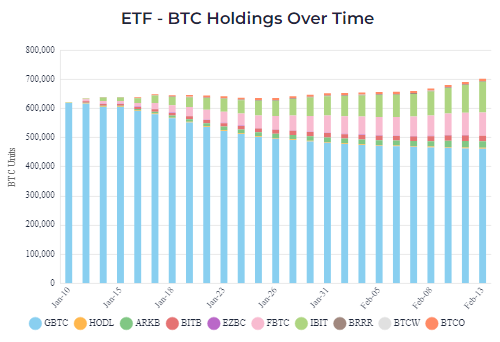
Bitcoin ETF Net In Flows + 12.8K #BTC 🚀
New All Time High 704.4K BTC Held in ETFs
New 9 ETFs + 14.3K BTC
Highlights
Blackrock +10K BTC 🤯
Fidelity + 3.3K BTC
GBTC -1.5K BTC
Follow our ETF Tracker for Live Updates
US Citizens Had To Become Market Speculators
The citizens of America are being forced to become market speculators. Historically, some portion of the population was drawn to the idea of wagering capital to drive a return on their investment, yet a majority of individuals chose to refrain from this activity and merely save their money.
To understand the phenomenon, we must first identify a key structural change that happened in the 1970s — the United States went off the gold standard, the government became addicted to running an ever-increasing deficit, and the national debt has ballooned to $33+ trillion. This chart from Pantera’s Dan Morehead is eye-opening.
As the national debt became larger, the US government realized they had a more robust ability to devalue the currency so we theoretically could pay off a fixed debt amount with future devalued dollars. You can see a rapid decline in the purchasing power that began at the start of the 1970s.
While the devaluation of the dollar allows for debt to be paid off at advantageous terms later, even though it is unlikely that the US will ever pay off their debt, the largest negative repercussion from this decision is the erosion of citizens’ savings value. The majority of citizens were holding cash in the bank account trying to save their way to wealth, yet the government was destroying that value simultaneously.
This devaluation forced more citizens to seek paths to protect their wealth. Investment assets like stocks became a popular option because the belief has been that the stock market will outgrow any inflation implemented by the government.
So how significant was this trend?
Within 30 years, more than 50% of all US citizens owned stocks directly or indirectly. Last year the percentage of US citizens holding stocks hit an all-time high just under 60%.
The rise from 53% stock ownership in 2019 to 58% stock ownership in 2022 is largely driven by the mania ushered in from zero-interest rates and trillions of dollars in quantitative easing.
This problem is not going away.
The national debt chart looks like an exponential growth chart a Series A startup would show investors to elicit their next mega-round of funding. Up and to the right. No end in sight.
This runaway debt means the United States has no choice but to continue devaluing the US dollar. As they devalue the dollar, more citizens will seek investment assets like stocks, real estate, gold, or bitcoin to protect their wealth. We should see ownership of each of these assets, especially stocks, hit new all-time highs over and over again throughout the next decade.
At the same time more capital and investors has flooded into the public stock market, the number of public companies has been declining at an alarming rate. The folks at BlueTrust write “In 1996 the number of listed companies in the U.S. peaked at 8,090, but as of Q1 2023, it had fallen to 4,572, a drop of 43%. This dramatic decrease in public companies...occurred in spite of growth in the economy, global market expansion, and new industries and technologies.”
More capital chasing fewer companies. All this happening while the dollar, which stock prices are denominated in, continues to become less value over the long term.
This is what drives the stock market up forever. There is immense wealth to be built by simply buying stocks and letting the market structure take over from there.
If you take this analysis to the extreme, there is also more capital chasing a finite amount of bitcoin, so the same macro tailwind should work in the digital currency’s favor as well.
Investors win, savers lose. That is the story in America for the foreseeable future. Don’t get caught on the wrong side of the equation.
Global markets are waiting for this suit to give a thumbs up or thumbs down to your portfolio.
Do you see how silly this is?
Imagine home builders waiting for someone to tell them how many inches are in a foot before they ordered lumber.
We can build homes because the underlying math never changes.
We can send satellites into space because Newton discovered a gravitational constant.
Constants help our species accomplish things that once seemed impossible.
They offer a solid foundation to build upon.
#Bitcoin is the first monetary constant.
21 million coins issued on a predictable schedule, regardless of demand.
It's the opposite of waiting for a suit to tell you the price of money.
And it's a big deal.
As the central bankers wildly swerve between inflation and deflation, humanity will organize around a predictable monetary constant.
And in the process, we'll unlock a new level of economic achievement that makes today look like the dark ages.
Soldiers from the British Royal Lancers and the Polish 2nd Lubelskie Brigade guarding the Polish border with Belarus together on horseback.
The terrain is difficult in the border area and sometimes it’s simply easier to patrol it on a horse.
🇵🇱🇬🇧
🚨#BREAKING - 🇺🇸 US Congressman Brad Sherman admits US govt prints money out of thin air:
“Crypto bros…will accuse the US government of making money out of thin air. Maybe we do, but we’re the US government.”
With the 'sudden' onset of bank insolvency and credit risk, it seems a good time to peek at the US Treasury’s *own* financial position.
Take its debt temperature, so to speak. This is a long but really important one, so saddle up and settle in.
It's time for debt 🧵👇
@scottmelker So correct me if I'm wrong but the solution they have come up with is to allow issuance of new debt using..... Other debt as collateral.....
Why this sudden meltdown in bank stocks?
A couple of interesting theories and charts are doing the rounds, so let's have a look under the hood.
A thread.
1/
@wimgtr@mzehetm@lukaseder@elonmusk We use Wrike is far better, simpler UI far more adaptable and as long as you set your framework up the right way much easier to navigate. Though still gets a little laggy when handling large amounts of data.
@deadsbirth Easy
All ~80% of the way through there respective time period:
Thursday = 80% way through work week (4/5= 0.8)
October = 83.3% way through year (10/12 = 0.8333)
8pm = 83.3% way through day (20/24 = 0.8333)