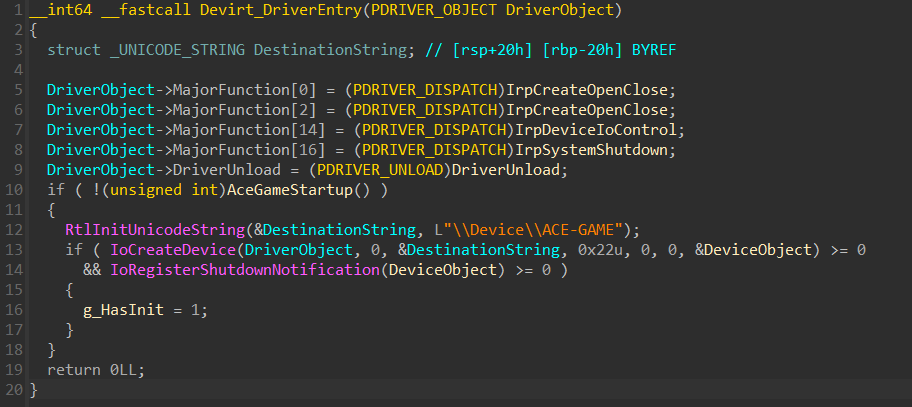
They did it again. This time it's Tencent's kernel anticheat VM.
815 of 865 virtualized functions across four kernel drivers statically devirtualized back to native code. 94.2 percent coverage, 99.3 on ACE-GAME.sys.
Same approach. Guided symbolic execution, constant promotion, constant folding. The entire math obfuscation layer comes down to sixteen identity rules that fit on one screen.
If you're unpacking malware protected by Themida or VMProtect, this is the same problem. Same VM architecture, same obfuscation patterns, same deobfuscation techniques. Doesn't matter that it's anticheat, you're learning the same skills.
Denuvo anti-tamper is next.
https://t.co/FKRijJIBXk
Author: @BackEngineerLab@_xeroxz
#ReverseEngineering #MalwareAnalysis #Infosec
IonStack Blog Series:
Part I (Firefox SpiderMonkey JIT RCE): https://t.co/PbUJTlFLa2
Part II (GhostLock, a 15 yo universal Linux LPE): https://t.co/TxHv6lBaAd
IonStack Part III (Rooting Android with GhostLock): https://t.co/z98lRbnWiH
AI is changing vulnerability research but not in the way many expect
Our intern, Jia Jie, reflects on how AI made Linux kernel 0-day hunting feel surprisingly similar to n-day analysis & why deep system knowledge remains essential for reliable exploitation
https://t.co/9A5V1hqRYe
As promised, DarkSword Kernel Exploit writeup is now live at https://t.co/aji0Xc3JNU
This goes over the root cause, what happens on the Kernel side and how the kernel exploit is implemented.
Hope it helps anyone looking to understand it! :)
This super ultra mega rare fuck off ultra malware my colleague sent me has a really fancy schmancy anti-VM feature. It is the fanciest I've seen to date. I like it.
After bonking this goop with a stick, sifting through dummy and decoy data, I figured out how they evaded my VM, RecordedFuture Triage, AnyRun, and VirusTotal.
They made a really fancy entropy thingie by collecting a bunch of data and doing fancy math.
I respect it.
https://t.co/097fsse2w5
RAM is expensive these days :’/
Found a KVM bug that lets the guest eat the host’s RAM, but the guest itself loses nothing. That memory is never returned to the host - a permanent leak.
Maybe this bug, someone could just drain entire physical host RAM of some cloud provider
https://t.co/Wdnd3jXSw4
Alright, let's try this livestream thing again. Hopefully it will work this time.
We spent some time hacking browsers and wanted to understand what the future of exploitation may look like in this field. So we decided to invite the GOAT of browser hacking, @5aelo, to share his perspectives on browser security and exploitation. He'll discuss the current state of the art browser exploitation and mitigations.
The event will be live-streamed on YouTube and everyone is welcome to attend + ask questions. It will take place on July 16, 17:00 CEST.
Ask your questions by filling in this form: https://t.co/OfBzuTUzd1
Add to your Google calendar: https://t.co/QewG6L1QkI
Add to your Outlook calendar: https://t.co/fyJHXlGd2W
https://t.co/Wdnd3jXSw4
Intel #CET killed traditional #callstack#spoofing. Here is how to bypass modern #EDRs telemetry anyway.
New: CET-Compliant Callstack Spoofing via Thread Pool & Enum callbacks.
Manual shadow stack resync via JMP & #INCSSPQ. Article & Rust PoC included👇
https://t.co/fJOmAcFGOa
We've documented a new EDR-bypassing process injection technique from @z3ro2504 & Max Hirschberger on the @sensepost blog. Link to post and code in the replies.
#ThreadSanitizer can now injects random delays info program execution to catch more tricky data races:
https://t.co/QVAlKs9AiL
Enabled with TSAN_OPTIONS=enable_adaptive_delay=1
Thanks to Chris Cotter
(not in any release still)
The Gentlemen ransomware, in a BYOVD attack, used a zero-day exploit to kill EDRs before deploying their payload. The driver they abused wasn't on any public blocklist. Here's our analysis of their techniques. 🧵