A SpaceX intern once described eating lunch next to Elon Musk in the company cafeteria.
The intern said Elon sat down at a regular table with a regular tray of food. No entourage. No reserved section. He sat next to two junior engineers who were clearly terrified. One of them was explaining a problem with a valve component to the other.
Elon listened without introducing himself or interrupting. After about three minutes he turned to the engineer and said "have you tried running it at a lower pressure gradient first." The engineer stared at him. Then realized the CEO of the company had just casually solved a problem his team had been stuck on for a week.
The intern said what happened next was the part that surprised him. Elon didn't leave. Didn't check his phone. He spent the next twenty minutes asking the engineers questions about their work. Not CEO questions about timelines and budgets. Engineering questions about fluid dynamics and material stress tolerances. He was genuinely curious. The cafeteria conversation was indistinguishable from a technical review.
The intern said he understood in that moment why people work 80-hour weeks for this man. Not because he's inspiring. Not because he pays well. Because he's the only CEO in the world who sits in the cafeteria and solves your engineering problem between bites of a burrito.
People follow leaders who are above them. People worship leaders who sit next to them and prove they understand the work better than the people doing it.
“At first, when caged, we were in absolute darknesss. Pitch black.”
Listen to Rimon Kirsht, who was taken hostage by Hamas on October 7th, recount the horrifying details of her captivity.
We will never stop sharing the stories of October 7th.
🎥 @N12News
Why are we seeing so much investment in western Canada's natural gas transportation infrastructure?
Oil, natural gas, and natural gas liquids (NGLs) are closely interconnected. In many Western Canadian plays, oil and NGLs drive project economics, while natural gas is a byproduct.
Western Canada produces more natural gas than it can consistently consume or move to higher-value markets. During periods of severe transportation constraints, prices have even turned negative. That's why expanding market access matters—through pipelines to the U.S. and eastern Canada, LNG exports to Asia and Europe, or as power generation for data centres.
As oil sands production grows, so will demand for condensate (used as diluent). Meeting that demand will require development of liquids-rich resources, which will bring yet more natural gas to market.
Building natural gas transportation infrastructure is essential for us to capture more value for producers, governments, and the broader Canadian economy. It’s very low hanging fruit for better productivity, revenue and exports.
This is Jerusalem during the Jordanian occupation, prior to the reunification of the city on June 5, 1967.
Jordan destroyed the entire Jewish Quarter of the Old City, including 52 synagogues. Pictured is a Jordanian soldier standing on the ruins of Hurva Synagogue.
On Yoel Solomon Street in Jerusalem, you can buy a keffiyeh. Right at the heart of the country.
The keffiyeh is not Palestinian. Its name comes from Kufa, a city in Iraq that goes back to ancient Mesopotamia, worn by Sumerians and Babylonians long before there was a Palestinian national movement. Bedouins and farmers wore it for centuries against sun and sand. Only in the twentieth century did it turn political, when Palestinian fighters adopted it in the 1930s revolt, and Arafat later made it his signature.
From a Western point of view, it reads as terr0r*sm. From an Arab point of view, it reads as resistance. Both readings agree on one thing: the keffiyeh is tied to violence. Whether that violence is justified is a separate argument, but nobody can deny the association of the keffiyeh with violence even when they endorse “resistance.”
That violence has one target: the Jewish state. And still, the keffiyeh is sold here, openly, in the same state accused of oppression, apartheid, fascism. Israel doesn’t ban the symbol of its enemies, although it should, as any country would.
Some critics call me a propagandist. They say I whitewash Israel. But I once stood in their shoes and believed what they believed. Then I traveled Israel, and I understood the country is nothing like what people imagine.
#Israel #keffiyeh #jerusalem
I still remember the day she was released — that fierce, defiant glare captured on footage as she faced her captor head-on.
As former hostage Rimon Buchshtab-Kirscht was finally driven toward the Red Cross after 53 harrowing days in Hamas captivity, her tormentor tried one last cruel jab.
“Yagev will be here in two days,” he taunted.
Then: “Yagev will be here in four days.”
He was speaking of her husband, Yagev Buchshtab, kidnapped alongside her from Kibbutz Nirim on October 7.
Yagev would later be murdered in captivity.
The terrorists coached her: “Smile and wave. Don’t be afraid.”
But by then, hunger and exhaustion had burned away her fear.
Instead, Rimon turned to her captor and unleashed a torrent of Arabic curses so everyone around them would understand.
Looking him straight in the eye, she declared: “Just because you’re masked doesn’t mean I can’t see you. Just because your eyes are covered doesn’t mean I don’t recognize your voice — or remember what you did to me.”
And then came the words every Arabic speaker knows: “Every dog has his day.”
Can you imagine summoning that kind of raw courage while still in the hands of your captors?
During her time in Gaza, Rimon negotiated directly with Sinwar, stabbed her captors multiple times to protect her husband, endured sexual assault, and emerged from hell blazing like a lioness.
Her unforgettable words in this first long-form interview (given to Channel 12) say it all: “If you need to stab a terrorist, you stab a terrorist.”
This is the kind of unyielding strength and moral clarity the world needs to witness. Rimon’s story deserves to be heard far and wide.
Thank you, Rimon, for your unbreakable courage and for refusing to be silenced. Am Yisrael Chai. 💙🇮🇱
Revised From Shira Lankin Sheps
https://t.co/WnD91QE1tM
The global misinformation campaign surrounding Dr Hussam Abu Safiya, director of Kamal Adwan Hospital in northern Gaza, has reached fever-pitch.
Time for some home truths!
I examine the publicly available evidence, explain Israel's Incarceration of Unlawful Combatants Law and address what international humanitarian law actually says.
The international NGOs, politicians, celebrities and media broadcasters pushing this false narrative must be held to account!
When defending Canada's foreign policy to re-engage with Türkiye and Saudi Arabia—despite their troubling human rights records, including the imprisonment of LGBTQ+ people, political opponents, and pro-democracy advocates—Prime Minister Carney said that "lecturing countries from afar is an ineffective strategy."
Less than two weeks later, Global Affairs Canada is publicly lecturing Israel about its detention of individuals responsible for acts of terror, including Dr. Hussam Abu Safiya who has been documented to be a colonel in Hamas—a banned terrorist entity in Canada—and who helped transform Kamal Adwan Hospital into a Hamas headquarters.
Canadians are left to ask: Did Foreign Minister Anand miss the Prime Minister's speech, or is this another example of a double standard when it comes to Israel?
Watch what happened when 20 Americans who had no idea what actually happens to the hundreds of thousands of children of Gaza and Palestinian Territories who attend UN schools. Their ignorant eyes are opened to the lies they’ve been told all this time.
If only millions more knew the truth.
Hamas terrorists are firing missiles from tents in civilian clothing.
When Israel kills them, Hamas claims they were just innocent civilians.
It was all propaganda from the beginning.
"NO ONE in Gaza helped me. I was treated worse than animal. The civilians saw us suffering and they cheered our kidnappers. They were definitely involved."
Khamis Salem Deab, editor for the PIJ-affiliated Al Quds Radio, is listed on the International Federation of Journalists' list of media workers slain during the October 7 War.
On Friday, PIJ confirmed the death of an operative by the same name in their Gaza Brigade Rocket Unit.
Several family members of the PIJ operative have shared photographs of the terrorist, noting his date of death -- A date that closely aligns with death date listed by IFJ.
The terrorist killed today in the fighter jet strike in Gaza City’s Nasser neighborhood was Adham Nasman (Abu Rateb), a commander in Hamas’s military wing. He was killed along with his wife and three children. His only surviving child was outside the home at the time of the strike.
Here's me a couple weeks ago with the Israeli ambassador (and the German ambassador and a smart U of O prof too). No cowboy hats, but I hope this makes Naheed Nenshi and his Jew-haters completely miserable.
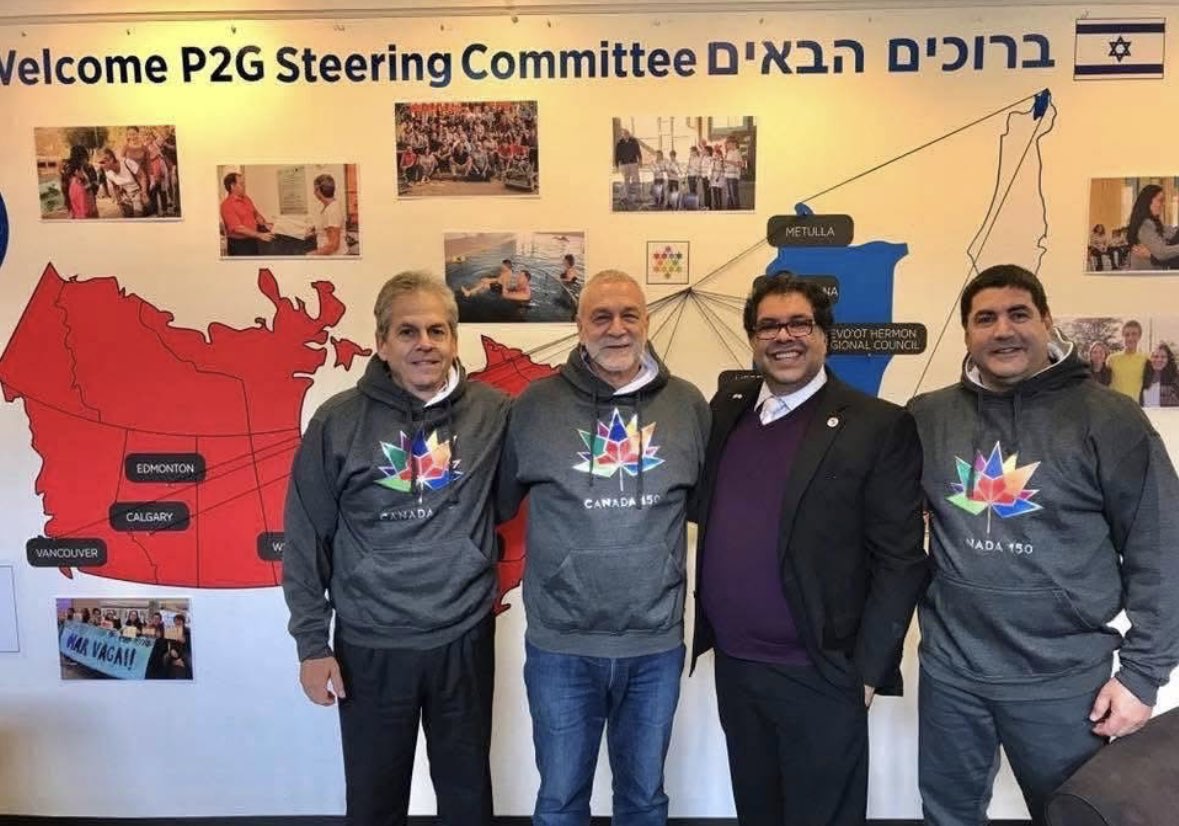
Here's Naheed Nenshi, who is a liar, with a bunch of mayors from Israel. We look forward to your servile apology for this one, too, you fucking hypocrite. #ableg#cdnpoli
British Barrister and International law expert Natasha Hausdorff explains to you exactly what is happening in the Middle East
Under International Law there is no “Illegal occupation” by Israel
None.
Share it, educate
Via @triggerpod
H/t @LiquidFaerie