Clown eggs show how groups can enforce informal intellectual property norms where traditional IP law fails, very relevant to the current challenges with IP in a time of AI.
Paper: https://t.co/8PVlaP19yX
Actual clown eggs: https://t.co/5rtaty5tqh
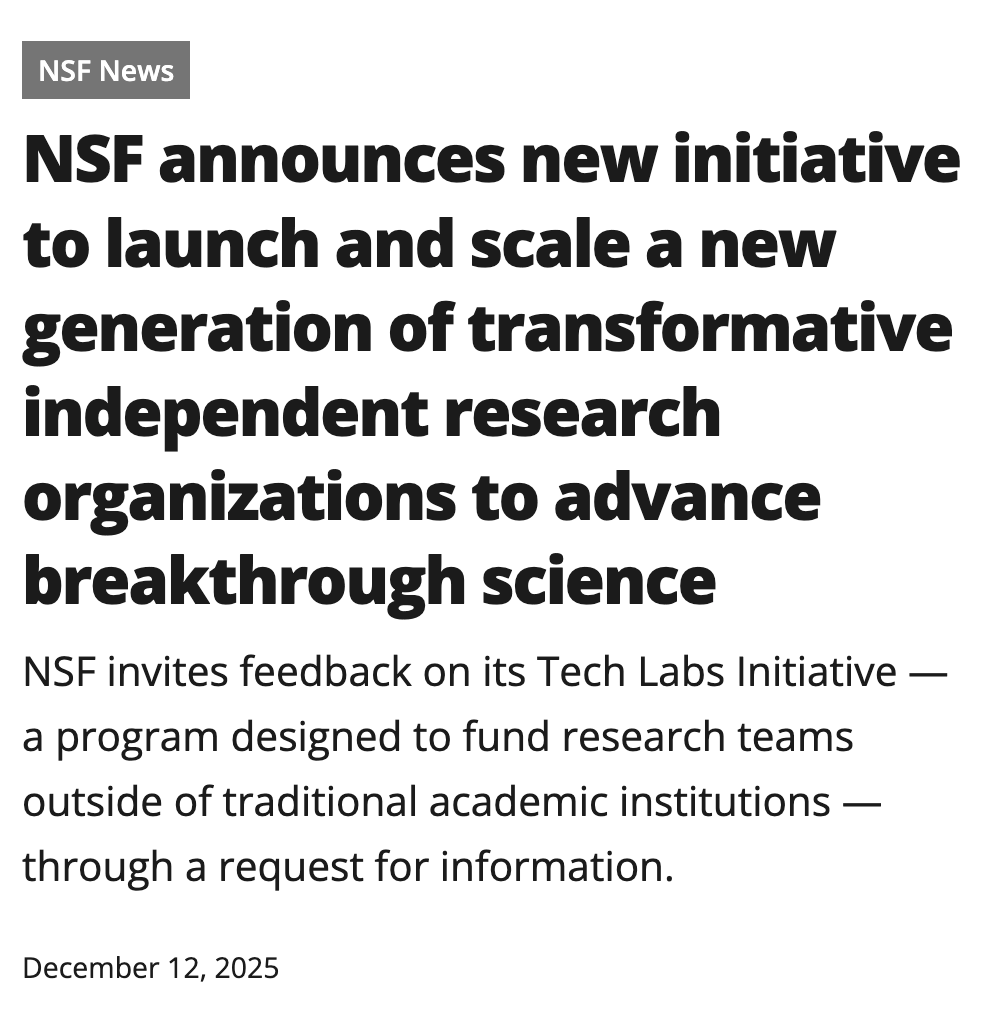
NSF is launching one of the most ambitious experiments in federal science funding in 75 years.
The program is called Tech Labs, and the goal is to invest ~$1 billion to seed new institutions of science and technology for the 21st century.
Instead of funding projects, the NSF will fund teams. I’m in the @WSJ today with a piece on why this matters (gift link): https://t.co/xteQ3NgWVC
Here’s the basic case:
1) Most federal science funding takes the form of small, incremental, project-based grants to individual scientists at universities.
2) The typical NSF grant is ~$250k/year to a professor with a couple of grad students and modest equipment over a few years. This is a perfectly reasonable way to fund some science, but it's not the only way.
3) A healthy portfolio needs more than one instrument. Project-based grants are like bonds: low-risk, steady, safe. But no one trying to maximize long-run returns would put 70% of their portfolio in bonds.
4) Yet that's basically what our civilian science funding portfolio looks like. Around 3/4ths of NSF and NIH grant funding is project-based.
5) Tech Labs is NSF's attempt to diversify that portfolio. The Tech Labs program is aiming for:
- $10-50 million/year awards per team
- 5+ year commitments
- Measuring impact through advancement up the Tech Readiness Level scale rather than papers published
- Up to ~$1 billion for the program
- Supporting research orgs outside traditional university structures
6) Scientific production looks very different than it did when the NSF launched 75 years ago. The lone genius at the chalkboard can only do so much. Frontier science + tech today is increasingly team-based, interdisciplinary, and infrastructure-intensive.
7) The team behind AlphaFold just won the Nobel Prize in Chemistry. It came from DeepMind, an AI lab with sustained institutional funding and full-time research teams. It would be near-impossible to fund this kind of work on a 3-year academic grant.
8) Same pattern at the @arcinstitute (8-year appointments, cross-cutting technical support teams) and @HHMIJanelia (massive infrastructure investments to map the complete fly brain). Ambitious science increasingly needs core institutional support, not a series of project grants stapled together.
9) Similarly, Focused Research Organizations (@Convergent_FROs) have showcased a new model supporting teams with concrete missions and predefined milestones to unlock new funding.
10) There’s a whole ecosystem of philanthropically-supported centers doing amazing research, like the Institute for Protein Design, the Allen Institute, the Flatiron Institute, the Whitehead Institute, the Wyss Institute, the Broad — the list goes on.
11) But philanthropy can’t reshape American science alone. The federal government spends close to $200 billion each year on research and development, an order of magnitude more than even the largest foundations.
12) If we want to change how science gets done at scale, federal funding has to evolve. And the NSF and NIH don’t have dedicated funding mechanisms to support or seed these sorts of organizations.
13) Earlier this year, I started working on a related framework called “X-Labs” that built on all this exciting institutional experimentation that’s been happening within the private and philanthropic sectors. It’s time for the federal government to step into the arena: https://t.co/0iVLobqQeA
14) Traditional university grants are still important for training the next generation of scientists and for certain kinds of curiosity-driven work. But after 75 years of putting nearly everything into one model, we should try something different.
15) And key program details are still being developed! You can reply to the Request for Information with suggestions or feedback on how to design this program here: https://t.co/R6MNo0ZfN1
16) Science is supposed to be about experimentation. Science funding should be too.
My student Michael Cuna is on the econ job market this year. He has an excellent paper showing the impact of the hidden curriculum on educational outcomes, particularly in the case of first-gen students. The paper also demonstrates the potential for AI tools to close these gaps.
Please do not hesitate to reach out to me or the rest of the committee if you have any questions.
Presented at #EASD2025:
In the ATTAIN-1 phase 3 trial, the use of orforglipron, an oral GLP-1 receptor agonist, led to significant mean body-weight reductions in patients with obesity, as compared with placebo. Full trial results: https://t.co/avDbBYKZDr
@EASDnews
This is a huge victory for A.I. Filmmakers across the world. The Copyright Office has officially declared what I've been preaching for so long. Work that has been manipulated and transformed by humans is indeed copyrightable, even if the tools used were rooted in A.I. . This is a big step in the right direction.
Let's move forward & continue breaking boundaries.
https://t.co/JqPo3g98Cs
DeepSeek's first-generation reasoning models are achieving performance comparable to OpenAI's o1 across math, code, and reasoning tasks!
Give it a try! 👇
7B distilled:
ollama run deepseek-r1:7b
More distilled sizes are available. 🧵
Independent evaluations of OpenAI’s o3 suggest that it passed benchmarks that were previously considered far out of reach for AI including achieving a score on ARC-AGI that was associated with actually achieving AGI (though the creators of the benchmark don’t think it o3 is AGI)
"The United States Copyright Office granted a copyright exemption last week that gives restaurants the “right to repair” the [McFlurry] machines by bypassing the digital locks that prevented them from being fixed." https://t.co/Tq4NmaqEQb
There aren't enough smart people in biology doing something boring
https://t.co/MF8FNxDUuY
new argument piece
i often meet a lot of founders in biology pursuing really crazy, revolutionary ideas. i love them! but i wish there were more people pursuing the boring ideas
🧵





![scottlincicome's tweet photo. "The United States Copyright Office granted a copyright exemption last week that gives restaurants the “right to repair” the [McFlurry] machines by bypassing the digital locks that prevented them from being fixed." https://t.co/Tq4NmaqEQb https://t.co/O0rZx3CEyj](https://pbs.twimg.com/media/Ga_hsyQXQAAw9Pt.png)