My latest article is live at @lawfare
“Understanding Al-Shabaab’s Recruitment Pipeline” — 7 years of primary field research inside Mogadishu’s prison system. 300 interviews. 200 military court cases.
The finding that no one expected: Al-Shabaab’s pipeline is not ideology. Not poverty. It is family. In ~200 court cases I reviewed, defendants told a Somali judge the same thing — they joined because their father or uncle was already a member. Two independent evidentiary channels. Same answer.
This has a direct policy implication. Every counter-recruitment program Somalia runs assumes Al-Shabaab recruits through ideology. If the dominant pathway is family membership, these programs are not failing due to poor implementation. They are built on the wrong premise.
There is a generational dimension. Generation 1 joined for money, authority, and revenge against warlord-era figures now in government. Generation 2 — their children — joins because father was Al-Shabaab. There was no other world to grow up in. The motivation changed. The pipeline did not.
This is the first in a series of pieces on Al-Shabaab’s operational architecture — from how it recruits, to how it forms operatives, to how it kills. All from primary field research that no institutional access has replicated.
Thank you @lawfare for publishing this work.
🔗 https://t.co/HXNht29hY6
The delegate in the hotel room, sworn on the Quran, is the base of a structure whose apex is a presidential election purchased by foreign states." Read Bought, held, and sworn, the first of the two long reads. Thanks to @ROAPEjournal for sharing it.
In this piece, Ismail Abukar provides in-depth details on how Somalia’s elective political positions, from parliamentary seats right up to the presidency, are sold and bought by a select few, rather than be subjected to the will of the people.
https://t.co/aC4l9Iu0Xt
Somalia’s parliamentary seats are auctioned before the vote.
275 seats. 275 simultaneous, separate auctions. Each seat has its own pool of delegates, its own clan elder who builds the list, and its own money. On the most contested seats, one delegate’s vote can cost up to $30,000.
The method repeats: an invitation, a dinner, a hotel, an oath on the Quran. A former delegate, speaking anonymously, described what came next: “After that, you are not a delegate anymore. You are a captive.”
I interviewed more than a dozen delegates, candidates and clan elders across the 2016–2017 and 2021–2022 cycles. Then I followed the market upward. The parliament it produces goes on to elect the president.
New in @ROAPEjournal: Bought, held, and sworn. https://t.co/WQbQfdj8oj
#Somalia #Elections #Democracy #AfricanPolitics
Thank you @Pambazuka_News for publishing this. One case in my piece doesn't fit the pattern neatly. @MOALIMUU , a former BBC and Reuters journalist, became a government spokesperson and survived at least five al-Shabaab assassination attempts because of that job. He may have had his own reasons for taking it. Even so, he stayed silent about the colleagues the government later detained. Today he is a member of Somalia's parliament, on the committee that oversees media policy.
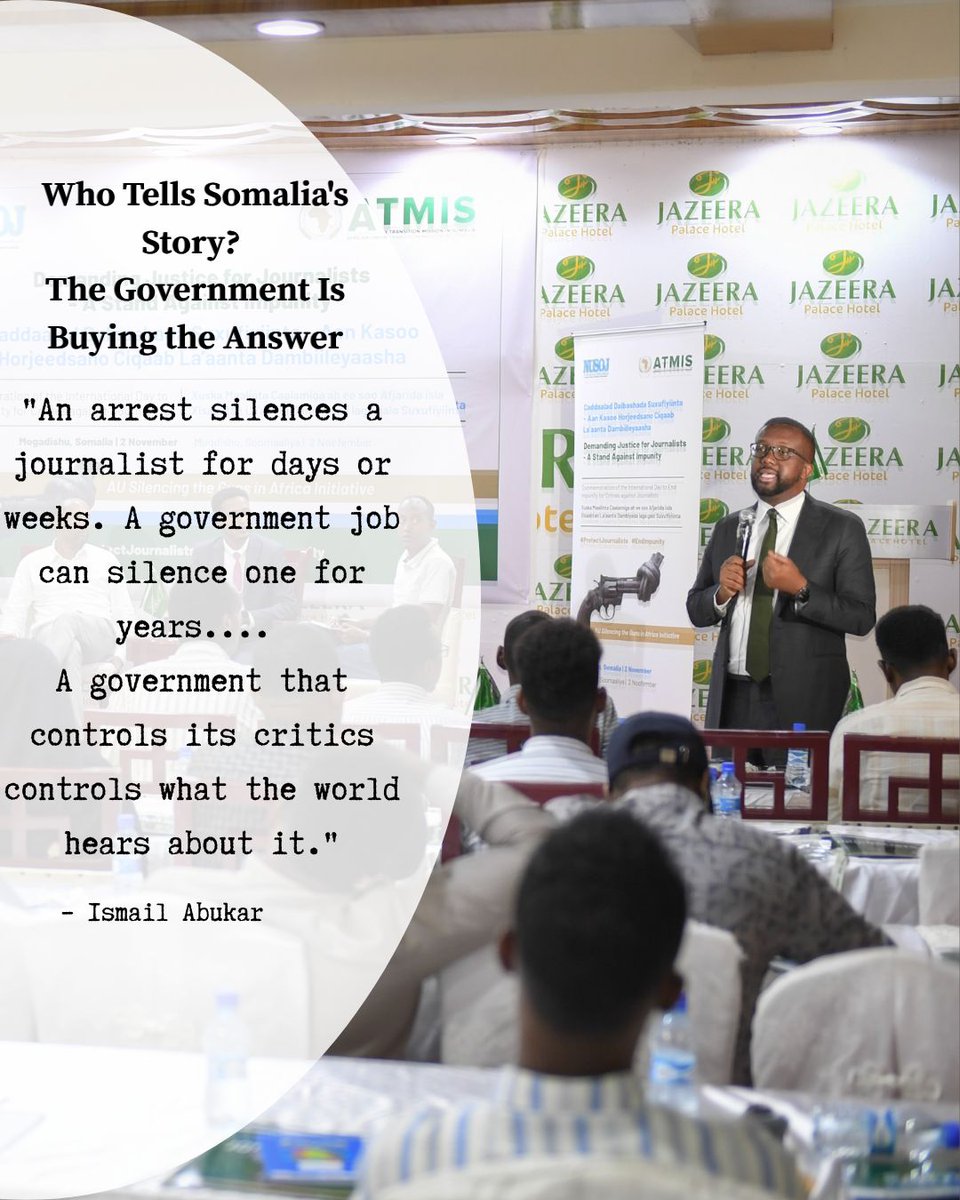
"An arrest silences a journalist for days or weeks. A government job can silence one for years." – Ismail Abukar @Ismailabukar_
https://t.co/G44yPMYTQ1
#Somalia#PressFreedom
Thank you @Pambazuka_News for publishing this. One case in my piece doesn't fit the pattern neatly. @MOALIMUU , a former BBC and Reuters journalist, became a government spokesperson and survived at least five al-Shabaab assassination attempts because of that job. He may have had his own reasons for taking it. Even so, he stayed silent about the colleagues the government later detained. Today he is a member of Somalia's parliament, on the committee that oversees media policy.
"An arrest silences a journalist for days or weeks. A government job can silence one for years." – Ismail Abukar @Ismailabukar_
https://t.co/GNb8YDiFo1
#Somalia#PressFreedom
Somalia’s government arrests journalists. It has also found a quieter method: giving critics government jobs.
Hussein Abdulle Mohamed owned SYL Somalia TV. NISA arrested him in April 2024. In May 2025 he was publicly accusing security forces of night raids on journalists’ homes. In June, Benadir made him its Information Director. By September he was praising the president’s leadership as “100 percent” good.
@golfyare posted a caption in May 2025 about politicians who criticize the government as opposition, then do the same things once in power. Five months later he became Villa Somalia’s communications director. Six days after that, police in Mogadishu detained six journalists. He said nothing.
Not every case fits. Daauud Aways Jama, a longtime BBC Somali journalist, became Minister of Information. CPJ tried to reach him about the 2025 arrests and couldn’t. Al-Caddala is a different story: he came up through state media, so he’s a loyalist rewarded, not a critic silenced. Ali Yare, a government defender, was also given a post.
That’s the point I make in the piece. The job itself guarantees the silence. Hiring a well-known critic isn’t only about gaining a friendly voice. It removes an unfriendly one.
I checked every case against dated records and said where the proof is thin. Full piece for @pambazuka@Pambazuka_News News, with 17 sources:
https://t.co/crBEcS4bqN
@NUSOJofficial@pressfreedom
On 14 October 2017 a truck bomb at the Zoobe junction in Mogadishu killed more than 500 people. Nine years to the day, Judge @shuuteh , who chairs Somalia’s first-instance military court, told a national conference how his own father was killed.
He says Al-Shabaab shot his father at home on 2 January 2018 to stop the trial of a man who once drove for the group’s spokesman. He says he buried his father and went to the next hearing the same day. He did not step aside, and the court stopped announcing hearing dates in advance.
I edited this report and watched the full recording of the speech. Much of the account matches earlier reports. What the killers intended rests on Shuute’s word alone, and the report says so plainly.
By Abdulkadir Isse. Please read it, and share it with anyone who follows Somalia’s courts.
#Somalia #AlShabaab #Mogadishu
His father was shot at home in Mogadishu in 2018. The judge says the killers wanted to stop the Zoobe bombing trial.
Nine years after the bomb, he told a national conference what happened. The motive rests on his word alone, and our report says so.
https://t.co/cXkdxnNQhn
A missile killed at least 12 people at Riyadh's main airport on Saturday, including an American, and wounded more than 300. The airport is shut. Oil is above $100 a barrel. President Trump says the US "may" join the war on the Houthis.
Here is the number that stayed with me. A Patriot interceptor costs about $4 million. The drones it gets used against cost at most tens of thousands of euros, @Bruegel_org 's analysts write. Saudi Arabia is paying millions to stop weapons that cost thousands, and on October 10 one got through.
My policy analysis argues that bombing Yemen is the wrong first move. I propose four things instead: cheaper air defence (interceptor drones that cost $800 to $3,000, per @orfonline ), a UN-checked truce on civilian airports, narrow Congress-approved force if it comes to that, and a plan for Yanbu, the Red Sea port Saudi oil now leans on.
The full analysis, with sources: https://t.co/p8MX2TQYLS
Published by @TheFieldHQ
Togo mines almost no gold. In 2024 it sent 52 tonnes to the UAE, worth about $4 billion, according to Swissaid.
I spent days on one question: why does Africa have about four in ten of the world's armed conflicts (the Red Cross count) but only about four in a hundred of its arms imports (SIPRI)?
The clue I found is that these wars are cheap. Al-Shabaab raises about $100 million a year by a US Treasury estimate, roughly 40% of what Somalia's government collects. Swissaid says gold held by Sudan's RSF leaves through Chad and Libya. If you can tax roads, sell gold and collect ransoms, you don't need a big arsenal.
Youth unemployment? In sub-Saharan Africa it is 8.9%, below the world's 13%. Colonial borders hold up better as a cause than most slogans do.
The UAE's 2024 figures were later removed from the UN trade database, Swissaid notes. I found no UAE response.
Full piece, including what I could not prove: https://t.co/PVddIvV5v6
@ICRC@SIPRIorg@ACLEDINFO@ACAfricaCenter@TheFieldHQ
Twenty graduates, on their way to national youth service, were taken after gunmen stopped two buses in Imo State, Nigeria, on October 1.
Police say they were rescued on October 7. As of October 12 I can find no report of an arrest, and police have not named the gunmen.
A mother told @TheICIR her family paid N6 million. The state police commissioner told Channels TV he knows of no ransom payment. Both accounts cannot be complete.
It is also the second group of youth corps members taken in 36 days, after 15 in Kogi State on August 26. And in May, a freed teacher from the Oriire school abduction in Oyo told ICIR there had been no fighting: the captors took off the blindfolds and chains and told them to leave.
In each case the official line says "rescued" and stops. I asked who took them, and what the police know.
https://t.co/EHTfvNWkke
@TheFieldHQ
October 7. Two residents of Adigrat, in northern Tigray, told @Reuters they saw dozens of soldiers pass through town in two trucks, in off-white uniforms they took to be Eritrean. Reuters said it could not verify it.
The next day Ethiopia wrote to France's foreign minister and, an official said, other UN Security Council members too, calling it an "all-out invasion" that reached up to 60 km into Tigray. Reuters could not verify the depth. On October 10 Eritrea's foreign minister asked the Council to condemn what he called Ethiopia's "declaration of war."
What is actually backed up? @ACLEDINFO says Eritrean forces crossed near Zalambessa and came under Ethiopian drone attack. Analysts at Critical Threats and ISW matched a video of a destroyed truck to satellite imagery near Adigrat, but call any incursion "likely limited."
No neutral body, UN or African Union, has confirmed it. I wrote down what we know, what we don't, and how two former allies got here:
https://t.co/oFjXxLRB5y
@TheFieldHQ
In seven months, from November 2024 to June 2025, Chad's president named three of his brothers to senior posts at the presidency. One has since been replaced. I could not confirm what the other two do in 2026.
One of them, Daoussa Idriss Déby Itno, is the president's personal secretary with the rank of minister. RFI reported he is about thirty and had been made a general when his brother took power in 2021 after their father was killed fighting rebels.
On October 5 I emailed the presidency six questions. The deadline is noon today in N'Djamena. I had no reply when I published.
This is the second country in First Families, a weekly series on which relatives of ruling families hold which posts. 54 countries, one a week. My argument for Chad: publish who holds each post at the palace, and why they were chosen.
https://t.co/suyonMZ7iO
@jeune_afrique@RFI@TheFieldHQ
November 2020. African Union headquarters, Addis Ababa.
On the 3rd, the building was a diplomatic hub. On the 4th, nobody was talking. Delegations vanished overnight. Nobody made eye contact in the hallways. My Tigrayan colleagues, the translators and staff I worked beside, didn't know if they'd be allowed back in tomorrow.
I was there as Somalia's Youth Representative to the @_AfricanUnion
Last Sunday, four leaders signed a pledge of non-interference at Alamein: Egypt, Eritrea, Somalia, Sudan. Two days later, Eritrean troops were reported inside Tigray. Eritrea hasn't confirmed it. I found no evidence the two are connected.
But 2020 is the record these governments have to answer to.
Read: https://t.co/TYUBhR7J8Z
Reporting on the declaration by @AJEnglish Troop reports tracked by @ACLEDINFO@CrisisGroup
#Tigray #Eritrea #Ethiopia #HornOfAfrica #Somalia #Egypt #Sudan
A Somali bus driver was sentenced to six months in prison. He served thirteen years — for a death that turned out never to have happened.
That's one case in my new piece for @Pambazuka_News@FahamuAfrica on how Somalia's Jareerweyne minority are still locked out of the courts, the constitution, and a political system that gives them half the voice of every major clan — a pattern @MinorityRights has documented for years.
https://t.co/lt0Sje2rj9