El año pasado, en este mismo café, me encontré con Ben Horowitz, cofundador de Andreessen Horowitz (@a16z ). Estaba tomándose un café antes de irse a una comida. Me acerqué, platiqué con él y me presenté.
Hoy arranca la @MexicoTechWeek: más de 600 eventos en la ciudad, con fundadores, corporativos e inversionistas. Si puedes darte una vuelta, ven.
#MexicoTechWeek
Last quarter we learned a lot about field operations and the challenge of coordinating work that today happens over WhatsApp, SMS, phone calls, and countless spreadsheets.
We're very excited about the next version of the product.
@pilisuagi@agentcardhq Nice! I also did @neuraan’s explainer video with AI using @higgsfield and @claudeai. It is amazing what you can accomplish these days at a fraction of the cost to do traditionally. I even added Mexican accents. Here is the result:
We promised a pilot in 28 days and it took four months. Operations validated it; the day the annual proposal arrived, leadership paused it. We hadn’t signed a closing plan. Step 3 of the guide is that: write the decision before you start.
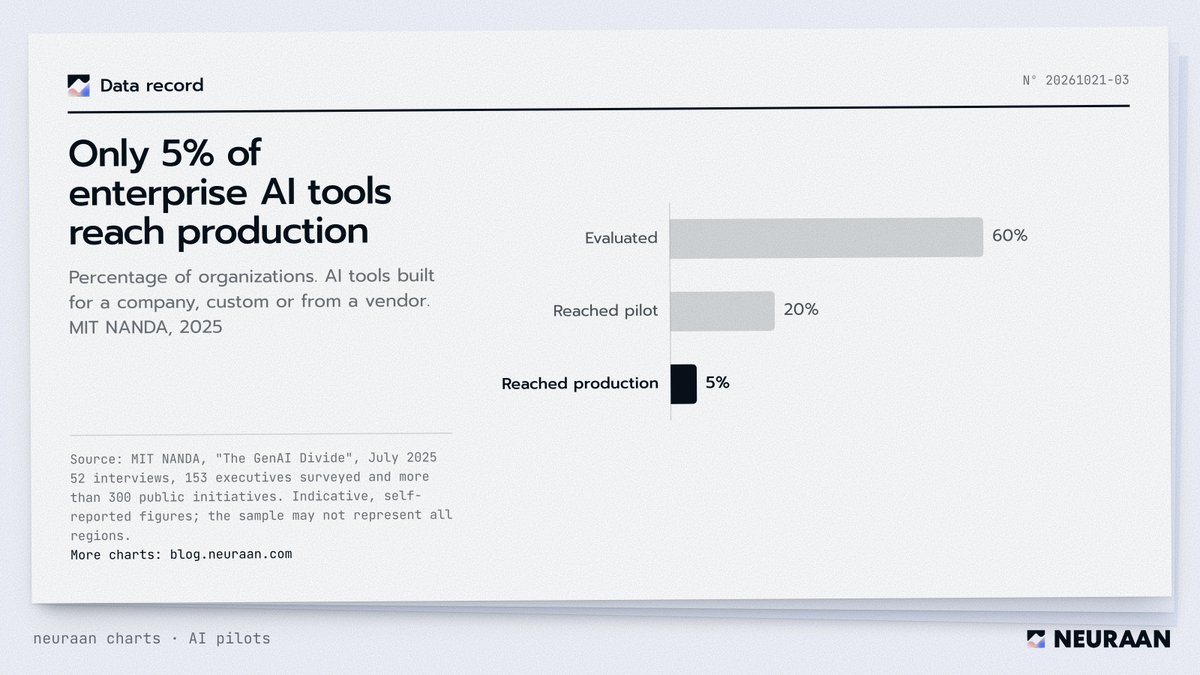
Of every 100 organizations, 60 evaluated an AI tool built for their company. Only 5 took it to production.
In our experience, pilots stall less on the model than on who signed, what was agreed and who checks the work.
Six steps to run one... 👇
I’ll be at @MexicoTechWeek in CDMX, Oct 26-30, to meet COOs, CTOs and CIOs with lots of people in the field: technicians, drivers, crews, route supervisors.
At @neuraan we coordinate field work, the kind that doesn’t happen at a desk. DMs open.
@LuisHCCDev Me imagino que para usos militares será más útil al inicio que para civiles y considero que este es un auto que no será accesible para la mayoría de las personas.
Nobody puts this job on the org chart, but every field operation depends on it: someone chasing each case so the process moves.
We're building agents that carry the case, so she can spend her day on what the rules don't cover.
The script is ours. Characters, scenes and voices are AI.
Field operations run on one person who chases every case: confirms, follows up, asks if it arrived, if it's done.
Neuraan is building AI agents that carry the case in your existing systems. That person decides what the rules don't cover.
Characters, scenes and voices are AI.
I'm amazed about what foundational models now technically allow us to do, and to standout you need passion, ambition, and taste... incredible times to be alive and build stuff that matters.
Dusting off this tweet from April because this gap in shared understanding of LLM capability is *widening*. It's now less "two groups of people speaking past each other" and more a sharp funnel.
- Napkin math somewhere around 6B people (~75% of the population) have barely come in contact with LLMs at all.
- Around 1-2B (~20%) are casual and infrequent users of free-tier ChatGPT-like products. This group sees derpy chatbots and treats them a bit like a better Google search, a writing aid, or etc. Maybe an agent tries to book you a flight. I have non-tech friends who (reasonably, imo) say they have not much use for it at all. Even many professionals outside of math&code are in this tier. For example, execs and many other functions spend a lot of their time talking to other people, so while they understand what is happening intellectually, it is still second-hand and a bit abstract.
- Now we get to professional use of frontier-grade LLMs in math&code. Somewhere around 20M people (0.2%) see first-hand that large, complex projects that used to take them weeks/months can now be completed by agents with a prompt. Building apps, copying apps, translating apps, decompiling apps from binaries... This has all happened very quickly and recently - less than 1 year ago, I was writing code manually by hand, typing memorized computer code commands into a code editor character by character, occasionally pressing Tab to autocomplete a little chunk of code.
- And finally we get to the ~5,000 people (~0.00006%) with access to frontier-grade systems internally. The external world has seen the preview. It looks like swarms of thousands of agents collaborating over weeks on software mega projects: minting zero days, running cyber attacks and defenses at machine speeds, discovering new science, advancing the frontier of mathematics. Things that would have taken top professionals in the industry years of work. Meanwhile, human review and comprehension are starting to fall behind. For example, people are still involved in the "archeology" of the OpenAI-HF incident from many months ago. Mathematicians may be poring over the 722 manuscripts on frontier mathematics for a while.
The funnel is driven by a combination of factors:
1. The impact scales with ambition, problem size, and horizon. A question with a paragraph answer barely stresses the system. You need a reservoir of big, difficult problems that you really care about. This aspect drives the consumer / professional dimension of the funnel.
2. The jaggedness of the system (which I have written about a lot separately). Capability peaks in domains that are digital, verifiable and economically valuable. This is because LLM capability emerges from reinforcement learning on verifiable rewards on a curated environment mixture driven by revenue potential. This aspect primarily drives the area (e.g. math&code) dimension of the funnel.
3. Access. Free-tier, paid-tier, internal.
So this is the weirdness of the moment. The general public has mostly not interacted with these systems. When they have, it looks like a derpy chatbot. The majority of professionals still see only a modest uplift. And a small sliver of professionals are experiencing the vertigo of the curve going vertical. And it is all happening at the same time.