Thrilled to announce my postdoc paper is now out in @NatureComms! Huge shoutout to the KY lab & @kishoreravicha for the amazing support. Special thanks to @RuizdeAlmodovar for your insights, and to @KarinaYaniv for your mentorship and guidance! 🚀
Our latest work on the NeuroVascular Unit is out! New insights into neuronal vs. glia differentiation, Notch3 regulation, BBB formation and more! All spearheaded by the one and only @IvanBassi3 in close collaboration with @RuizdeAlmodovar! 1/5
https://t.co/7BD2qrk97Z
Insane paper alert!
Interferon is the one therapy that can actually deplete the mutant stem cells in myeloproliferative neoplasms, the blood cancers where the marrow keeps overproducing one lineage or another. The standard explanation for how it works was fairly mechanical. It pushes the mutant cells into the cell cycle, they divide, and eventually they exhaust or lose ground. Clean enough to teach. Lama et al. pulls it apart, and it can do that because of a set of single-cell methods that read out the mutation, the transcriptome, the surface proteins and the chromatin in the same cell, so the healthy stem cells sit inside the same patient as a built-in control, right next to their mutant neighbors.
What they see is that interferon does not do one thing to a stem cell, it does two opposite things at once. Part of the stem pool is driven into an inflammatory myeloid progenitor state nobody had really described before, running on AP-1 and NF-κB. Another part is pushed toward lymphoid output. That lymphoid arm is easy to overlook, but it seems to be doing the clinical work, offsetting the myeloid overproduction that defines the disease, which is likely why counts normalize even in patients whose mutant fraction barely moves.
Interestingly, the result that carries the paper is a negative one. If fitness ran on proliferation, the clones cycling fastest under interferon should be the ones whose fate you could predict. But the mutant cells cycled faster than the healthy ones throughout, before treatment and during it, and that gap predicted nothing about which clones expanded and which collapsed. What predicted it was whether a clone would follow that inflammatory myeloid path out of the stem state. The ones that resisted held on or grew. The ones that went along got cleared.
So the drug is not really wearing the clone down. It is holding open an exit from the stem cell state, and resistance amounts to declining to take it. The mutations tilt the cell's transcription-factor wiring, PU.1 in particular, so mutant and healthy cells read the same interferon signal differently, and the mutant ones tend to sit tighter in the stem compartment…and the same resistance signature turns up in DNMT3A clonal hematopoiesis, so it is probably not tied to one mutation or one disease. If a clone survives by refusing to differentiate, killing it is beside the point. You would have to take the exit away, so it has to leave the stem state whether it resists or not, and I don't know what that looks like yet, or how much of this same quiet sorting runs in ordinary aging marrow where no one is being treated at all.
@AnnaEnim@landau_lab and many more rockstars!
#MyeloproliferativeNeoplasms #Hematology #StemCellBiology #SingleCell #Interferon
Nature Genetics, https://t.co/r7ODgE9avp
Dream team around Inbal Shainer @IShainer (now Assistant Professor at @TechnionLive) and JJ Kappel report on 66 neuron types in the zebrafish tectum and how their transcriptional profiles are linked to function and morphology. Buckle up for a wild ride!
https://t.co/ftnAXqhLPf
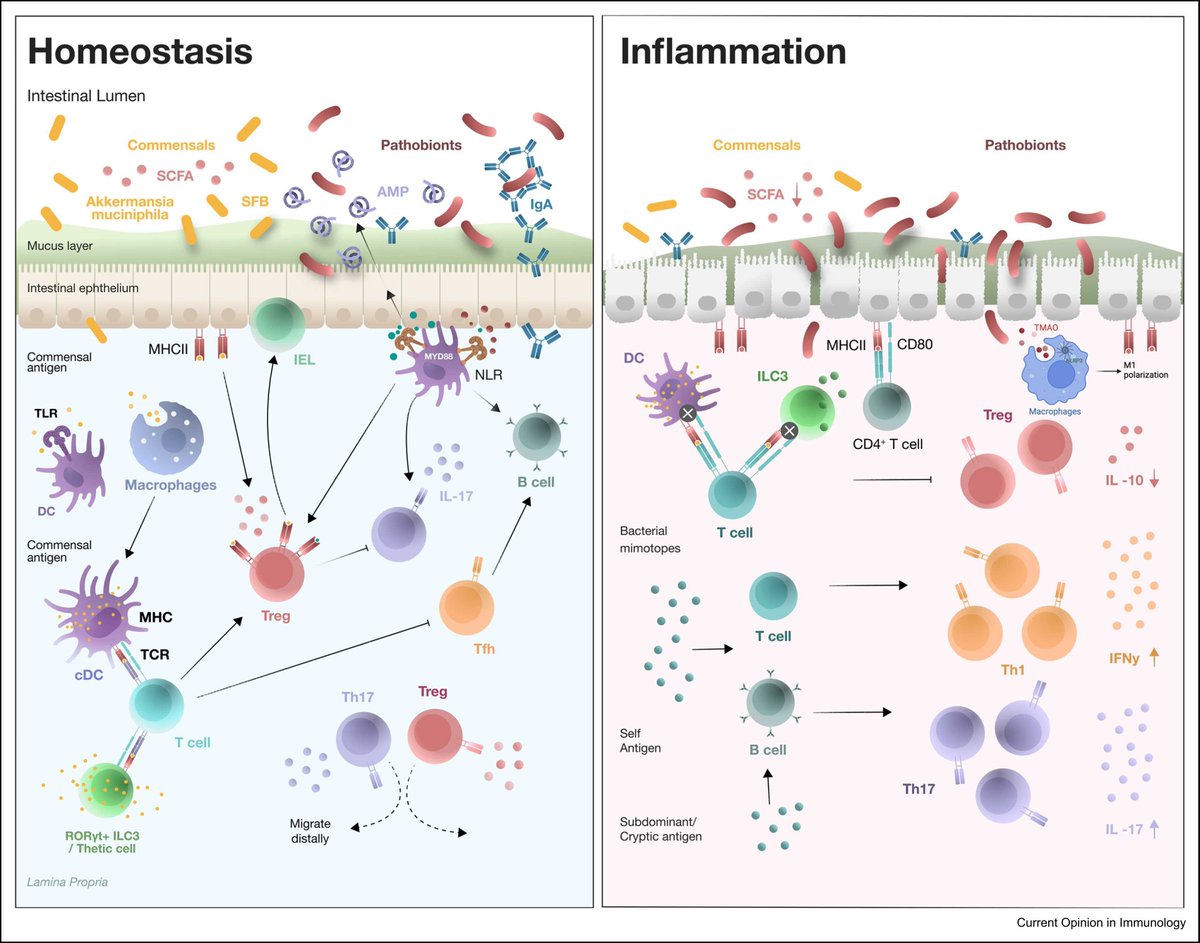
Ever wondered how the microbiome controls antigen presentation in immunity? Check out our review on the latest developments in the field
@Elinav_Lab@gayatree620@asokan_sahana_ & Yiming He
https://t.co/WN0Xkj7KlP
Amazing work from the Gur lab at @WeizmannScience! What a beautiful use of @ZebrafishRock to understand crystal biology! Congratulations @DvirGur and team!
Do catch @Giuseppinalamb8's poster at #IZFC2024
She has led our project on Inferior Vena Cava (IVC) development at @KarinaYaniv lab. Through imaging & lineage tracing in #zebrafish, she provides insights into many unresolved issues in human IVC dev.
Session on 18th, poster 112
Happy to be speaking tomorrow together with Bong-Ihn Koh @bikohcello! Great opportunity to discuss our new works on Neurovascular interactions and Lymphatic Malformations, both led by the great @IvanBassi3👏. I'm super nervous to be presenting these for the 1st time!! @yaniv_lab
Happy to share the first @yaniv_lab entry into the fascinating world of lymphatic malformations! @IvanBassi3 took a mutation identified by our collaborators all the way to a zebrafish screen and found surprising results! More details soon!! https://t.co/QgpbgTnLDk
It’s submission day! Congratulations to @IvanBassi3 who bravely decided to come back to the lab in spite of the difficult circumstances, to finish his fantastic 2nd paper! I am so proud and grateful for your hard work and dedication! Stay tuned for the pre-print soon! @yaniv_lab
Dear friends,
I started fund raising to support my family in surviving and rebuilding back their lives
I could use your help reaching my fundraising goal. Every single share and donation makes a difference. https://t.co/2KTElZnWDY
Haemoglobin is also produced outside erythrocytes 😮. Chondrocytes, that are well known for developing under avascular conditions, produces its own haemoglobin and survives the hypoxic environment.
Amazing discovery and extensive work!
[1/2]
https://t.co/tgz7ohEya1
New preprint alert📢
Brain vascular abnormalities are at the root of serious cerebrovascular diseases like strokes & dementia. In this work, led by @IvanBassi3, we investigate the mechanisms regulating Neurovascular unit (NVU) development & integrity
@KarinaYaniv@IRB_Department
New preprint alert📢
Brain vascular abnormalities are at the root of serious cerebrovascular diseases like strokes & dementia. In this work, led by @IvanBassi3, we investigate the mechanisms regulating Neurovascular unit (NVU) development & integrity
@KarinaYaniv@IRB_Department
New paper alert 📢! The first @yaniv_lab venture into the brain territory, led by @IvanBassi3 with huge input from @RuizdeAlmodovar. What a ride it has been! Not easy to explore new lands, but so rewarding🤩. Tweetorial coming up soon- Feedback welcome🙏
https://t.co/PQiQbmWQxU
Next on our @Sys_Immunology morning event, an awesome talk by @NobsSamuel@Elinav_Lab on the intersection between immunity and metabolism (surprisingly, no microbiome!..) great job Sam!
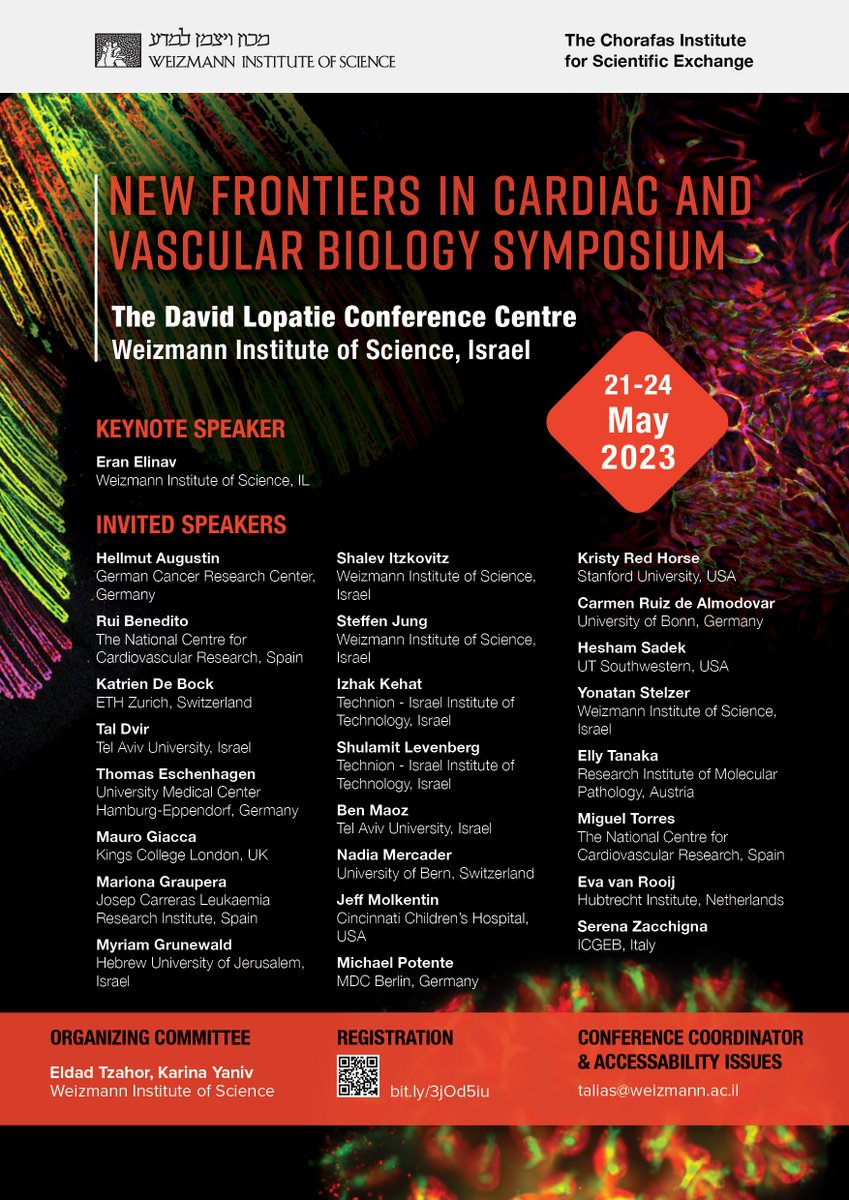
"When cardiac met vascular..." surely sounds like a meeting you don't wanna miss! We have a fabulous lineup of speakers from two fields that don't get to meet often. Join us in Israel to talk heart, vessels, and everything in between! Registration is free! Details 👇 @Tzahore