This is the best way to use Claude Fable in Claude Code without immediately hitting your limits.
1. Model set to Fable 5
2. Reasoning on Max
3. Instruct Claude to run a dynamic workflow where:
3a. Fable is the orchestrator
3b. Opus does the reasoning heavy phases
Fable is so overpowered that you don't need its intelligence for every step.
Let it orchestrate Opus or even Sonnet.
Si eres Programador Web y usas IA... ¡Instala esto!
Agent Skills de Addy Osmani (de Google) para:
✓ Rendimiento Web
✓ Mejores prácticas
✓ Accesibilidad
✓ SEO
Para React, Vue, Angular, Astro o lo que uses.
$ npx add-skill addyosmani/web-quality-skills
CHINESE GIRL WITH CLAUDE 5.0 JUST DROPPED THE FULL 31-MIN TRADING BOT BUILD GUIDE
(Build Apps & Automations)
bookmark it and watch when you've got 31 quiet minutes, you will forget what losing manual trades are forever.
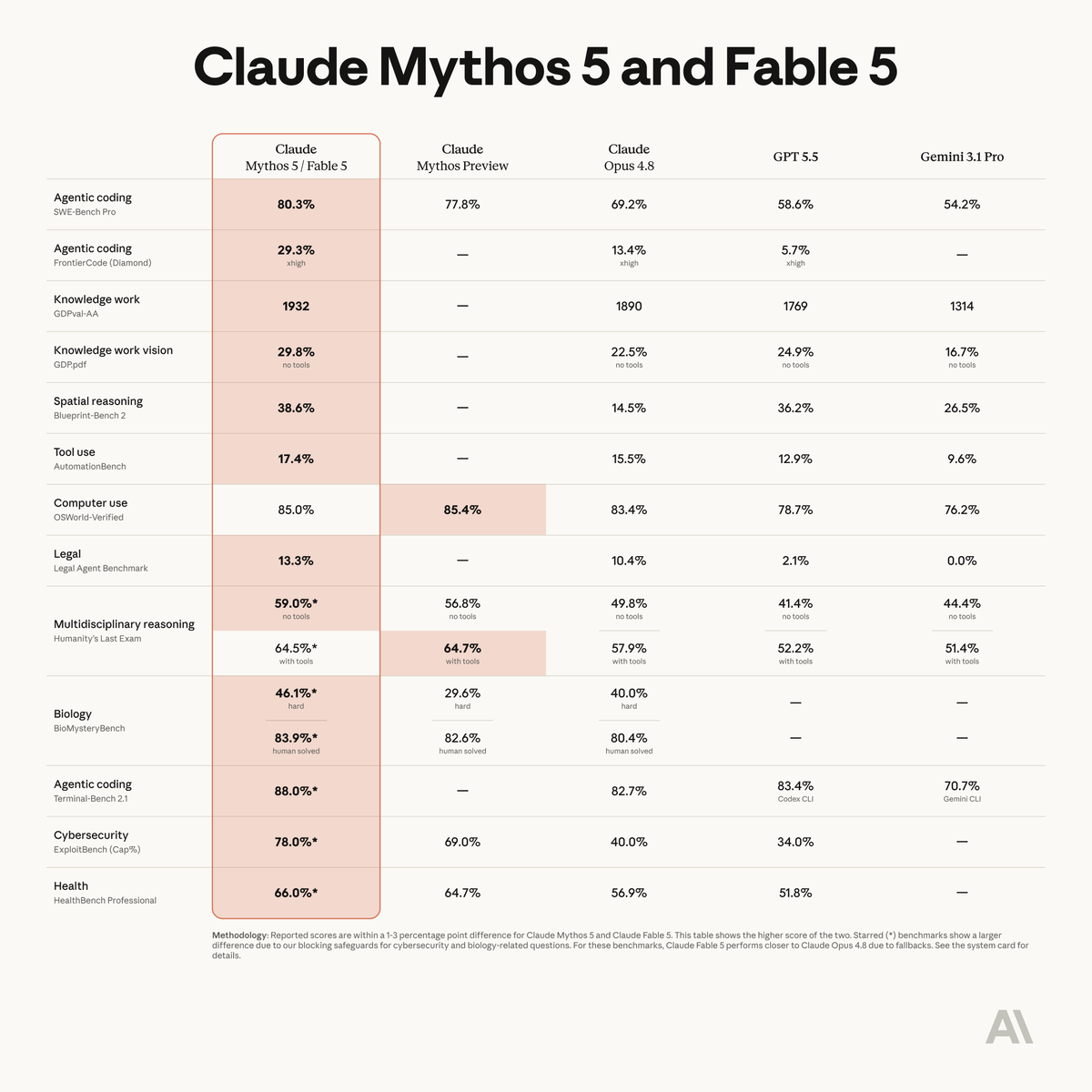
Fable 5 is state-of-the-art on nearly all tested benchmarks, with exceptional performance in software engineering, knowledge work, scientific research, and vision.
The longer and more complex the task, the larger Fable 5’s lead over our other models.
The rumored ChatGPT superapp could be huge.
From what’s being reported, OpenAI may be moving toward one unified app that brings together:
• ChatGPT
for thinking, writing, planning, research and everyday AI assistance
• Codex
for coding, debugging, building apps and automating developer work
• Atlas browser
for browsing the web, understanding pages and taking actions online
• Computer use
where GPT-5.6 level agents are way above human baseline on real desktop tasks
If true, this is much bigger than another chatbot update.
It means ChatGPT becomes the central AI operating layer for work.
You don’t open 10 different tools anymore.
You open ChatGPT and it helps you think, browse, build, click, automate and act.
Claude Code can now run an entire PhD-level research pipeline by itself.
it runs a 10-stage workflow from blank page to publication-ready PDF, replacing the work of a PhD advisor, three peer reviewers, and a copy editor in one repo.
→ Deep research with 13 agents (PRISMA + systematic review)
→ 12 agents write the paper section by section
→ 5-person peer review (Editor + 3 Reviewers + Devil's Advocate)
→ Integrity agent catches fabricated citations + stat errors
→ Final output: LaTeX → PDF, ready to submit
After the paper is finalized, it runs a Collaboration Quality Evaluation that scores YOU, across 6 dimensions, 1–100. Direction setting, intellectual contribution, quality gatekeeping.
It tells you exactly where you were the bottleneck.
Drop it into .claude/skills/ and the whole pipeline auto-loads. Works in Claude Code, Cowork, and as a Claude Project.
100% open source. CC-BY-NC 4.0.
ChatGPT is getting better at remembering what matters: your preferences, constraints, and the context that helps you pick things up where you left off. And with memory summaries, you can review and steer what it remembers.
Rolling to all users over the next few weeks, starting today with Plus and Pro users in the US.
for anyone asking where to learn this stuff:
• RAG → https://t.co/4bzbUIwV5g
• Agentic RAG → https://t.co/IotOiGmV1Y
• AI Agents → https://t.co/nEeMnVJQbk
• Multi-Agent Systems → https://t.co/pavDPVJEFj
• LangGraph → https://t.co/3miEqqFzF0
• LangGraph (code) → https://t.co/v7kxHZXqba
• MCP → https://t.co/lKawRb4etX
• Memory Systems → https://t.co/LSaT2UaPAS
• Evals → https://t.co/vxChxa1kqQ
• Context Engineering → search "Context Engineering Survey" on arXiv
and please skip the "build an ai agent in 10 minutes" videos
build something, watch it fail, then figure out why.
even phds are still coding like cavemen while terminal ai is literally printing 3% gains per minute
if you are still copying and pasting into cursor you are decades behind the real automated money
the exact setup that cuts out the middleman and lets you deploy polymarket bots from zero to live
TIL: You can optimize any agent (cli) with GEPA to automatically optimize your prompts.
GEPA accepts any `(str) -> str` callable, it works with your own custom CLI, local models, or API agents. Wrap your agent in a python function and let it self-optimize.
Role-specific plugins in Codex are built around the work teams actually do.
Plugins for Data Analytics, Creative Production, and Product Design give Codex the tools and context to create reports, creative directions, and prototypes.
Built and used by OpenAI teams.
New full-stack A2UI demo ✨
Upload a PDF, ask a question, agent picks from 21 react building blocks and builds the UI on the fly, using your design system.
Built with LangChain & CopilotKit.
https://t.co/w4RqKOv9aT
Un contable de 35 años de China dejó su trabajo y pasó un mes entero aislado trabajando con Claude.
¿El resultado? Ganó 45.000$ en un solo día.
Tras unas 300 horas de trabajo minucioso, tenía listo un algoritmo de trading para Bitcoin.
Si sigue a este ritmo, podría superar el millón de dólares en un solo mes.
Su wallet:https://t.co/c2LYYjVct4
Eligió el nombre de usuario **nsh91qaz**, una referencia irónica a su año de nacimiento, 1991, una edad en la que mucha gente cree que ya es demasiado tarde para darle un giro a su vida.
Pero él lo hizo.
Probé su estrategia mediante un backtest utilizando Claude y Nautilus a través de PyPI.
Los resultados me sorprendieron de verdad: la lógica general es relativamente fácil de entender para cualquiera.
La verdadera ventaja competitiva está en los números y en el modelo que hay detrás. Eso es lo que, supuestamente, permite generar hasta 45.000$ al día basándose únicamente en cálculos matemáticos.
Simulé todas y cada una de sus operaciones y analicé cada transacción al detalle: 75 mercados operados, 72 ejecuciones, una tasa de acierto del 85,1 % y un ratio Sharpe de 4,21.
Todo ello ejecutado sobre el simulador de bróker Nautilus Core, utilizando 41,8 GB de datos históricos almacenados en formato Parquet y procesados con DuckDB.
Según el análisis, cada operación sigue un ciclo perfectamente definido y cada dólar ganado procede de aprovechar ineficiencias del mercado.
No intenta predecir el futuro: el modelo matemático ya incorpora toda la información necesaria. Su trabajo consiste en interpretar correctamente los datos y ejecutar las operaciones.
Modelo ensemble optimizado para pérdida de Brier:
* 400 trees
* Learning rate: 0,03
* Validación walk-forward
* Ratio Sharpe: 4,21 ± 0,08
Guarda esta publicación si de verdad quieres aprender cómo construir algo parecido.
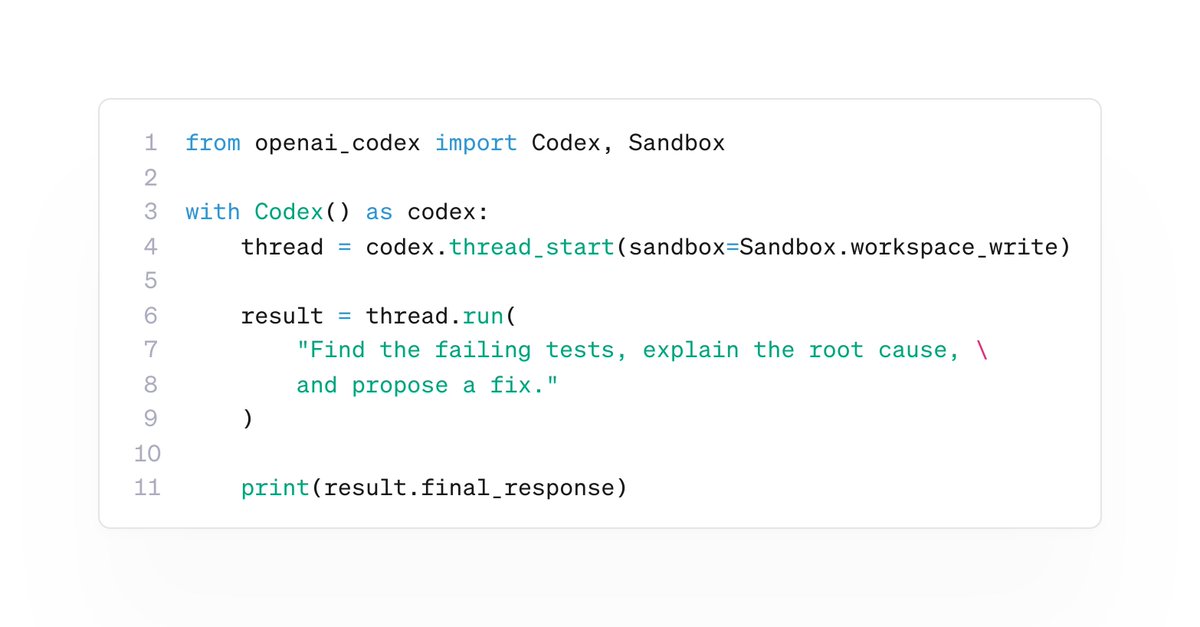
We just released the Codex Python SDK 🔥
You can now embed Codex directly into your Python apps and workflows!
> Start threads
> Run turns
> Stream progress
> Resume sessions
> Pass images
> Control sandbox access
All whilst reusing your existing Codex auth.
pip install openai-codex
Go build with it!!
CURSO COMPLETO EN ESPAÑOL PARA EMPEZAR DESDE CERO CON CLAUDE CODE.
Proyectos reales, automatización y todo su potencial.
Paso a paso. Con ejemplos prácticos.
Guárdalo antes de que lo necesites. ⬇️