In our new review, we discuss how aiming for the best answers leads to inconsistent perception: https://t.co/2fQYkNIBnf In this digest, I will present some examples. The first is that the Brentano illusion affects the length (green) of a line, but not the endpoints (blue) (1/5)
There’s still time to join!
From 7–15 February, learners around the world are dedicating time to strengthen #Python skills.
It’s self-paced, beginner-to-advanced friendly, and supported by the community on r/neuromatch Reddit.
➡️ Take the pledge: https://t.co/1UemT01oFC
Weet jij allang op wie je gaat stemmen, of ben je nog in dubio? Om het je zo makkelijk mogelijk te maken, hebben we de tien beste redenen om op GroenLinks-PvdA te stemmen verzameld. Lees, deel en stem voor een links, progressief kabinet!
https://t.co/ErxiCYWFij
OUT NOW in @EJNeuroscience
Reaching Distance Influences Perceptual Decisions - Assarioti @EAssarioti
Jeroen Smeets @JBJSmeets and colleagues
@FENSorg @WileyNeuro
https://t.co/mkISYfKE7Z
OUT NOW in @EJNeuroscience
Reaching Distance Influences Perceptual Decisions - Assarioti @EAssarioti
Jeroen Smeets @JBJSmeets and colleagues
@FENSorg @WileyNeuro
https://t.co/z7P8bzDU8M
#VU_BW is excited to welcome Florentina Hettinga as our new department head by October first. At the same time, we'd like to thank departing department head @DieenJaap for his leadership and curiosity
✨ 📽 Imagine you're a professional football player. You dribble, kick, and score. But how does that work in your brain? @pmedendorp and Leonie Oostwoud Wijdenes provide you an unique look at the Sensorimotor lab in this video: 👉
https://t.co/VsDS65TCzA
Happy :) to be a co-author with @ninavanmastrigt, @Katinka3D, @JBJSmeets and Bernadette van Wijk. Many, many circles & inspiration from all authors led to this paper on reward-based motor learning!
https://t.co/kRhqK3OzxB
Poetic summary by Nina&me in the thread!
#one_tweet_a_day
#VU_BW@Katinka3D, @JBJSmeets, Joyce Burgers en een fantastische groep studenten onderzochten in @NEMOamsterdam hoe succeskansen motorisch leren en #motivatie beïnvloeden. Kijk de video om te zien hoe dat ging! https://t.co/XdVjJocRBO
Door onnadenkendheid is wetenschappelijke nauwkeurigheid soms niet meer dan schijnprecisie.
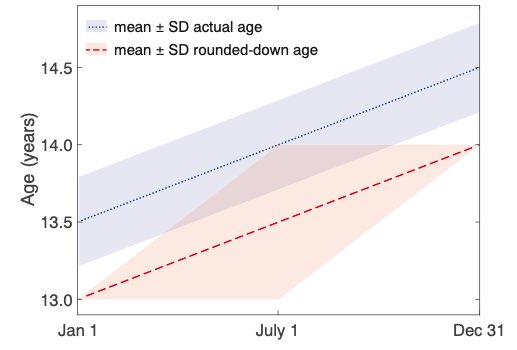
Originele studie van @JBJSmeets over hoe leeftijd van proefpersonen systematisch een half jaar te kort gerapporteerd wordt.
https://t.co/lvIrGyRoZ0
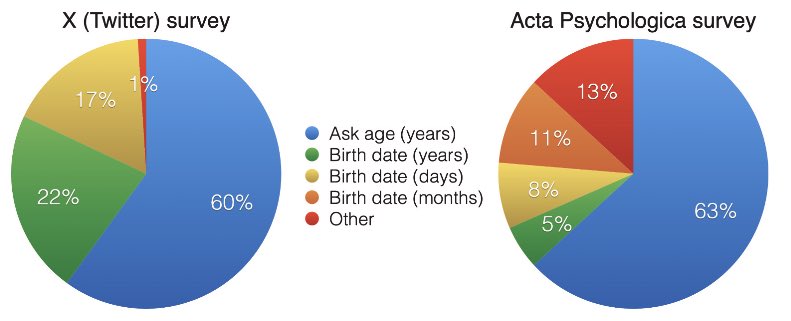
The responses to this tweet made it to the scientific literature in my paper on the bias and precision of reporting the average age
(https://t.co/OlHdnaJJcT).
Please retweet! A question for those who have human participants in their research. How do you determine the age of your participants (with which resolution)?
Scientists have a peculiar way to report the average age of their human participants. They suggest they know this average with a few days precision, but introduce a half year bias. Read about it in my short paper https://t.co/OlHdnaJJcT Thanks to all of you who answered my poll.
Voor NRC mocht ik voor “Jong Geleerd” een interview geven over mijn proefschrift (doi: 10.5463/thesis.619). Waarom worden meer mensen wagenziek in zelfrijdende auto’s? En is er een manier om dat op te lossen?! Antwoorden op die vragen lees je hierin terug: https://t.co/OrItDe8dBe
🔔🔔🔔 Triton heeft Varsity gewonnen! Daarom speel ik om 21.00 uur Tritonlied op de carillon van de #Domtoren#Utrecht! 🔔🔔🔔Varsity: winst voor vrouwen van Orca en mannen van Triton https://t.co/n95KED3ams #rtvutrecht
Please retweet! A question for those who have human participants in their research. How do you determine the age of your participants (with which resolution)?
This is an elegant experiment using a new task (grasping thin objects using a precision grip) to find out how grasping is controlled. The answer: "the digits-in-space hypothesis provides the most plausible account of the data". Worth reading!