Texas receives over 1,000,000 TWh of energy from the Sun every year.
Over the past 12 months, solar PV captured ~0.006% and provided 16% of all electricity.
Dear Secretary Bessent @SecScottBessent,
My name is Everett Stern. In 2010 I was a compliance officer at @HSBC. From a back office in New Castle, Delaware, I watched billions of dollars move to drug cartels, sanctioned regimes, and terrorist organizations. The enemies of the United States. I documented it, I escalated it, and when the bank would not act, I took it to the @FBI, the @CIA, and eventually the @SECGov.
The result was a $1.92 billion settlement. At the time, it was one of the largest in American history. It was also about five weeks of the bank’s profit. Not one banker was charged. Not one went to prison.
I paid a different price. I lost my career, my savings, and my place in the industry I had trained for. I was blacklisted. Every door in American finance closed at once. I slept on a camping cot in a 300 square foot apartment because I could not afford a bed, and I waited tables at @PFChangs to eat. I tell you this not for sympathy, but so you understand that I know exactly what it costs to do the right thing in American finance, and exactly how little the system does in return.
I made that sacrifice because I believed it would change something.
Yesterday, your department fined @BankofAmerica $1.2 billion for failing to report more than $5 billion in suspicious transactions, some of it tied by your own findings to Chinese laundering networks, narcotics, and the southwest border, alongside 475 apparent sanctions violations touching Russia, Iran, and global terrorism. The bank admitted it willfully violated the Bank Secrecy Act.
Fourteen years after HSBC. A bank with “America” in its name. And once again, not one individual charged.
Secretary Bessent, I want to say plainly what I believe you already know. The fines are not working.
A fine is paid by shareholders, absorbed by the balance sheet, and forgotten by the next earnings call. Bank of America reported earnings this morning. Nobody who set the alert thresholds, nobody who decided the 2024 cease and desist could wait, nobody who chose the backlog over the law will lose a single thing they value. Their lives are untouched. That is the entire reason the behavior repeats.
This is money laundering. This is blood money. Money that reaches a cartel buys fentanyl that kills Americans. Money that reaches a terrorist organization buys the next attack. This country has fought a war on drugs and a war on terror for decades, at enormous cost in lives and treasure, and all the while we have allowed the financing to flow through institutions we charter and regulate. Cut off the money and we win. We have never seriously tried.
There is also a question of equal justice that I cannot let go.
Before I walked into the FBI building to report HSBC, I stopped in front of the Great Seal on the wall and read the words engraved beneath it: “Justice is the defense of our liberty.” I believed that. I still want to. But every day in this country, people go to prison for crimes that are nothing next to moving money for the people who want Americans dead. A suit, a title, and a corporate badge should not be a shield from the consequences that apply to everyone else. If a street dealer goes to prison for what he sells, the banker who moved the cartel’s money should be standing next to him.
I also want to raise something that is rarely said in these conversations. Why has no one inside Bank of America come forward the way I did? The answer is that everyone in American banking knows what happened to me, and to the whistleblowers who came after. The last person who spoke up is the only policy anyone believes. That is a culture problem, and it starts with leadership, in the banks and in the agencies that regulate them.
This is not a political issue. It has spanned administrations of both parties. It is a national security issue, and I am asking you to treat it as one.
Three things would change the math overnight.
Refer individuals for criminal prosecution. Not the analyst in the queue. The executives who set the thresholds and chose the risk. One banker in handcuffs would do more than every fine in Treasury’s history combined.
End “too big to jail.” An institution cannot be too big to fail and too big to jail at the same time. If it is the first, it must be held to a higher standard, not a lower one.
And if Bank of America will not act as America’s bank, review its charter. A national charter is a privilege granted on behalf of the American people. It should be conditioned on not moving money for the people trying to kill them.
Secretary Bessent, you said yesterday that these actions send a clear message that even the biggest institutions are not above the law. With respect, the institution was never the problem. The people inside it are above the law, and they know it. Until that changes, I will keep writing letters like this one, and the next bank will keep paying the next fine.
I gave up everything I had to stop this. I am asking you to use the power you have to finish it.
Respectfully,
Everett A. Stern
HSBC Whistleblower
Founder and Intelligence Director, Tactical Rabbit
@DerechaDiarioMX Recordemos que Baja California es gobernado por Morena y Tijuana también. Ustedes votaron por esto y se les advirtió. Y ahora se quejan?
Atomic Machines has invented the first deeply new manufacturing technology since… 3D printing?!? They can make important micro-scale electro/mechanical devices that are otherwise impossible. The first product is a breakthrough power relay that will be important to data center scaling and electrification generally. (You might think switches are a solved problem—but they very much are not… until now.)
Proud to be an investor and board member, and proud to have known @jeffholden for more than a quarter century. Jeff and team Atomic Machines are wicked smart and grind as hard as anyone I’ve ever met.
We will almost certainly use PrimeSwitch on Overture, where it will enable digital power control with significant weight savings.
Things you learn in Texas:
1. The guy in the F-150 is worth a lot more than the dude in a Mercedes.
2. The small business owner from a state school is smarter than the majority of Ivy League grads.
3. There’s more racism in Connecticut country clubs than in rural honky-tonks.
4. Rednecks are more honorable than investment bankers.
5. The man who looks like he can’t afford the tab could buy the building.
6. They don’t ask for a deck before the meeting.
7. Prep school is where they send the problem kids.
8. If he’s wearing dusty boots, a 2XL Magellan shirt, a gold Rolex, and has a bulletproof case on his iPhone 12, you’ve already lost the negotiation.
9. “How’s business?” is a real question. “What do you do?” is a New York question.
10. Tips are bigger and egos are smaller.
11. A handshake still closes deals that a term sheet would kill.
12. The wealth is in real estate, oil, or a company nobody in Manhattan has ever heard of.
13. Your wife or daughter will never struggle finding help to change a tire.
14. Nobody asks where you went to college.
15. A weekend invitation to their ranch makes you part of the family.
Approximately 54% to 60% of Mexico’s entire electricity grid relies directly on natural gas imported from the United States. Washington just demonstrated that it can cripple Mexico within 72 hours at will.
The arbitrary 20% reduction in U.S. natural gas exports to Mexico was executed precisely as American production reached an all-time high in July 2026. One could be forgiven for thinking this is a veiled message designed to signal absolute leverage.
While the domestic commentocracy naively invokes "long-term supply contracts," as if assuming the Trump administration doesn't treat contractual legalisms as irrelevant, the structural reality is that half of Mexico's national grid hangs by a Texan pipeline valve.
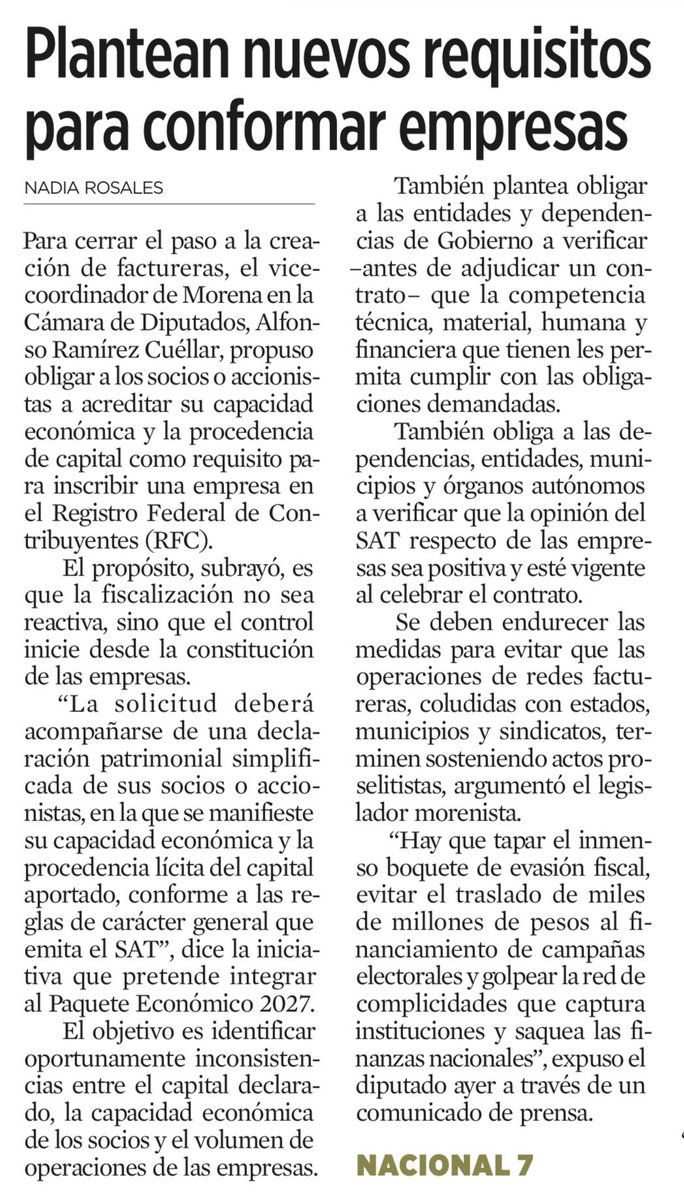
El riesgo para la inversión extranjera no es que México pregunte de dónde viene el dinero. Eso ya ocurre en cualquier operación seria. El riesgo es otro: que el @SATMX pueda valorar si los socios tienen “capacidad económica” suficiente y relacionarla con cuánto puede facturar su empresa.
La iniciativa contra factureras propone declarar patrimonio y origen del capital al inscribir una sociedad en el RFC, e incluso restringir CFDI cuando su monto exceda “notoriamente” la capacidad económica de la empresa o de sus accionistas. Pensemos en una startup, un fondo o una sociedad vehículo: pueden nacer con poco capital y después recibir millones en inversión o deuda perfectamente lícita.
Combatir empresas fantasma exige trazabilidad, beneficiarios reales y probar materialidad. Pero patrimonio del accionista y capacidad económica de la empresa no son lo mismo. ¿Queremos detectar simulaciones o terminar convirtiendo la riqueza previa del inversionista en una especie de permiso administrativo para crecer?
Glaciers in Switzerland experienced "extraordinary" ice loss in 2026, losing 5.5% of their total volume in a single year due to warmer temperatures and lower snowfall rates, a recent report found. https://t.co/kszuhukiux
Theo Von: “Do you think the American Dream is still alive?”
Zohran Mamdani: “It feels like you have to luck out in some big way. In many ways I feel like it’s why a lot of people play the lottery. For many it feels like their only chance. People think they have better odds playing the lottery than making it in their own life. What does that say about the country we live in?”
Natural gas at Waha, the pricing hub of West Texas, traded below zero for 90 days in a row this year. Producers paid buyers to take it, since the Permian Basin made more gas than its pipelines could carry.
Most of that gas comes up with the oil, so the wells keep producing it at any price. Waha prices were below zero on 99 days by mid-June, against 49 in all of 2024.
The Hugh Brinson pipeline started on June 13, and the price turned positive three days later.
This is one of several startups using robotics and standardized designs to vastly accelerate installation of utility-scale solar. Modules are so cheap, they're only a fraction of solar capex now. Attacking installation costs is a huge lever. Innovation to make clean energy cheaper hasn't stopped.
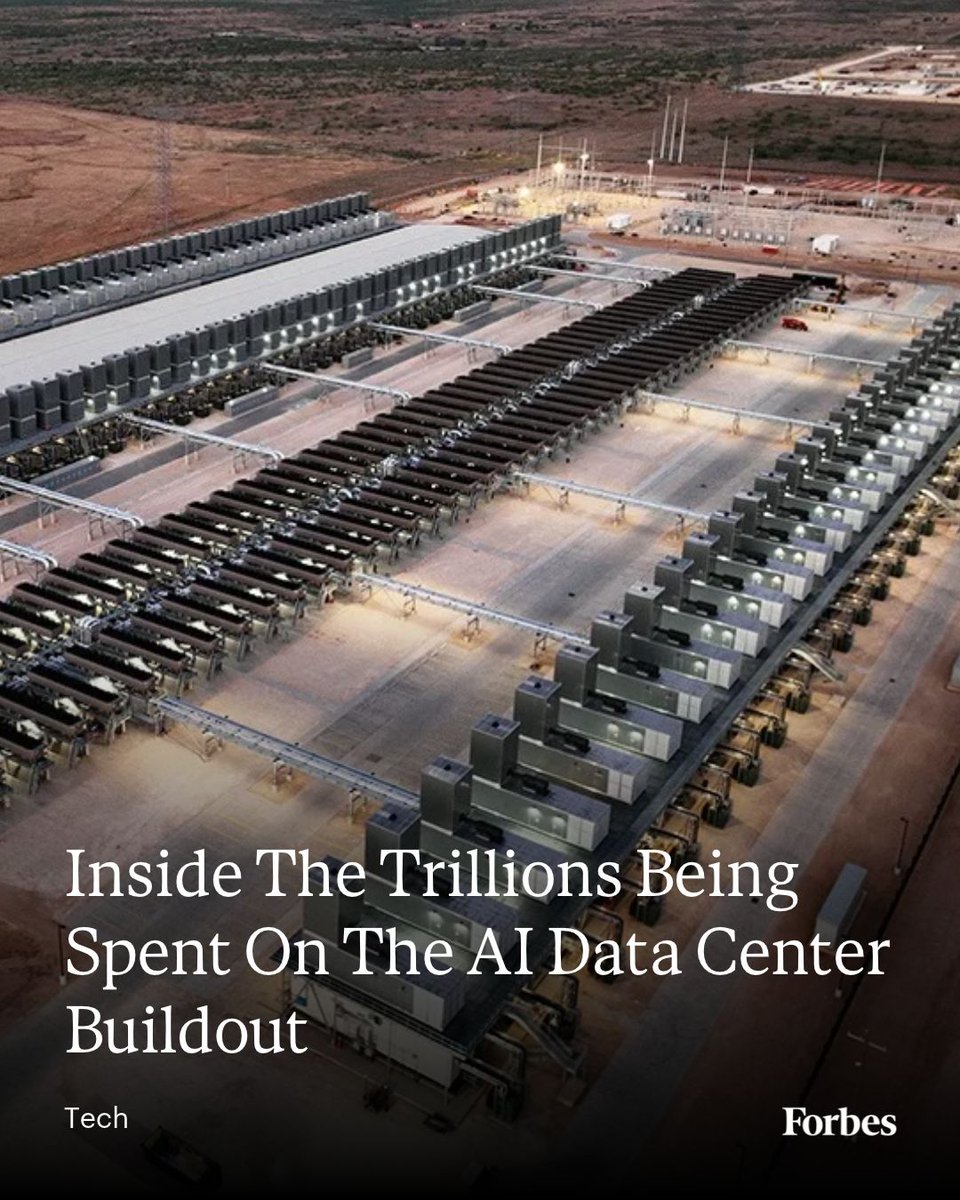
The U.S. is racing toward an infrastructure boom that could cost upwards of $10 trillion and surpass the railroad mania of the late 1800s by as early as 2028. Here’s where all that money is being spent on land, power, water and cement—and who stands to benefit.
Read more: https://t.co/rTWE2ExALL
📸: Clayco
I recommend people read Time's interview with Trump to get a sense of the president's grave cognitive impairment. Trump is either unwilling or unable (or maybe both) to answer the questions he's actually asked, so he just rants and raves while the interviewers do their best to provide structure to his random brain firings. https://t.co/wUBAQYBGjd