@MarcAndreChart1@pilliarscreatio Maybe his mood is caused by narrowly missing his chance to land on the Moon with Apollo 17 because of his helicopter crash.
@barbylon @LarryNittler Selenology was a popular term for studying lunar geology in the 50s and 60s. There were those who didn't like calling it geology because they weren't studying the Earth sensu stricto. Futility was realized when the term for studying rocks would have to be different for each body.
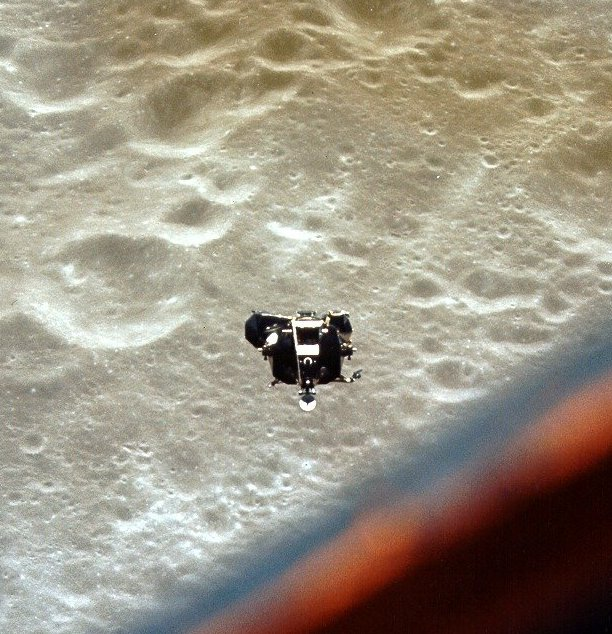
@ninjaneergirl Snoopy has pioneering space for a long time too. It was the callsign of the Apollo 10 LEM, which paved the way for Armstrong and Aldrin. Let's hear it for the dogs!
September 22, 1971: The syndicated daytime TV talk program "The Phil Donahue Show" welcomes Frances Poppy Northcutt, a mathematician and engineer at Houston's Manned Spacecraft Center, to talk about careers for women in space science and technology.
@pilliarscreatio This is a two-frame panorama (frames A17-143-21836 and A17-143-21856) taken by Jack Schmitt at Station 9. Gene Cernan is seen twice in this picture, hammering a double core tube and bringing it back to the rover. Taurus Littrow, EVA 3, 13/12/72.
September 17, 1962: In Houston, NASA introduces the second group of astronauts who will pilot many of the future Gemini and Apollo missions. They are Neil Armstrong, Frank Borman, Ed White, John Young, Jim Lovell, Jim McDivitt, Tom Stanford, Pete Conrad and Elliot See.
Come join a great team of astromaterial and planetary scientists at Washington University, St. Louis. Apply for a tenure-track assistant professor faculty position specializing in the study of the formation and evolution of planetary systems. Apply at https://t.co/lM75jojVUK