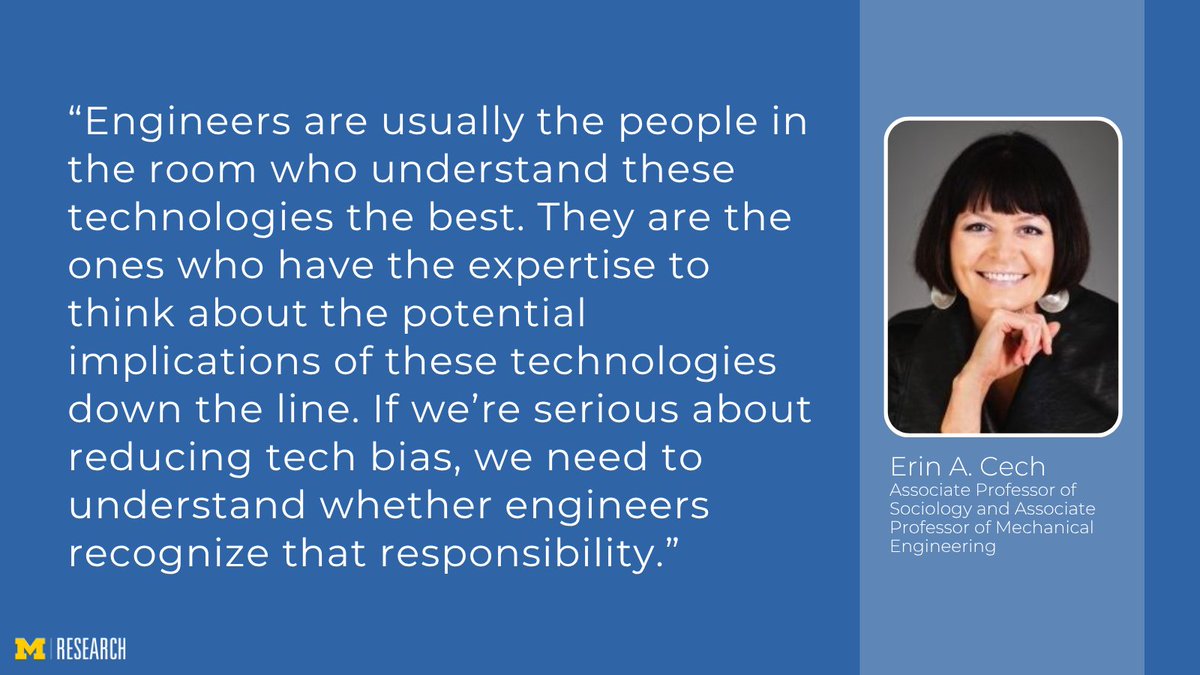
AI is transforming how people work, communicate and make decisions. @UMich professor Erin A. Cech investigates how engineers think about technology bias and the intended and unintended ways technology can reinforce or amplify social inequality. https://t.co/YO9Y6idkYb
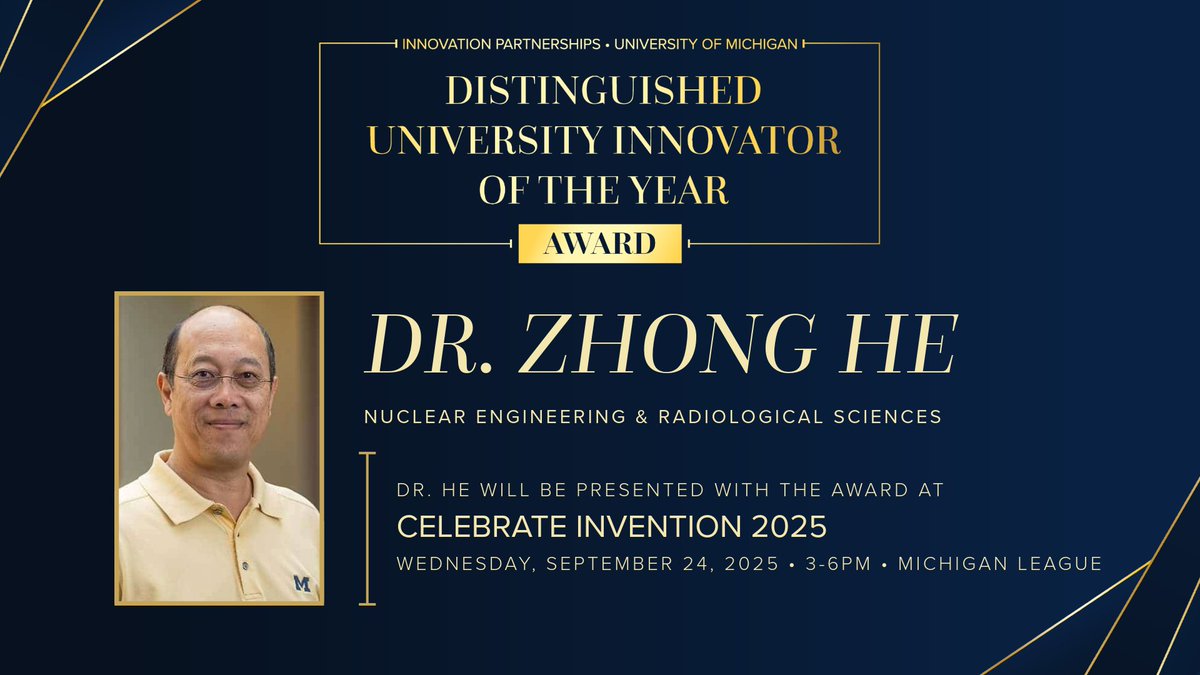
.@UMengineering’s Zhong He has won this year’s Distinguished University Innovator of the Year award. He is a professor of nuclear engineering and radiological sciences, and will receive the award at Innovation Partnerships' Celebrate Invention on 9/24. https://t.co/Z5kbAcLm0f
NEW ARTICLE: “Tumor-destroying histotripsy, explained by its co-inventor: A Q&A with Zhen Xu University of Michigan startup HistoSonics was acquired this week for $2.25 billion. https://t.co/AComrim3xA
NEW ARTICLE: “University of Michigan startup Ambiq goes public.”
NSF-funded research led to ultra efficient chip used in wearables and medical devices. https://t.co/qwF5YwZDLn
NEW ARTICLE: “How to revive American shipbuilding: A Q&A with Matthew Collette.”
American shipbuilding rusted away in the 1970s and ’80s. Congress and the White House want it back, but how do we do it effectively? https://t.co/eNLopVjvKX
U-M is building a community of research around cystic fibrosis. These interdisciplinary collaborations have drawn participants from nine different units across campus, highlighting U-M’s strength in both engineering and medicine. Read more: https://t.co/1tk5bjL30Q
Student athletes with ADHD more susceptible to concussion: U-M researcher discusses
When athletes who have attention-deficit/hyperactivity disorder get concussions, their ADHD disorder may prolong recovery, researchers think.
A recent study in the Journal of Athletic Training has examined this theory. It found that high school athletes with ADHD who experience a concussion also experienced prolonged recovery in returning to learn and returning to sport. The researchers also found that women and younger athletes experienced a longer recovery.
Steven Broglio is a professor of kinesiology, neurology, and physical medicine and rehabilitation at @UMKines, and director of @UMichConcussion. He joined a roundtable discussion hosted by the National Athletic Trainers’ Association to discuss the research.
Can you give a brief context of the study and your discussion for us?
The study evaluated the length of recovery among concussed high school student-athletes, finding that those with ADHD had a slightly longer timeline. These studies are important as we think about concussion as a biopsychosocial injury, with risk and recovery influenced by the injury biology, the psychology of the athlete (e.g., ADHD) and the social structure around the athlete (e.g., team/family support).
What were the primary study findings?
Between 4% and 8% of young athletes have ADHD. Athletes with ADHD often present with multiple risk factors for prolonged concussion recovery, which makes it difficult to isolate the effect of ADHD. Athletes with ADHD are more susceptible to multiple concussions, exhibit more severe acute symptoms, and typically have at least one coexisting condition. While the effect of ADHD has been debated extensively, there’s no clear clinical consensus on how to optimize patient recovery.
This study analyzed the recovery outcomes of student athletes from 60 high schools between 2010 and 2018, tracking the recovery of 553 males and 382 females. It found that ADHD was a significant predictor of prolonged recovery to both return to learn and return to sport. Athletes with ADHD were about 1.16 times longer to return to learn and 1.17 longer to return to sport.
The study also found that female athletes and younger athletes were also more likely to have a longer recovery. Women took about 1.13 times longer to return to learn and 1.07 times longer to return to sport. Younger athletes experienced longer recovery, but each year they gained in age decreased recovery days by 0.98.
Why are student athletes with ADHD more susceptible to concussions, and why would they have more acute symptoms?
It is believed that those with ADHD are less likely to pay full attention to their environment and other players while participating in sport. In those instances, they may not appropriately brace for or avoid a head impact that results in a concussion.
What should athletic trainers or health care providers understand from this study?
Athletic trainers are typically the front line health care providers for active individuals. As each concussion is unique and specific to the athlete, athletic trainers are best equipped to provide an individualized approach to concussion management that is unique to the athlete.
In light of the study findings, health care providers need to recognize #ADHD as a risk factor for prolonged concussion recovery. Given the significance of sex-based and age-related differences, individualized approaches to #concussion management should be prioritized to optimize recovery outcomes.
NEW ARTICLE: “Enabling stroke victims to “speak”: $19M toward brain implants to be built at U-M.” Marcus Foundation’s $30 million gift supports a collaboration between Stanford and U-M to help stroke victims regain the ability to read, write and speak. https://t.co/KRt3YRNDgD
Animatronics, puppetry, water jet cutting?
Yes, and lecturing, managing a staff, and laser cutter maintenance. All things that Alyssa Emigh takes on, and more.
We again congratulate Alyssa on earning the @UMengineering Staff Excellence Award this year.
Use this link to watch an interview highlighting Richardson’s journey and experiences going from the segregated South to becoming a trailblazer in U-M Engineering history: https://t.co/xSu7EwPExQ (2/2)
While we celebrate the 110th anniversary of our department this fall, we look back on the alumni who helped pave the way. Today, we would like to highlight Barbara Richardson (‘77), the first Black woman to graduate from the U-M Aerospace Engineering Undergraduate Program. (1/2)
NEW ARTICLE: "The corona is weirdly hot—Parker Solar Probe rules out one explanation." S-shaped bends in the sun’s magnetic field don’t form at the sun’s surface, like some scientists thought, and can’t directly heat the sun’s corona. For full story 🔽 https://t.co/0q1XDPZdRY
NEW ARTICLE: “Not quite ready for autonomous taxis? Teledriving could be a bridge.” If drivers could choose any available car as a starting point, ride-hailing services could become cheaper as energy and labor are used more efficiently. Image for story 🔽 https://t.co/XtNhF5Tf0H
Congratulations GCI Faculty Affiliate Dr. Joshua Jack and GCI staff member Dr. Stephen McCord and colleagues on their exciting new findings!
#co2#carbonmangement#carbon#carboondioxide
https://t.co/36zs2HY8QM
I am incredibly excited to announce that I will be joining the University of Michigan as an Assistant Professor of Chemical Engineering @UMichChE, joint in the Life Science Institute, staring in January 2025! Go Blue! https://t.co/zUHgZH1Rmr