I worked on Siri at Apple and couldn't reliably use it. My stutter eases when I whisper, so I wanted a microphone that could hear me at that amplitude, no matter where I was. That's what sparked VOX.
This isn't just for the 1% of us who stutter. It's for MouthPad users living with weak voices, and for anyone who wants privacy when they talk to their computer.
We're convinced that speech is a key part of the future of human-computer interaction, but today it only really works in a quiet room, with nobody around. So we rebuilt the keyboard around a stethoscope: VOX picks up your voice through your body, rather than the air in the room, so a whisper still gets through when everything around you is loud. Private, robust, always available.
I'm a big believer in agentic workflows, but my fear with more and more agents is that we become slaves to the screen. My hope is that, through well-designed interfaces, we untether ourselves from the desk and reclaim an hour under the sun.
Beyond feeling comfortable using voice AI in public, and actually being able to use it, it's changed how I work. Over the past few months I've gone from under 8K steps a day to 15K+ on average, since I can now work on the go even when it's noisy around me.
Universal design is the key to effective human-machine interfaces. Designing for the most constrained is how you make something better for everyone.
Introducing VOX: a microphone you wear on your skin, made for private dictation.
Works with low-volume speech (even whispers) and in loud environments.
Remappable buttons for your shortcuts.
La vibe entre les Coréens 🇰🇷 et les Mexicains 🇲🇽… FRANCHEMENT C’EST MAGNIFIQUE. 🤩
Les vidéos qu’on voit partout c’est trop cool !
C’est ça le football Mesdames et Messieurs. 🥰⚽️
ENSEMBLE 🤝✊
Real-time World Models are the next AI frontier.
Today, we @reactorworld are taking the first step towards this reality: our early preview lets you experience worlds generated in real-time, running on our global low-latency infrastructure.
Try it now: https://t.co/YojJ5qVDrG
ROMPIENDO LA BARRERA DE LAS DOS HORAS.
REESCRIBIENDO LA HISTORIA.
Sebastian Sawe gana la Maratón de Londres con un tiempo de 1:59:30 y establece un nuevo récord del mundo. Yomif Kejelcha también baja de las dos horas en su debut. Marcianada.
🏃♂️ Lo has visto en @Eurosport_ES y @StreamMaxES. #LondonMarathon
If you pitched this as a screenplay, every studio would reject it for being too on-the-nose.
Fernando Mendoza was a 2-star recruit ranked 2,149th in his high school class. Zero FBS scholarship offers. Not one. He walked on at Cal, fought for a starting job, transferred to Indiana for his senior year, then led them to 16-0 and the first national title in school history. Heisman, Walter Camp, Maxwell, Davey O'Brien, Manning, Big Ten MVP. 41 TDs, 72% completion, 8-to-0 TD-to-INT ratio in the playoffs.
The Raiders took him #1 overall Thursday night. $54.56M fully guaranteed. Only the third player ever to win the Heisman, win a national championship, and go first overall the next spring. Burrow. Newton. Mendoza.
Then he skipped Pittsburgh.
The biggest stage in football, the moment every kid imagines from the second they pick up a ball, and Fernando watched the call from his living room in Florida because his mom Elsa is in a wheelchair and the travel is hard for her. She was diagnosed with MS when he was 4. She wrote a letter to her sons in The Players Tribune in 2015 promising the disease "won't affect us in the ways that matter."
The part nobody talks about: while every other top pick was on stage, Fernando announced the Mendoza Family Fund the same day. $500K personal donation to the National MS Society. Committed to raising $1M over three years. He hasn't taken an NFL snap and he's already given more to a cause than most players donate in a full career.
He and his brother Alberto have already raised $360K through the Mendoza Bros. Burger at BuffaLouie's in Bloomington. At Christmas, he handed four families dealing with MS $10,000 each for an Adidas shopping spree.
Both his parents are children of Cuban refugees who fled Castro. His dad rowed at Brown, won a Junior World Championship in 1987, and played high school football in Miami next to a teammate named Mario Cristobal. Fernando beat his dad's old teammate in the national championship game in January.
Every athlete talks about playing for their family. Fernando actually did it.
We see you, @NASAEarth
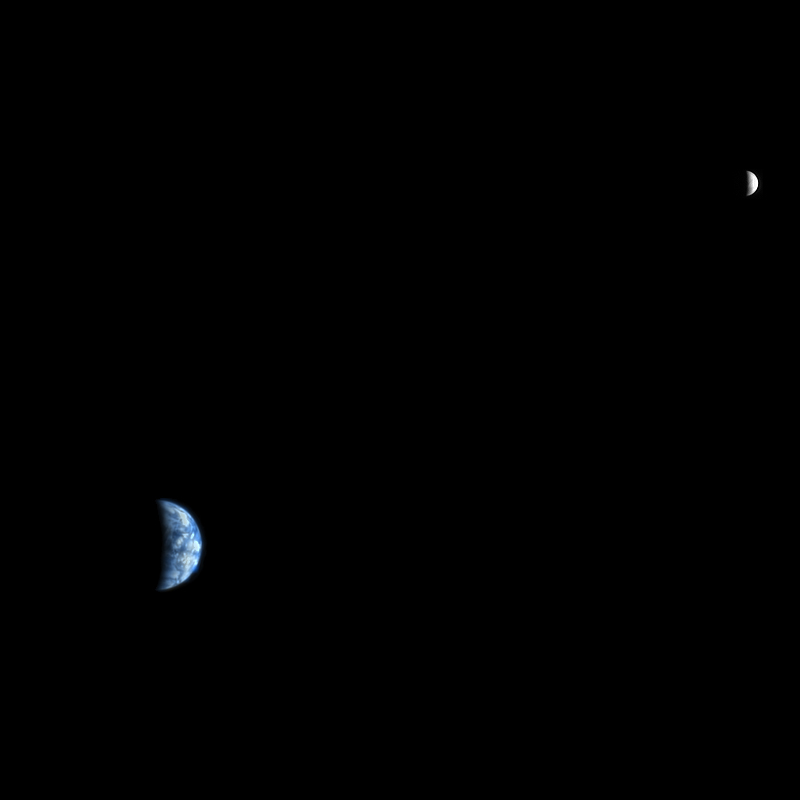
Here's a view of the extraordinary Blue Planet and its moon, taken by the HiRISE instrument aboard the Mars Reconnaissance Orbiter. Happy Earth Day!
Earthshine.
Artemis II astronaut Christina Koch captured this video of Earth outside the windows of the Orion spacecraft during the second flight day of the mission. Orion was roughly 33,800 miles (54,500 km) away from Earth when @Astro_Christina took this video.
Your last flight hit maybe 600 mph. Tonight four astronauts hit Earth's atmosphere at 25,000 mph. Forty times faster. NASA needs them at 17 mph by the time they touch water off San Diego. The engineering behind that slowdown is one of the best stories I've come across.
It comes down to one piece of hardware: a 16.5-foot shield bolted to the bottom of the capsule, made of 186 blocks of a heat-absorbing coating called Avcoat on a titanium frame. When the capsule hits atmosphere, those blocks burn away on purpose, carrying heat with them so the crew sits at 75°F inside while the outside hits 5,000°F, roughly half the temperature of the sun's surface. And there is no backup for this system. NASA builds redundancy into everything else on the spacecraft. Not the shield.
I have to tell you what happened last time because it makes tonight way more interesting. In 2022, NASA flew this exact shield on an uncrewed test called Artemis I. When the capsule came back, chunks had cracked off in over 100 spots. Way worse than any computer model predicted. Took two years and over 100 lab tests to pin down why.
The answer is sort of beautiful in a nerdy way. During that 2022 reentry, the capsule did a "skip," dipping into the atmosphere, bouncing back out into space, then diving in again. The problem was the bounce. When the capsule floated back out, the outside cooled, but the inside of the shield was still scorching. Gases trapped in the coating had nowhere to go because the cooled outer layer sealed shut. Pressure built. Cracks formed. Pieces blew off. Apollo engineers in the 1960s were aware of this exact gas-venting issue. But when NASA remade the coating for Orion decades later, they accidentally made it less breathable.
The fix for tonight is my favorite part. They kept the same shield; it was already bolted on, and swapping it would've added 18 months. Instead of changing hardware, engineers changed the flight path. Tonight's capsule does a shorter, shallower bounce, keeping steady heat on the shield so gases can escape properly. Same shield. Different math.
One detail from a January safety review gave me real confidence. Engineers modeled total shield failure, coating stripped clean off. The titanium frame underneath could still protect the crew on its own. A physics professor at Northeastern said she'd personally feel safe riding in it because with a system this simple, there are only so many things that can go wrong.
By tonight, these four people will have gone 252,756 miles from Earth, farther than any human ever, beating Apollo 13 by over 4,000 miles, at the fastest speed a human has ever moved. And the moment the capsule hits the Pacific, a diver will swim underneath and photograph the shield, giving NASA its first real proof of whether the new math worked.
no center compositions (avoids putting subject in gutter on a 2 page spread), each half of the photo has it's own composition, obeys rule of thirds, understands negative space has compositional weight that has to mirror subject's if image is divided in half. this is incredible
The eclipse from Orion.
On April 6, external cameras attached to the Orion spacecraft's solar array wings captured the Moon backlit by the Sun during a solar eclipse.