Figuring how proteins work in their native state, using super-fancy solid-state Nuclear Magnetic Resonance
PD @MeiHongLab @MIT
PhD @MarkusWeingarth @UniUtrecht
So proud of this team🤩
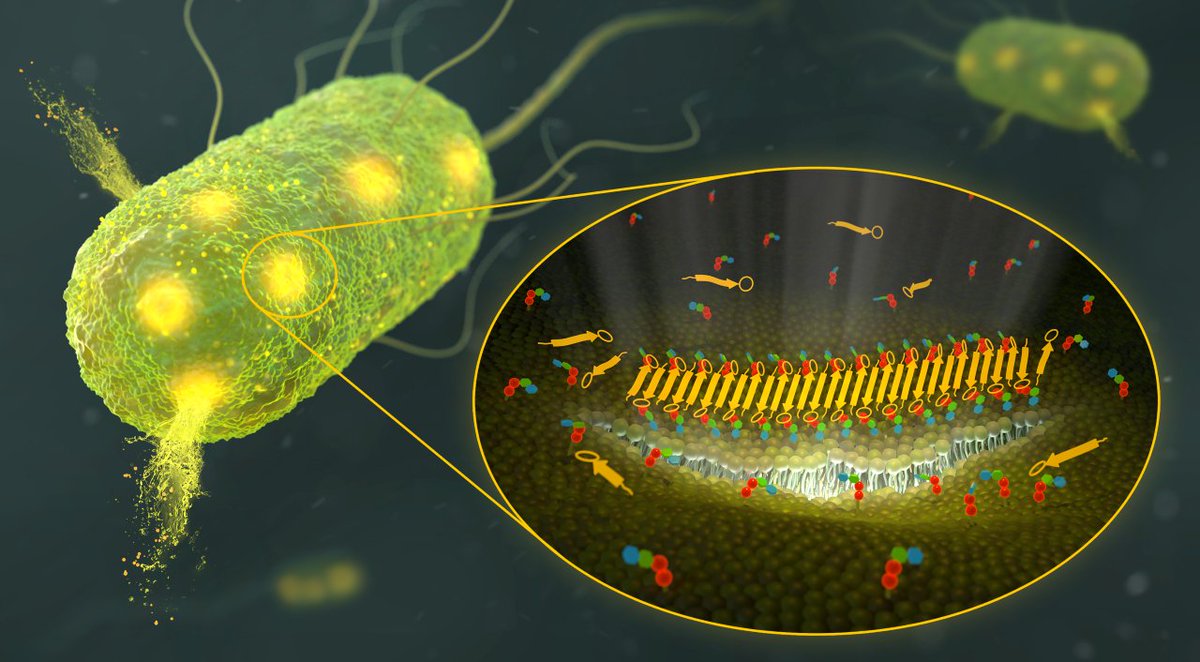
This is massive: mode of action of the newest antibiotic Teixobactin was just reported at the highest detail, both for receptor-antibiotic and resulting supramolecular assembly. Both kill!
This might be game-changing for fighting those pesky Superbugs
#Teixobactin, isolated from 'unculturable' bacteria, is considered the first new 💊#antibiotic💊 in 30 years. But how does it kill bacteria?
We show teixobactin uses a new mechanism that involves a double attack on the cell envelope
Out @Nature
https://t.co/391CtcSy4K
#NMR 1/n
I have 3 PhD and 3 postdoc positions available at Utrecht University, all in the context of ‘solid-state #NMR & drug discovery (#antibiotics: small molecules & peptides)’
Starting date is flexible.
Please see here:
https://t.co/uaUmzev1Pd
#Postdoc#PhD
Polar Networks Mediate Ion Conduction of the SARS-CoV-2 Envelope Protein | Journal of the American Chemical Society @ChemistryMIT@MIT@nmr900 High Resolution Structure E Transmembrane Domain SARS Cov2 https://t.co/lrGWohd4js
Check out our new NMR study of how a dynamic polar network in the SARS-CoV-2 E protein mediates proton and calcium ion binding! https://t.co/nRsXt9kvpI
🔥Hot off the press⬇️⬇️⬇️ in @NatureMicrobiol
https://t.co/kTuxzjSDnI
Plectasin is a complex peptide 💊 #antibiotic, isolated from funghi.
We show that plectasin uses a new Calcium-dependent supramolecular mechanism to ensnare its target on the membrane surface.
1/4
#NMR
Such a noble initiative promoted by Native Scientists, thanks for enabling this science class for children in my hometown!
School dropout in my region is ~25%, we desperately need initiatives like these that keeps kids interested in school and motivates them to seek knowledge
Da @NYUScience à Figueira da Foz e do @MIT aos Açores! Os cientistas Sílvia Curado e João Silva trouxeram a ciência de volta a casa, inspirando 75 crianças com os maravilhosos mundos da biologia e da química
🙏🏼Muito obrigada pelo apoio @FundlaCaixa e @FLAD_PT
We distinguish α- from 310-helices using a 3D hCOhNH, a straightforward 1H-detected ssNMR experiment. The obtained CO(i-n)NH(i) signal intensity patterns give a signature of the helix type.
https://t.co/QbZWTQ6vS0
Subtle but important difference: α-/310-helix are not the same! 310-helices are often hard to distinguish due to higher dynamics, hence lower resolution. This is why 310- may grant functional properties; they're plastic. Here's an NMR approach to distinguish α-, 310- and π, helix
Here's what the open E viroporin from SARS-CoV-2 looks like! A cone-shaped barrel with a wide N-opening, narrow C-opening, a phenylalanine belt, and a hydrophobic gate. The structure elucidates how this viroporin work and sets a drug target for the potential treatment of COVID-19
This viroporin is intriguing: the pore is narrow and mostly hydrophobic, impeding the passage of ions. The polar sidechains at the C-term opening may lower the energy barrier for water to cross the gate. Hence, this channel's C-term is wide when closed but narrow when open!
We report the discovery & mechanism of #Clovibactin, an #antibiotic from unculturable bacteria!
⬇️⬇️ @CellCellPress ⬇️⬇️
💊 https://t.co/TSfzcQNHXy
Clovibactin uses a 'hydrophobic cage' motif to target the cell wall and kill without detectable resistance
@UniUtrecht
1/n
A postdoc position is available in my lab at UChicago to work on various aspects of (bacterial) cell biology using cryo-ET. Please feel free to contact me directly at [email protected]. Re-tweeting and spreading the word is highly appreciated. Thank you!