Two biggest disappointments that Modi government will carry with it :
1. Failure to control corruption by building systems
2. Failure to promote meritocracy at all levels
Migration out of India seeded the ancient world.
Two hills in southwest Ireland are named after a Rig Veda goddess. They are called the Paps of Danu. Every spring, farmers lit fires around them and drove cattle between the flames for protection. The Vedas describe the same ritual.
Danu is the Rig Veda mother goddess of the flowing waters. Her name is written into the geography of half of Eurasia. The Danube. The Dniester. The Dnieper. The Don. The Donau. Greek Demeter. Northern Greeks once called themselves the Dannuni. In Ireland, the pre-Christian pantheon called itself the Tuatha de Danaan. Children of Danu.
The mainstream story that pale steppe nomads invaded India around 1500 BC and imposed Sanskrit on a dying Indus Valley civilisation has been steadily dismantled over the last thirty years. The recent genetic and linguistic papers still cited in its defence describe contact at the edges, not replacement at the centre.
The direction of travel runs the other way. Out of India, in pulses, over thousands of years.
Iran took the name of the people, Aryans. Ahura Mazda is the Vedic Asura. The magi are the Vedic magoi.
The Germanic and Slavic pulse moved overland from the ninth millennium BC. They carried the sky-father Dyaius, who became Tyr in Scandinavia, Zeus in Greece, Deus in Rome.
The Italo-Celtic pulse moved by sea from the seventh millennium. When the Celtic branch turned up the Atlantic coast around 5,400 BC, it left place names all the way from Iberia to Ireland. Portugal. Galicia. Gaul. Pays de Galles. Cornwall. Galloway. Galway.
Then the Sarasvati river dried around 2000 BC. A military wave moved west into the Near East. The Kassites ruled Babylonia for 500 years. The Mitanni signed a treaty with the Hittite king Suppiluliuma in 1380 BC swearing by Mitra, Varuna, Indra and the Nasatyas. Four Vedic gods, on a Hittite tablet, thirteen centuries before the earliest date the invasion theory allows for the Vedas.
The Greeks came in the same window. Zeus is Dyaius. When Alexander crossed the Hindu Kush he met people at Nysa claiming descent from Dionysus. Some of their heroes, they said, had come this way.
Link to full Substack essay, with sources, in the comments below.
#Space#Update
2 strategically important satellites, #NVS03 & #Gisat1A, are sitting in Sriharikota for weeks, awaiting govt nod for launch. Also waiting is a #GSLVMk2, whose propellant filling was halted midway after clearance failed to come through. 1/n
Pic for representation
Hello space, we have arrived! Vikram-1's Test Flight-1 has completed it's mission.
The first ever Indian private sector launch has been successfully completed.
#Vikram1#MissionAagaman#OpeningSpaceForAll
ORBIT ACHIEVED. 🚀
Vikram-1 Test Flight-1 has reached orbit. India's first privately developed orbital rocket has completed its final burn and injected its payloads into a ~450 km orbit, making India the third country in the world with private orbital launch capability.
History is made. 🇮🇳
#Vikram1 #JourneyToOrbit #SkyrootAerospace
LIFT-OFF! 🚀 Vikram-1 has left the pad at Sriharikota. India's first privately developed orbital rocket is flying. History is being made. 🇮🇳
#Vikram1#JourneyToOrbit#SkyrootAerospace
It’s official. 🚀
July 18. 11:30 AM IST.
Vikram-1. Test Flight-1. Mission Aagaman.
India’s first private orbital launch from the historic First Launch Pad at SDSC-SHAR, Sriharikota.
The countdown begins. 🇮🇳
#Vikram1#MissionAagaman#SkyrootAerospace#OpeningSpaceForAll
Indian roads don't fail only because of poor-quality materials or corruption. They also fail because of poor workmanship and a lack of attention to engineering details. Road edges are often left unfinished, manholes are placed without proper alignment, drainage slopes are poorly designed, and transitions between road sections are abrupt. Many of these issues are not caused by a lack of intent alone, they reflect inadequate skills, weak quality control, a lack of seriousness toward execution, and most importantly pride in doing work the right way.
This problem extends far beyond roads. It is visible in building construction, factories, public infrastructure, restaurants, and countless other sectors. Projects are frequently completed without adherence to standards, resulting in products and infrastructure that are functional only on the surface but are fundamentally compromised.
A major reason is the widespread acceptance of jugaad or the "band-aid approach" to problem-solving. Instead of building robust systems that prevent problems, people at every level often focus on somehow getting the job done. The objective becomes "kaise bhi karke khatam karo" rather than "sahi tareeke se banao."
Until craftsmanship, engineering discipline, and accountability are valued as much as speed and cost, these failures will continue to repeat themselves. Infrastructure quality is ultimately not just a reflection of budgets or materials. It is also a reflection of the culture with which a society chooses to build.
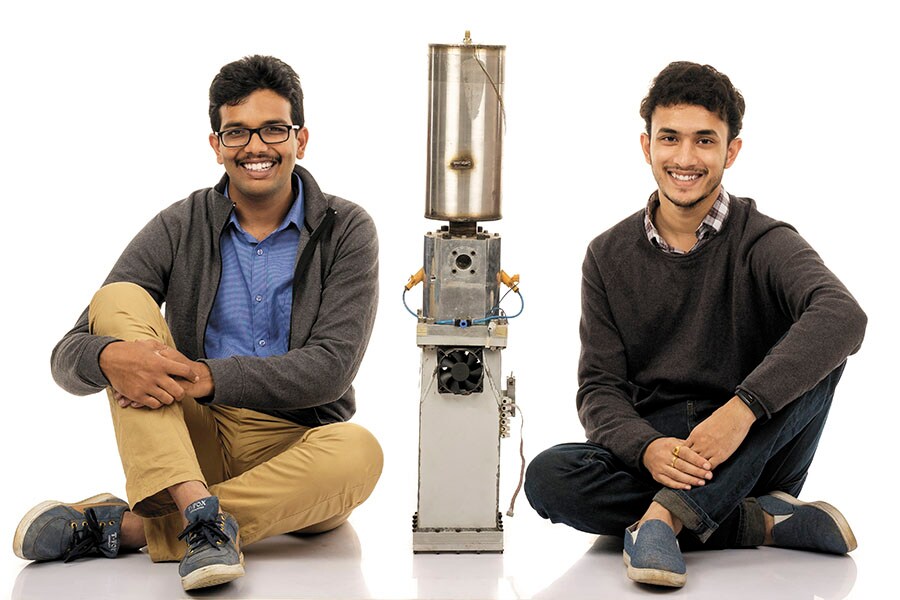
In 2012, a 19-year-old aeronautical engineering student from Coimbatore presented propulsion research at a NASA event. Dr. APJ Abdul Kalam noticed, sought him out for a meeting, and handed him a recommendation letter with one challenge: prove your concept.
That student was Rohan M. Ganapathy. Three years later, he and family friend Yashas Karanam co-founded Bellatrix Aerospace from IISc's incubation lab in Bengaluru. The problem they chose to solve touches every satellite in orbit.
Nearly all satellites run on hydrazine, a propellant that has been standard since the 1960s. It is deeply toxic, carcinogenic, and so hazardous that it requires specialized crews and loading facilities near the launch site. India imports all of it. Nobody was building an alternative.
Bellatrix built two. Rudra is India's first high-performance green propulsion system, delivering hydrazine-equivalent thrust while cutting handling costs by over 60%.
Jal is a microwave plasma thruster that uses water as propellant, which Bellatrix claims is the world's first such system built by a private company. Both have been tested in orbit: Rudra fired on ISRO's POEM-3 in January 2024, and again on POEM-4 in January 2025.
Their third product, Pushpak, is an orbital transfer vehicle the company says can bring satellite deployment costs from $45,000 to $25,000 per kilogram. In October 2024, Bellatrix signed an MoU with ISRO's commercial arm, NewSpace India Limited, to integrate Pushpak into its launch missions. The company has raised $31 million to date, backed by BASF Venture Capital, Inflexor Ventures, and Cactus Partners.
For India, a domestic green propulsion stack means less dependence on imported hydrazine, lower costs for Indian satellite startups, and export-ready technology in a global market actively moving away from toxic fuels.
Kalam asked Rohan to prove his concept. More than a decade later, the proof has been fired in orbit.
@rohanooty@BellatrixAero@YashasKaranam
The Royal College of Surgeons of Edinburgh was established in 1505. Sushruta had already been performing reconstructive surgery for over two thousand years by then. His ethical framework predates the Hippocratic Oath. East India Company surgeons were still learning rhinoplasty techniques from Indian practitioners in the 18th century.
What happened in Edinburgh this week is an overdue correction to Western assumptions about where foundational medical knowledge originated.
One of my board members had once reminded me - the Japanese don't just export bullet trains. They export all the standards that come with that. You will have to use the Steel that they would have approved. You will have to use the glass to seal the windows that they would have figured out. You will have to use the fasteners that they would have perfected.
And who will be best placed to build all these standardized items? Lo and behold, local suppliers from Japan. This is not evil, this is just sensible. The people who invented something, the people who perfected it, are obviously going to be the best placed to build it. Hence, standards.
Today, for the first time in our lives, there are things where India genuinely is becoming world-class at. Look at our industry, electric 2Ws. Look at payments. Maybe even drones and other new technologies soon enough.
For a change, we need to learn the confidence to write standards. To help everybody else figure out how to build something like this fast and, in the process, become the leading center for these technologies globally.
@aravind@Fintech03@amitabhk87@dilipasbe
India must issue notice to all Indian sailors to strike and return back to India. Let the world's shipping stall. Let's see how Trump keeps energy moving and China its exports shipping.
I have long been suggesting India create a network for Indian diaspora, of nurses and doctors, shippers and pilots, workers and constructors etc.
Every Indian going out to work from India - record their skills, put them into a database, give them a community to connect to, with GoI giving info and incentives for them there.
Use the power of this network when needed. Tap their skills if they return to India. And utilize their value outside India.
All countries will be much more respectful to India if India can unify its diaspora workers and make them act in national interests like China does.
Indian men are in a silent health pandemic that nobody is calling a pandemic.
No virus. No daily death count. So nobody is panicking. But every Indian man in his 30s is quietly carrying something he doesn’t tell anyone.
He’s been told he’s fine. He isn’t.
•Hair thinning since 25
•Moobs he’s been hiding for 6 years
•Belly that won’t move
•Tired all the time
•Performance issues he hasn’t told anyone
This isn’t five problems in five men. It’s one generation carrying five versions of the same collapse.
1. The hair loss isn’t just genetics. It’s metabolic.
Men losing hair before 30 have higher insulin resistance and lower testosterone than men who aren’t. The hair was the first warning. He bought a ₹1,500 shampoo and moved on.
2. The moobs aren’t fat. They’re hormonal.
40 to 60% of Indian men have them. High estrogen, low testosterone, and a body storing fat where it has the most estrogen receptors. He’s been hiding under a t-shirt for a decade.
3. The fatigue isn’t stress. It’s deficiency.
Vit D below 20. Ferritin below 30. B12 nobody tested. He’s running a 55-year-old’s hormone profile in a 32-year-old’s body.
4. The performance issues aren’t age. They’re vascular.
The arteries that fail here are narrower than the ones around the heart. They get blocked first. This is the warning. By 2 to 4 years.
The 28-year-old hiding his chest and the 40-year-old getting a stent have more in common than they think.
They’re the same man at different stages
of the same pandemic.
Nobody is calling it a pandemic because every man is going down quietly.
The pandemic is here. It’s just quiet.
@GabbbarSingh Popstars thrive in US due to lack of music in Hollywood barring a few musicals, while Bollywood keeps churning nice music which everyone enjoys so not everyone survives the competition
Recently my son asked me why he needs to do mental math when calculators exist. I told him if he doesn't, he will make irrational decisions throughout his life.
Let me explain. Say you see two packs of snacks. A 500g pack for ₹100, and a 200g pack for ₹45. Which one should you buy?
The math is not at all hard, but people who are scared of mental math will not do it. This is not such an important decision that you pull out a calculator for it. So you make the decision on vibes - say ₹100 "looks too high", or that the smaller pack costs "less than half of the biggest one" or some such.
The problem isn't that you made a poor decision on snacks. It is that if you do this repeatedly, you train your mind to make decisions on vibes. Over time your reasoning muscle atrophies - so you start relying even more on vibes.
Before you know it, you are taking even big decisions on vibes. Should I rent or buy a house? Let's decide based on "EMI affordability", not rental yield. Should I invest in this IPO? I have heard of the company's brand so I'm all in. It isn't only financial or quantitative decisions either - in my mind the math muscle and the logic muscle are closely correlated, so a decline in one certainly affects the other.
Like the Arab who let the camel's nose inside the tent, fear of math is the first step towards thoughtlessness, and needs to be nipped in the bud. Intellectual laziness starts with snack prices.
Meet Daiaphi Lamare, known by her stage name Reble.
- From Meghalaya
- 24 Yrs Old and did Engineering
- has been writing Rap songs when she was 10 yrs old
- Albums like "Terror," "Set It Off," and "New Riot" GOT hit
- Got National Fame in Dhurandhar Monica Song.
- Aditya Dhar clubbed his team with NO background in Bollywood and making her overnight Sensational.
6 YEARS: FROM COVID TO IRAN
TIME FOR SOME PAINFUL TRUTHS 🚨
Six turbulent years from Covid to the Ladakh standoff to Ukraine war to Trump’s tariff offensive to the current Iran war have exposed a hard truth. India remains dangerously dependent on the world for things a serious power should control at home.
Energy first, since that’s on everyone’s mind right now. India imports about 85% of its crude oil and roughly 50% of its natural gas. We depend heavily on overseas supply chains for critical minerals like lithium, cobalt and nickel that will power the next generation of batteries and energy systems. Any disruption anywhere from the Strait of Hormuz to sanctions on major producers immediately ripples through LPG prices, electricity costs and inflation. The current LPG anxiety during the Iran war is just the latest reminder of how exposed we are.
Defence is worse. Despite decades of rhetoric about indigenisation, India still imports roughly 45 to 50% of its major weapons systems, making it one of the world’s largest arms importers, if not the largest. During the Ladakh standoff with China (which is still on) the country had to rush through emergency purchases of munitions, drones, artillery shells and winter gear because either we don’t make those items or domestic capacity could not surge quickly enough. A country facing two nuclear adversaries should never have to scramble for weapons in the middle of a military standoff.
Pharmaceuticals reveal another uncomfortable truth. India is known as the pharmacy of the world, yet around 70% of our active pharmaceutical ingredients come from outside, including China. During Covid this vulnerability became obvious as India scrambled for oxygen, PPE kits, ventilators and key medical inputs.
Technology dependence is the most alarming of all. More than 90% of advanced semiconductors are imported, most high end AI chips and servers are foreign made, and critical digital hardware depends almost entirely on global supply chains. In an era where AI will define both economic power and military capability, this is a profound strategic vulnerability.
Add fertiliser precursors, rare earths, electronics components, solar modules and specialised machine tools and the list becomes even longer. Each time the world experiences a shock (Ukraine, Iran, Azerbaijan, Covid) whether it is a pandemic, sanctions on Russia, a war in West Asia or rising great power tensions India is forced into code red emergency management mode.
The uncomfortable reality is that true strategic autonomy requires historically painful decisions. Building domestic capacity in energy, weapons, pharmaceuticals, semiconductors and AI will demand huge investment, long term industrial policy, and years of political risk. It may mean accepting higher costs and slower returns in the short term in order to build resilience for the long term.
But India’s election to election political cycle rewards short term thinking. No government wants to take decisions that may, beyond a point, take a decade to pay off. The decisions these crises compel from a country like India will mean a total dismantlement of our politics as we know it today. It will mean a generation of turning the country on its head.
Yet the alternative is worse. As things stand India remains structurally vulnerable. A country that has to scramble every time the world shakes cannot claim true strategic autonomy.
From COVID to Iran, the last six years have made that painfully clear.
Political and bureaucratic flaws like incompetence, corruption, greed, lust for power, and even stupidity exist in all the countries. Be it the US, India, Pakistan, or Iran.
What sets United States apart is not moral superiority, but its ability to build world-class technology and institutions. Institutions like MIT, Stanford, NASA, Palantir, Apple, or Anthropic.
It is driven largely by imported talent. The first generation immigrants, their children and children of their children build these systems for the US. American strength comes from its ability to attract the best talent from around the world. That attraction is created by promises of comfortable living, relative equality, meritocracy, access to capital, quality of life, and a larger-than-life dream.
🟡 If a swimming pool smells strongly like chlorine…
…it’s not because there’s too much chlorine.
It’s because chlorine is reacting with pee, sweat, and body oils — forming chemicals called chloramines.
The stronger the “pool smell,” the dirtier the water.
A properly maintained pool should barely smell at all.
Next time you notice that strong odor… 👀