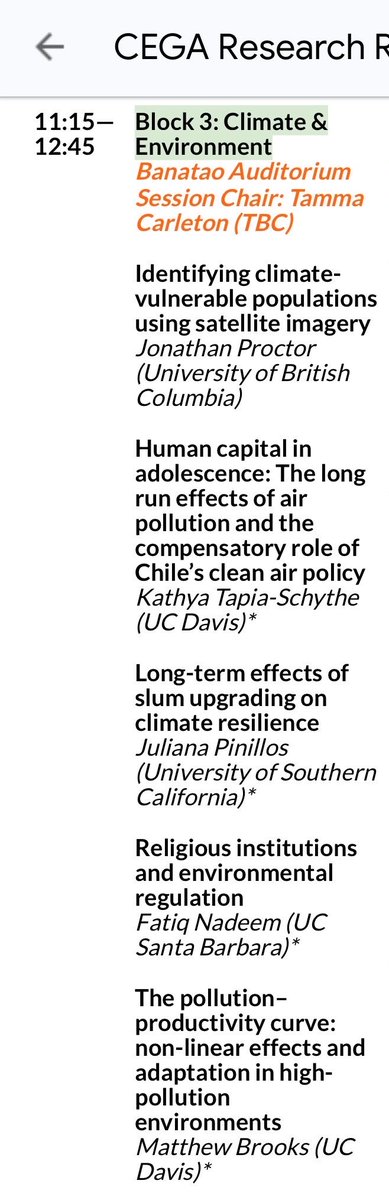
I’m excited to present this Friday at the @CEGA_UC Research Retreat at @UCBerkeley! If you’re around, join the Climate and Environment Session (Banatao Auditorium).
Looking forward to connecting!
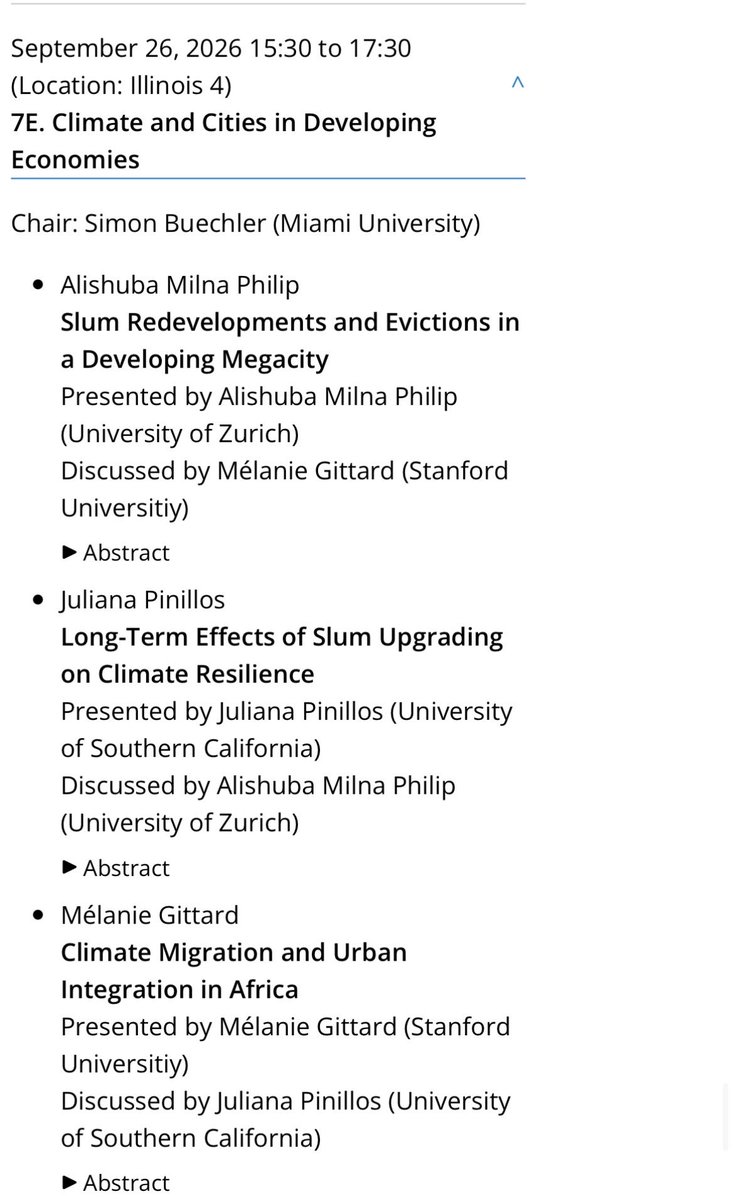
My first time presenting at UEA! Thank you for the great feedback. Also, I really enjoyed learning about slums around the world. I look forward to being back next year in one my favorite cities (Mexico City)!
Hope to see many of you tomorrow at the Chicago Fed for our North American meeting!
For those arriving in town early today, there is a casual happy hour at Theory (9 W. Hubbard Street) from 5 to 8pm
See more details and final program in the link below
https://t.co/ldMhfizxmV
A propósito del terremoto en Colombia, por estos días no he dejado de pensar de que cuando eres migrante en otro país esas dos realidades conflictuan demasiado en momentos atípicos como este. Colegas en USA piensan que si a uno y a su familia no le pasó nada (ciertamente lo más importante), entonces el terremoto no te afectó. La vida allá sigue como si nada y eso se espera de ti. Hay que enviar esto u aquello, las reuniones habituales, los compromisos laborales, nada para. Menos en país donde la cultura del trabajo es tan fuerte.
Mi realidad en Cali es bastante diferente. Todos los días viendo como uno puede ayudar, qué se necesita donar y dónde. Sales a la calle y ves un contraste entre solidaridad infinita entre miles de ciudadanos que ni se conocen y al mismo una gran tristeza de ver la ciudad como está. Las familias que no pierden esperanza, los voluntarios y rescatistas que trabajan sin descanso, las historias de l@s sobrevivientes, el dolor de los que han perdido un ser querido, las carpas de los que ya no tienen casa, los perritos y gatitos perdidos. Los mensajes en redes sociales de que se necesitan ayuda en todos lados. La lista sigue.
Obviamente sé que la vida sigue. Que de esta vamos a salir y nos vamos a reconstruir. Pero que la inercia no nos quite la posibilidad de reflexionar un poco.
Hi #EconTwitter and academia community,
Colombia was struck by a devastating 7.4-magnitude earthquake this week. My hometown, Cali, is among the most affected cities, together with many other municipalities across the country 🇨🇴❤️🩹.
People have lost their homes and loved ones, and many communities urgently need assistance (1/n)
https://t.co/8NIIGbbLDL
Hi #EconTwitter and academia community,
Colombia was struck by a devastating 7.4-magnitude earthquake this week. My hometown, Cali, is among the most affected cities, together with many other municipalities across the country 🇨🇴❤️🩹.
People have lost their homes and loved ones, and many communities urgently need assistance (1/n)
https://t.co/8NIIGbbLDL
Hi #EconTwitter and academia community,
Colombia was struck by a devastating 7.4-magnitude earthquake this week. My hometown, Cali, is among the most affected cities, together with many other municipalities across the country 🇨🇴❤️🩹.
People have lost their homes and loved ones, and many communities urgently need assistance (1/n)
https://t.co/8NIIGbbLDL
Part of my research studies natural disasters and their economic consequences. Yet, experiencing one is something entirely different. It reminds me that research is more useful when is connected people’s lives and to policy implications (5/n)
I had a great time at the International Conference of the @AREUEA_ORG in Medellín, Colombia.
It was wonderful to connect with so many scholars working on topics closely related to my research interests.
This conference was especially meaningful to me because I had the opportunity to present my research about Medellín place-based policies. It was rewarding to discuss the paper while colleagues from around the world were experience the context that motivates it. I hope this made it easier to understand why these questions matter, not only for this city, but for many rapidly growing cities across the developing world.
It was also a pleasure to share this experience with the @USC team, @parkhomenko_a_v and @JDelaRocaUSC.
Finally, many thanks to the organizing committee for an outstanding conference. Special thanks to the local organizing team at @EAFIT for their hard work and attention to countless details that made this such a memorable event. They showed that Colombia can host world-class academic events. 🇨🇴
Looking forward to continuing these conversations and reconnecting with many of you at future conferences, particularly at the @UrbanEconomics Meeting at the Fed Chicago!
I spent a couple of summers in Paris. I still remember how suffocating the heatwave days were. Studying or working was nearly impossible.
At the time, I thought this was more of an exception than the norm, so AC didn’t seem necessary. But the truth is that such days are likely to become more frequent and part of the new reality.
I wonder whether Europeans are fully aware of what this will imply for citizens’ welfare, productivity, and health outcomes.
Today, there are much more efficient cooling systems than before. Treating all AC as “maladaptation” ignores how much the technology has changed.
It seems to me that Econ departments maximize many things: teaching needs, a higher probability of producing outstanding researchers (a function of cohort size?), prestige, and Grad RAs (maybe AI will reduce this).
So PhD employment of grad students is not necessarily their priority.
I know nothing about soccer but I understand numbers. So I accepted the challenge from my brother-in-law. He bet Brazil was going to win because it's *Brazil*. I said let me see the data and run a model. So I bet on a draw and won.
People’s choices are often biased and sticky. Yet data analysis reminds us that evidence and judgment are more important than blind opinion.