How do we understand neural nets with so many interacting params that we can’t describe what they do in words?
Our take: objective functions and regularizers offer a concise description of "what models learn"
Can we *empirically* study implicit regularization in DL?🧵
@JRudoler@alexolegimas@ahall_research Yes - we found human graders even disagreeing amongst themselves about valuable contributions! We explore what this might mean for the question of 'taste' in the social sciences at the bottom of the piece
https://t.co/F1Kgrm386Q
it's like how in chess, computer-generated strategies can be totally unintelligible to humans because they're planning too many moves ahead.
maybe AI-generates proposals will be better but we won't be able to tell because we don't understand them. quite like AI math proofs
super interesting; this shows research taste alignment more than research taste quality -- how much experts like it, not how valuable it is
in poli sci the target "what is important" may always be "what humans care about", but is that so for eg physics or bio?
Frontier models can now propose technical social science research designs that experts grade more highly than the world's top political economist's---that's the finding from our new Free Systems eval, SnyderBench, in which we have PhD experts blind grade research proposals from AI models compared to papers written by Harvard political economist Jim Snyder (which the experts have not previously read).
At the same time, we see no evidence that models can develop research ideas that experts rate as better overall contributions. They're getting better and better at the technical part of research, but not necessarily at the more subjective part.
This could be because human experts possess "judgment" that the models do not.
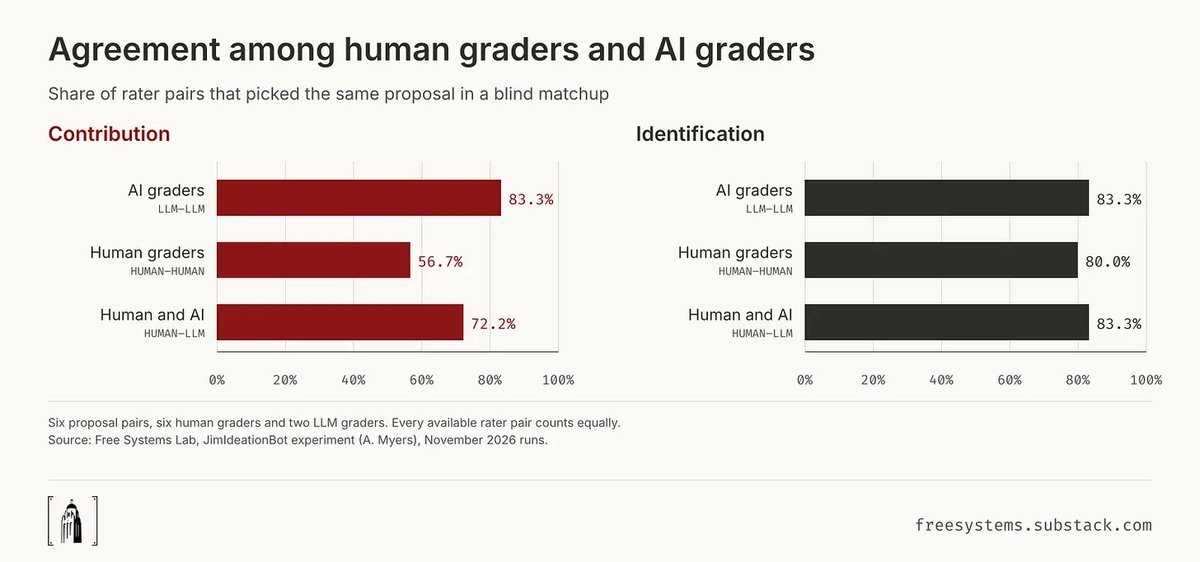
It could also be that research "contribution" is so subjective that it doesn't actually point at any meaningful goal---consistent with this possibility, we find that our human experts don't agree with one another when rating project ideas for the strength of their contribution, with agreement rates barely higher than random chance. Perhaps social science research is what @alexolegimas might call a "relational good": something people value in part because it's produced by a human. We're not sure.
This past January, I released the results of a pilot in which I had Claude Code replicate and extend a past empirical paper on vote-by-mail. 10 months later, it's stunning the amount of progress that's been made. It's no longer interesting to ask whether AI can collect data and run analyses automagically---we take that for granted---instead, the question is how much of the entire research loop AI can complete. Our tentative answer: AI can handle the technical aspects of empirical political economy research from end to end, devising the design and executing it, but for now, we still need humans to drive the agenda.
This is joint work with @AndyCWMyers, and is of course dedicated to my PhD advisor Jim Snyder, who remains the world's great empirical political economist, AI or no AI.
Lots more in the full piece here:
https://t.co/zgScGvp9EY
@alexolegimas@ahall_research@freesystemslab I subjectively don't think today's models have good research taste, but this kind of eval presupposes that expert graders *do* know better than the models what is an important question to work on.
This eval shows research taste alignment more than research taste quality, right?
It is an inevitable path of optimization that interpretable chain of thought goes away. It being intelligible is an inefficiency brought about how we first discovered inference time reasoning (related to in-context learning). Looped architectures are the first step there.
I'm a big supporter of being more open and transparent, but explain to me like a 5-year-old: How does knowing a model's perplexity without knowing the data improve safety?
It really is upsetting reviewing for conferences and getting multiple papers for which the **ABSTRACTS** are 100% AI-generated (according to both Pangram and the eye-test).
You really can't even tell me what your paper is about? Have a little pride.
Our colleague Eva Yi Xie, a Princeton neuroscience PhD student, was detained by ICE at Reagan National Airport on her way home from SfN, where she’d just presented her poster. She’s being held in Chantilly, VA. Please help us bring her home. 📷
Eva is a student at @PrincetonNeuro working with me, @brody_lab and Ben Eysenbach. She was abducted by ICE while trying to board a flight from SFN. Some thoughts below how we can help her.
Got around to making a visual for this:
*Model fairness* - are a particular fitted model's predictions similar across groups?
*Data fairness* - does the relationship btwn the chosen features and the outcome reflect systematic differences? (ie the population regression)
🧵New preprint (w/ @gileshooker): "Targeted learning for inference on data fairness"
Fairness judgements in machine learning often assume a fixed, pretrained model and quantify uncertainty due to finite-sample evaluation. But what about variability in the *training* data?
1/
My pet peeve that grifters love is the qualifier *if you’re cracked*
“Great opportunity, if you’re cracked”
“We want cracked engineers”
“If you’re cracked dm me”
I don’t know anyone serious or “cracked” who talks like this, ofc you want talent that’s implied. Weird ethos grab
it's almost unbelievable how bad ai writing is given how good they are on so many other things
i wonder if transformers are fundamentally bad at writing like humans
for transformers, all information is available simultaneously, so the sequential logical chain of an argument is less important
their context window is also so large (~1m words) compared to human working memory (~10 words), they can tolerate a lot of garbage in their context
whereas humans get easily annoyed by vague wordings so we are pretty sensitive to bad writing
i'm sure if you train a large llm heavily on writing quality they'll improve, but it might be really data intensive and inefficient
How do we understand neural nets with so many interacting params that we can’t describe what they do in words?
Our take: objective functions and regularizers offer a concise description of "what models learn"
Can we *empirically* study implicit regularization in DL?🧵
The goal is ofc to scale up to bigger models and show that estimates of implicit regularization can be a useful diagnostic and interpretability tool at scale
This is early, proof-of-concept work in this direction and I'm excited to be presenting it at NeurIPS 2026 in Sydney!
@DAgourakis IID data should not make much difference, but I would imagine networks learning different data distributions might show differences. You could define a regularizer class wrt data as well, the method is very flexible.
To the last — yes! They’d have different weights and grads
@DAgourakis Estimating implicit effects of architecture is a bit tricky, because you need a notion of what the unregularized network is (a network without that architectural feature). This might be easy (skip connections leave the rest of the network unchanged) but is often hard