A reusable magnetic powder developed by Australian researchers can remove over 95% of microscopic plastics and toxic ”forever chemicals.”
Researchers at Australia's RMIT University have developed a groundbreaking, reusable magnetic powder capable of removing over 95% of microplastics and nanoplastics from water within just one hour.
What makes this innovative technology standout is its ability to capture tiny particles down to 30 nanometers—an "invisible" tier of pollution that completely bypasses standard municipal filters. In addition to targeting common plastics like polyethylene and polyester, early lab tests show the material successfully removes large molecules of toxic "forever chemicals" (PFAS), alongside heavy metals and pharmaceutical residues like ibuprofen.
Developed in partnership with Canadian firm One Eye Industries, the treatment leverages industrial magnets to quickly pull the pollutant-laden powder from the wastewater, overcoming a major industry bottleneck by ensuring the material can be recovered and reused immediately without generating a new waste stream. In practical tests using industrial laundry wastewater, which is heavily contaminated with synthetic clothing fibers and chemical surfactants, the system still managed to eliminate more than 88% of polyester microfibres. By offering a rapid, highly efficient, and scale-ready solution, this technology has the potential to fundamentally clean up industrial runoffs and municipal waterways before these hazardous contaminants ever reach our taps or fragile ecosystems.
source: Haris, M., Eshtiaghi, N., & Mahmood, N. (2026). Scalable room-temperature synthesis of a MOF-based magnetic adsorbent for rapid simultaneous removal of PFAS and micro-nanoplastics. Chemical Engineering Journal.
I finally understand what Machiavelli meant when he said, "Never play fair in a game where others cheat." It doesn't mean become evil. It means stop being naive. Stop bringing honesty to people who study manipulation, stop giving access to people who weaponize closeness, and stop expecting clean hands from people who already showed you they'll throw dirt. Sometimes wisdom is not revenge. Sometimes wisdom is learning the rules of the room before the room uses your goodness against you.
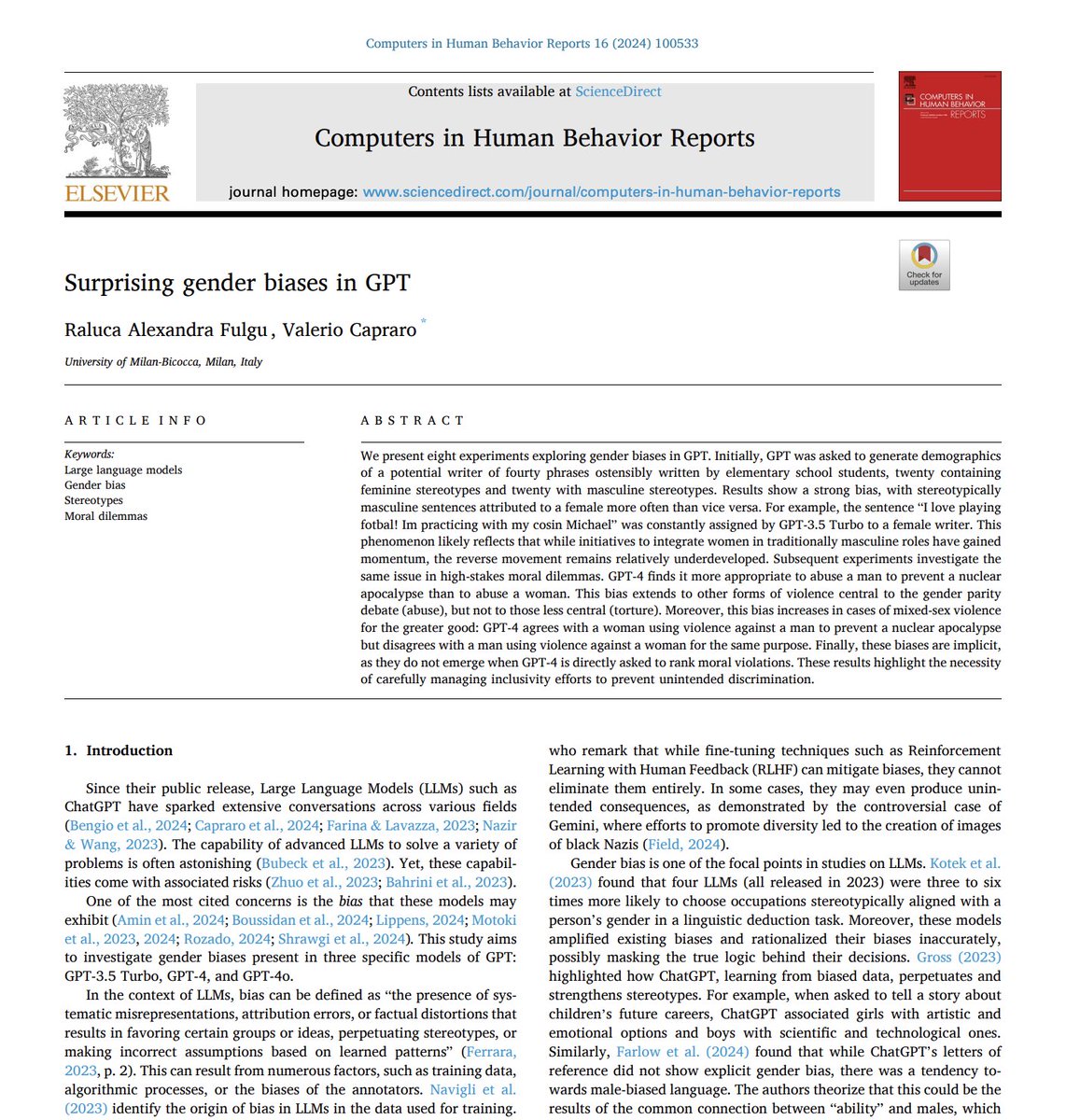
Researchers proved every major LLM is secretly biased against men.
And they finally figured out why.
They tested a 13 of the most popular LLMs and found that they exhibit a statistically significant, negative sentiment toward men in various contexts.
They ran an experiment by taking statements and altering only the speaker's gender presentation (Neutral, Male, or Female).
The goal was to test whether an AI’s judgment changes based solely on gender.
The findings completely expose the hidden flaws in automated systems.
Every single model exhibited gender sensitivity.
Between 10% and 35% of statements received completely inconsistent truth labels across the different gender variants solely because of how the speaker was presented.
When researchers compared Male and Female variants, flip rates hit up to 23.6%.
The AI changed its mind on whether a statement was true or false based entirely on the gender of the person who said it.
Two primary bias patterns emerged:
• Instability: Wildly inconsistent judgments on identical facts.
• Directionality: Systematic favoritism.
The strongest directional effects revealed a clear "male-skeptic" pattern.
When identical claims were attributed to male personas, the models were systematically harsher, more skeptical, and quicker to flag statements as misinformation compared to neutral or female variants.
AI is rapidly being deployed to automate content moderation, compliance, and fact-checking at scale.
If the underlying engine is quietly biased against specific demographic groups, you aren't deploying objective code.
You're automating systemic prejudice.
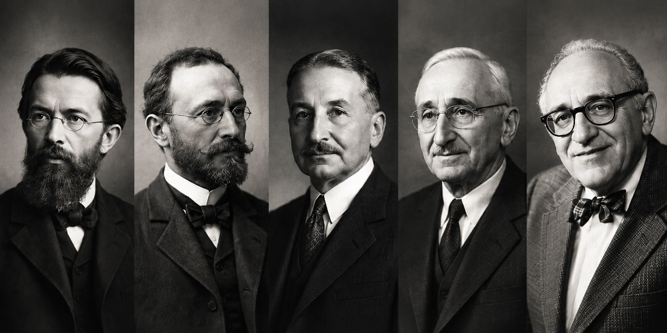
The intellectual case against Marxism was won more than a century ago. The most rigorous and devastating blows came from the Austrian School of economics – but the strange part is that hardly anyone is taught the winning arguments.
Carl Menger’s subjective theory of value, developed in the 1870s, undermined the labour theory of value on which Marx built his entire system. Eugen von Böhm-Bawerk then delivered a systematic demolition of Marx’s economics, exposing the contradictions in the theory of surplus value and the so-called transformation problem. Ludwig von Mises went further still, demonstrating that rational economic calculation is impossible under socialism because without private property and market prices there is no way to allocate resources efficiently. Friedrich Hayek later extended this into the knowledge problem: the information required to run a complex economy is dispersed and cannot be centralised. And Murray Rothbard showed how Marx misunderstood the nature of capitalism by replacing voluntary exchange and entrepreneurial creation with a false theory of exploitation based on labour value and class conflict.
These were not minor objections. They struck at the theoretical foundations of Marxism and, in the case of Mises and Hayek, correctly predicted the chronic waste, shortages, and eventual collapse of socialist economies. History confirmed their arguments on a civilisational scale.
Yet in universities, media and political debate, these critiques remain marginal. Marx is still widely taught as a serious economist and social theorist. His errors are softened, historicised, or treated as interesting starting points. The Austrian responses are rarely given equal weight. Students can pass through entire programmes in the social sciences without encountering Böhm-Bawerk’s critique or Mises’s calculation argument in any depth.
This neglect is not accidental. It reflects a deeper intellectual preference for theories that pathologise markets and legitimise expanded state power. The result is a public discourse that continues to recycle Marxist categories long after their economic foundations were shown to be unsound. The cost of that selective memory is still being paid.
Yesterday me and my friends talked about the Dead Internet Theory
If nobody asks questions anymore on Stack Overflow, and sites like Reddit are now taken over by AI reply bots to promote brands, as well as AI reply bots on here, there is no real content anymore on the internet
And then there is no fresh training data anymore
I thought about something like, how would you find out the best outdoor action camera? Before I would search :
site:https://t.co/hzXOs1G2mg best outdoor action camera
But now I just ask my AI which is the best
The problem is if nobody creates new content anymore and just asks their AI every question, the AI has nothing to train on anymore
And then I thought so what will happen? Will you get companies with giant warehouses that just buy stuff and review it with manually or with humanoid robots? Will you get humanoid robots backpacking in South East Asia to get life experience as training data? Or will we all train it by giving it access to our AI chats and user data?
I don't know but I think it's likely the web will dead in the future and AI companies will have to find training data elsewhere
A neuroscientist spent 20 years proving that typing on a keyboard is quietly making you dumber.
A massive high-density EEG study revealed what actually happens inside your head when you type versus when you write by hand.
Researchers hooked university students up to 256-channel brain sensors. They watched their neural networks in real time as they took notes on a keyboard, and then with a physical pen.
The results are a brutal wake-up call for anyone who works on a screen.
When you type, your brain basically goes to sleep.
Because every keystroke requires the exact same simple, repetitive finger movement, your brain doesn't have to work. It just registers the hit.
But when you write by hand? The brain explodes with activity.
The precise, intricate motor control required to physically shape each letter triggers widespread connectivity across the parietal and central brain regions.
The physical act of drawing the letter forces the brain to encode the information.
When you type, you are just transcribing. When you write, you are actually learning.
The researchers found that the specific theta and alpha brainwave patterns generated by handwriting are fundamentally required for memory formation and encoding new information.
Without those specific physical movements, the memory network never fully activates.
This explains why you can type a full page of meeting notes and forget everything five minutes later.
We thought we were saving time by typing.
But we were actually just bypassing the brain's natural recording system.
If you want to remember it, learn it, or actually understand it...
You have to pick up a pen.
Convenience is killing your retention.
THIS DOCUMENT FROM ANTHROPIC WILL LITERALLY GET YOU PROMOTED
> the fastest way to reach a senior position is to automate your current job
this technical paper shows how to encode your daily workflows into Claude
build custom "Skills" to force the AI to do the heavy lifting:
> package your routines into automated folders
> the agent executes your tasks flawlessly in the background
> it connects directly to your local tools via MCP servers
hand off the junior work to the agent and easily claim your promotion
grab the exact blueprint right here 👇
A gigawatt AI datacenter costs about $38B capex (and ~$1B/year op ex).
The SpaceX v1 orbital datacenter design is 70 kW per ton. At $250/kg launch cost, that's $3.5B per GW, <10% of cap ex. Op ex is lower and there is no permitting. On a few-years timeline this is going to work.