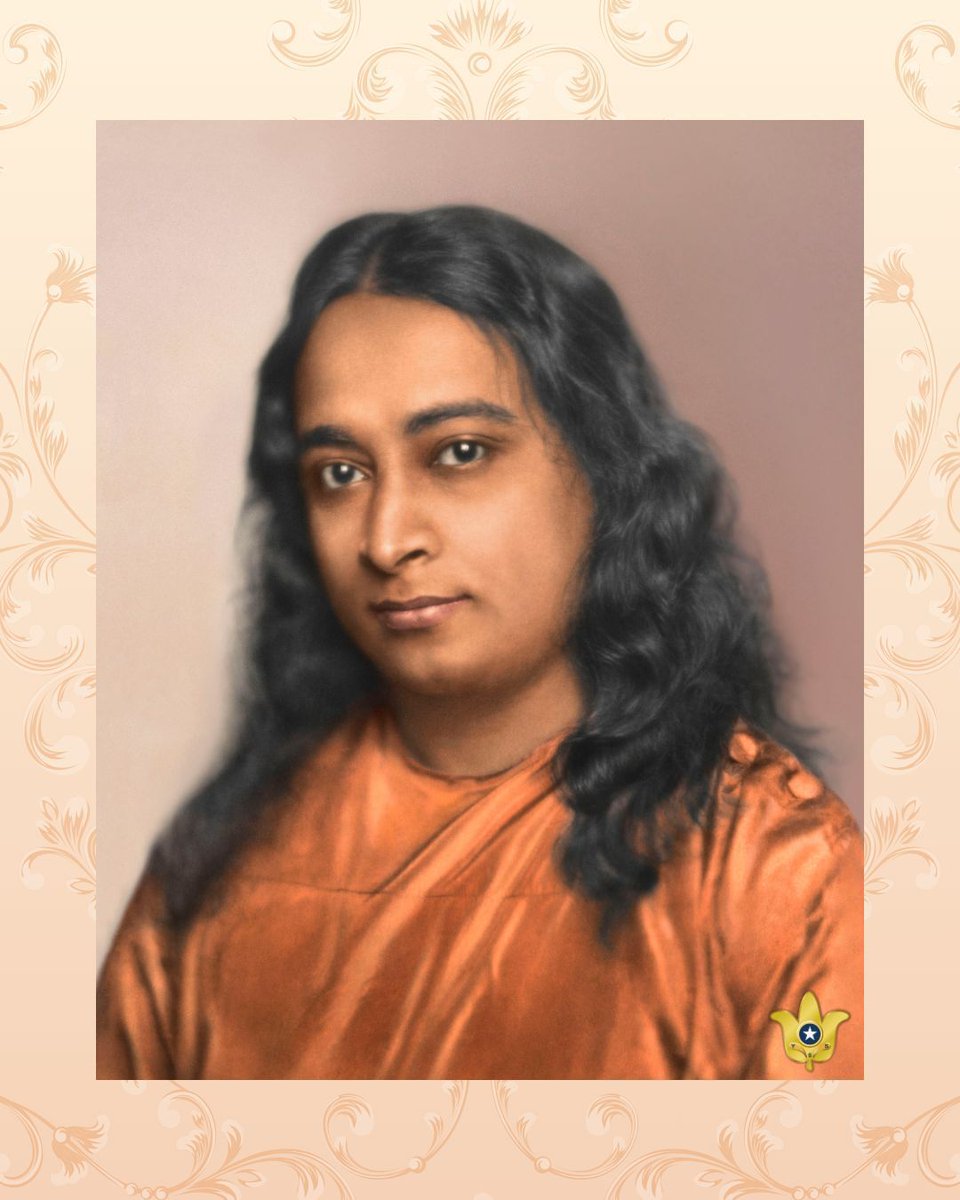
Paramahansa Yogananda wrote in “Autobiography of a Yogi:” “As the fragrance of flowers cannot be suppressed, so Lahiri Mahasaya, quietly living as an ideal householder, could not hide his innate glory. Devotee-bees from every part of India began to seek the divine nectar of the liberated master....The harmoniously balanced life of the great householder-guru became the inspiration of thousands of men and women.”
The commemorative programme of the Avirbhav Divas (birth anniversary) of Sri Sri Lahiri Mahasaya will be conducted online by a YSS sannyasi on September 30.
Tuesday, September 30
6:30 a.m. to 8:00 a.m. (IST)
To learn more and join, please visit: https://t.co/Ph4IyPnIdF
YSS ashrams as well as most YSS kendras and mandalis will also conduct special in-person programmes on this occasion. Please contact a YSS centre near you for more details: https://t.co/XbASiCAo5x
#LahiriMahasaya #KriyaYoga #AvirbhavDivas #YSS #YogodaSatsangaSocietyofIndia
It was on a Thursday in July of 1915 that Paramahansa Yogananda (born Mukunda Lal Ghosh) became a monk of India’s ancient Swami Order and took on the name Yogananda — bliss (ananda) through divine union (yoga).
We invite you to learn more and discover the illuminating story of Paramahansa Yogananda’s life: https://t.co/QvzHIDuJe2
#Yogananda #YogodaSatsangaSocietyofIndia #YogaHistory #swami
Brahmagupta was an ancient Indian mathematician and astronomer who lived in the 7th century CE. He made many important contributions to mathematics, especially in the fields of number theory, algebra, geometry, and trigonometry.
He introduced the concept and computation methods of zero as a number, and defined its properties and operations. He also recognized that any number divided by zero is infinity, and that zero has no reciprocal.
He developed a method of multiplication called “gomutrika”, which is similar to the modern lattice method. He also devised algorithms for finding square roots, cube roots, and solving linear and quadratic equations. He studied various types of indeterminate equations, such as the Pell’s equation, which is of the form x² - ny² = 1, where n is a given positive integer. He gave a general solution for this equation using a recursive method. He also found integer solutions for other equations of the form ax + by = c, where a, b, and c are given integers.
He discovered many formulas and theorems related to geometry and trigonometry, such as the Brahmagupta’s formula for the area of a cyclic quadrilateral, the Brahmagupta’s identity for the product of two sums of two squares, and the Brahmagupta’s theorem for the orthocenter of a cyclic quadrilateral. He also gave approximate values for pi and the sine function.
He wrote two influential works on mathematics and astronomy: the Brāhmasphuṭasiddhānta (The Opening of the Universe) and the Khandakhadyaka (The Edible Bite). These works contain many original ideas and insights that influenced later mathematicians and astronomers in India and beyond.
Brahmagupta was one of the greatest mathematicians of ancient India, and his legacy is still evident in modern mathematics.
1/ This widow from Bengal straddled 18th-century Benares like a colossus. Alongside another widow, Ahilya Bai Holkar, she revived the city’s sacred sites. The incredible story of Rani Bhabani—a thread.