@JimMarous@conorneill
Respected Sir
Small initiative!
Your guidance & Blessings 🙏
Every day we're told: "Work harder" or "manage your time better." Maybe the real solution isn't more effort—it's learning what truly deserves your attention.
Let AI agents coordinate the workflow and handle more of the execution.
But do not confuse autonomy with accountability: however much autonomy they are given, responsibility for the process and its outcome remains with the human process owner. By design.
Microblog @antgrasso
The job changes.
Imagine an order process that crosses sales, finance, and operations. Today, a process owner may spend time keeping handoffs moving and resolving exceptions between teams.
An AI agent could coordinate much of that flow automatically.
So what is left for the process owner?
Quite a lot.
Someone still has to define what the agent is allowed to do and when a case needs human judgment. Someone must also decide whether the outcome remains acceptable when business conditions change.
The process owner therefore moves from coordinating every handoff to governing the mandate behind the process.
AI can run more of the flow.
It cannot accept responsibility for what the flow produces.
#AIAgents #ProcessManagement
AgentOps is the discipline that keeps AI agents visible and under control once they begin working inside real business processes.
An agent may perform well during a pilot and still behave differently in production.
Data changes.
Workflows are updated.
Microblog by @antgrasso
A permission that looked harmless during testing may create risk when the agent starts acting across live systems.
Consider an AI agent that updates supplier records.
Before deployment, the company defines which fields it can change. Its behavior is tested with realistic cases, including incomplete information and unexpected requests.
Once the agent is active, the work continues.
Teams need to see what it did and where review is required.
When behavior moves outside accepted limits, they must be able to adjust the agent or stop it.
This is the purpose of AgentOps: turning autonomous activity into something the organization can observe and manage with confidence.
An AI agent should never be easier to deploy than to stop.
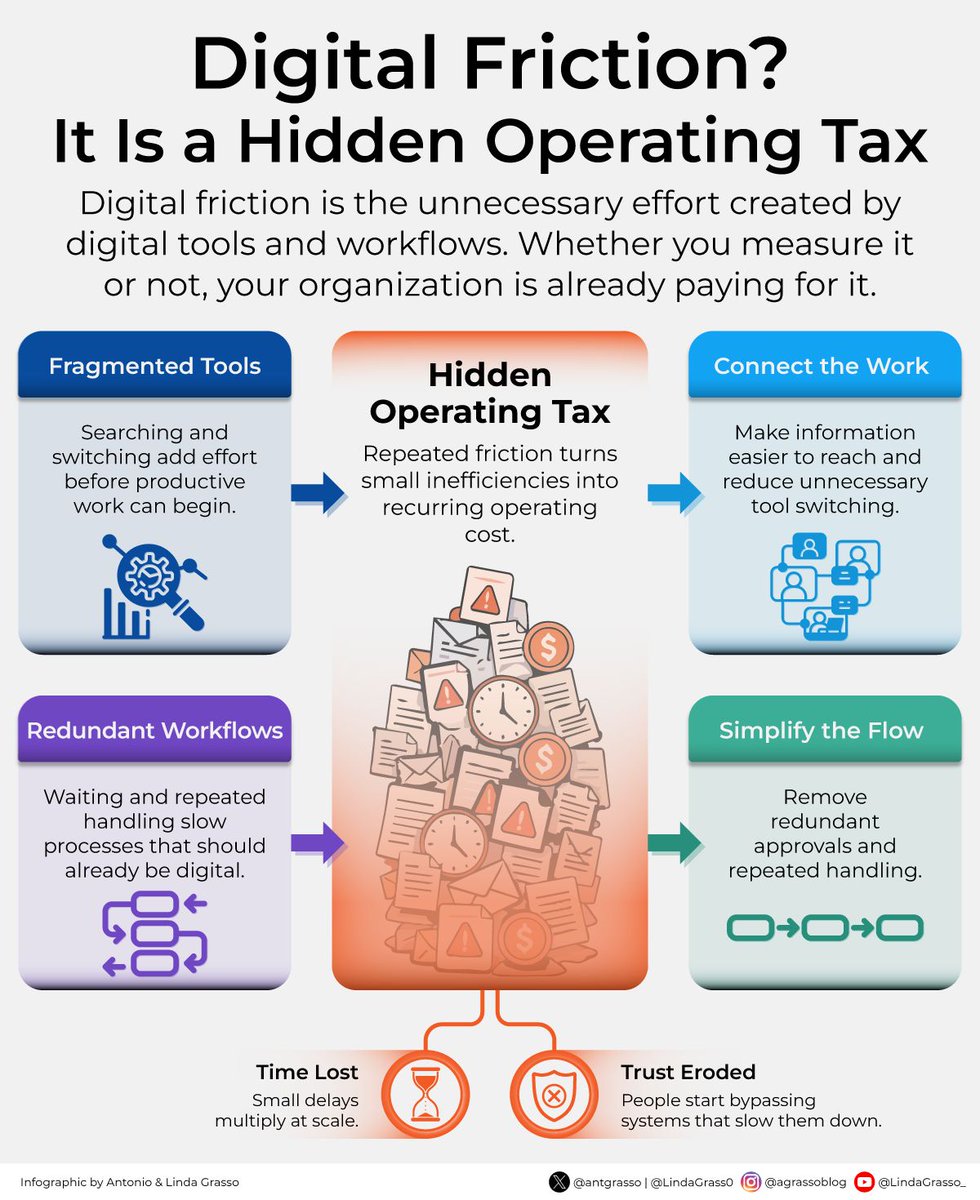
You are happy with the benefits digital transformation brings to your company, but now you are discovering a “hidden tax”: digital friction.
It appears when people repeat work, switch between systems, or wait for information, consuming time and capacity.
Microblog @antgrasso
Let me explain digital friction “papele papele,” as we say in Naples: plain and simple.
An employee updates a customer record in the CRM, then copies the same information into another system because the two platforms do not communicate.
Five minutes disappear. Multiply that by hundreds of people every day and the cost is no longer small.
Or take an approval process. The request is already inside a digital workflow, but someone still exports a file and sends it by email for another check.
The technology is there.
The work is still moving twice.
Digital friction often hides in repeated work or waiting between systems.
The answer is not another transformation project. Start by watching how work actually moves and identify where people repeat actions or leave one system just to complete a task in another.
Then remove the friction that adds no judgment.
A process can be digital and still waste time.
That waste is the “hidden tax” you keep paying until someone looks closely enough to see it.
AI won’t make most human skills obsolete, but it will change how they’re used.
Negotiation, problem solving, and leadership will matter more than ever as people work alongside agents and robots.
Our new Skill Change Index shows which skills will be most, and least, exposed to automation in the next five years: https://t.co/fRXfHF1k56
A foundation model gives AI general capability, but your business context turns that capability into something useful in daily operations.
So what actually makes a general-purpose model useful inside your company?
Usually, it is the context around it.
Microblog by @antgrasso
The model may know a lot, but it does not know your internal policies or current business data. It also lacks the practical context of how your teams work.
If RAG and MCP sound familiar, this is where they fit. Retrieval-Augmented Generation can bring relevant enterprise knowledge into the response, while Model Context Protocol can give AI standardized access to approved data sources and tools.
Then the operational questions start.
Can people trust the answer? And what happens when the business context changes?
Testing before deployment helps expose weak points. Once the system is active, monitoring shows whether its behavior still matches business needs. Human review remains important where judgment has consequences.
There is also a cost dimension. More context and repeated interactions consume more tokens, so organizations need to understand what useful personalization is really costing them.
A foundation model gives capability.
Your business gives it direction.
Still expecting the CIO to say “mea culpa” when resilience fails?
You may have once.
Today, digital resilience is a board responsibility because disruption reaches operations and business continuity, far beyond the data center and IT function alone.
Microblog by @antgrasso
Why has the responsibility moved?
Because a digital failure rarely stays inside IT.
If a cloud outage stops online orders, restoring the infrastructure is a technology problem. Deciding which business services must return first is an executive leadership decision.
If a cyberattack forces a factory to slow production, the CIO can coordinate recovery of the systems. But who decides how long operations can tolerate the disruption? Who decides what customers should be told and which business risks are acceptable?
Executive leadership needs to make those decisions.
Digital resilience now depends on knowing which operations the company cannot afford to lose and making sure technology recovery supports them. The CIO remains central, but cannot carry that responsibility alone.
And resilience starts before the incident.
Investment choices and continuity plans need agreement while everything is still working. Accountability must already be clear.
When disruption arrives, the CIO can restore technology. Executive leadership must already know how the business will continue.
Despite its complex name, a decision coherence system has a simple goal: helping different teams make choices from the same business context.
AI brings shared information and visible trade-offs into the conversation before decisions are made.
Microblog @antgrasso#EnterpriseAI
Consider a common situation.
Sales wants to promise faster delivery, while operations is already working close to capacity.
Both teams may be making reasonable choices, but they are looking at different parts of the business.
A decision coherence system can surface that dependency before the promise reaches the customer.
It shows where assumptions differ and which constraints need attention.
Outcomes from previous decisions can also guide what the organization does next.
People still make the final choice.
AI provides a common view, so local priorities do not create problems elsewhere.
For this to work, organizations need consistent data definitions and clear responsibility for the information feeding the system. Otherwise, they may coordinate decisions more quickly without making them more coherent.
Decision coherence does not require everyone to agree.
It requires everyone to begin from the same business reality.
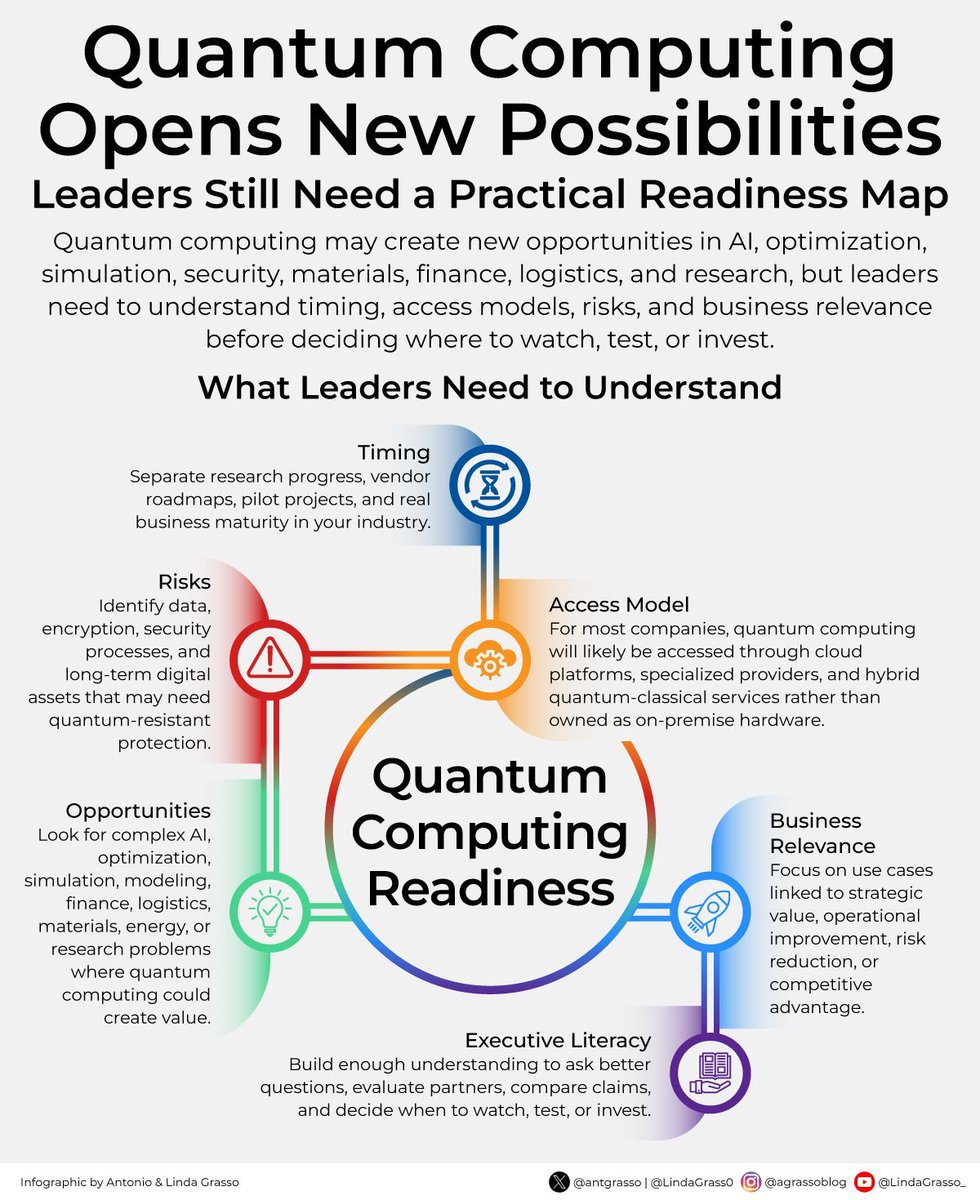
Quantum computing may feel distant, but readiness takes time, and leaders who wait for certainty may discover too late that literacy and risk awareness cannot be improvised.
The challenge is not to predict the moment when it will be ready for broad use.
Microblog by @antgrasso
The real challenge is to avoid reaching that moment without enough understanding to ask the right questions.
Leaders need to separate research progress from business maturity.
A promising roadmap is not the same as a useful capability for their industry, so timing matters as much as curiosity.
Access will also shape adoption.
Many organizations will not own quantum hardware. They will likely work through cloud platforms or specialized providers, which makes partner evaluation part of readiness.
Risk deserves early attention.
Data, encryption, and long-term digital assets may need protection before quantum capabilities are widely available.
Waiting until the threat is obvious can make the response slower and more expensive.
Opportunities need the same discipline.
Quantum computing may support complex optimization or simulation problems, but value will come from use cases connected to real business needs.
The message is simple: do not rush into quantum because it sounds futuristic, but do not postpone understanding until the future arrives.
AI adoption stands on more than the technology people can see.
Tools may look like progress, but weak foundations can make the whole structure fragile.
Buying AI is the visible part, while making it work is the part that many organizations underestimate.
Microblog @antgrasso
A company can invest in platforms and consulting, but the investment remains weak if data is unreliable, workflows are disconnected, or governance is unclear.
When information quality is poor, AI creates confusion instead of useful support.
When people lack the skills to question outputs and apply them well, adoption becomes dependency.
That is why AI adoption must be built below the surface, where reliable data and responsible governance give people the confidence to guide the technology.
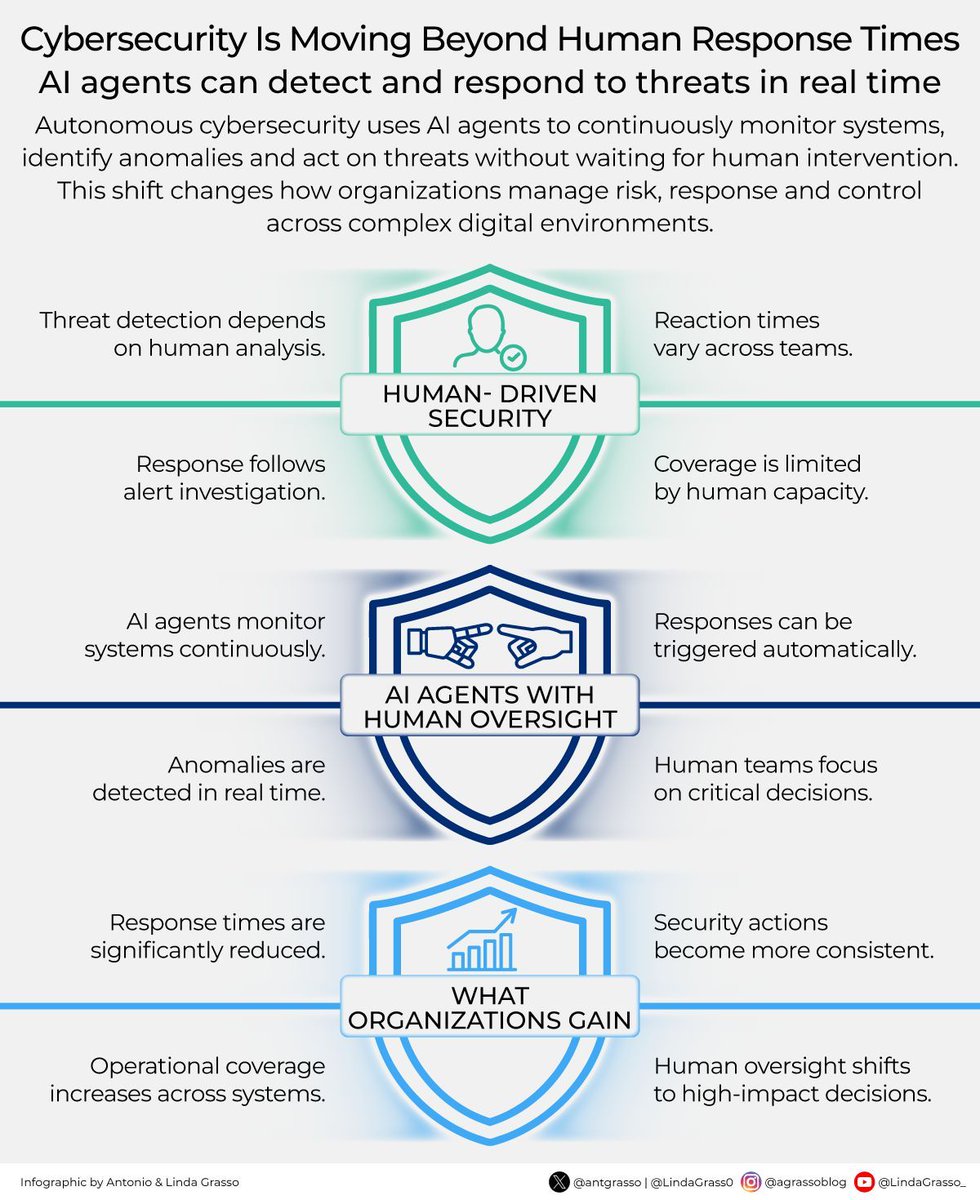
You may think your security team can respond in time, but attackers are already using automation and AI to move faster.
Defensive AI agents can help close that speed gap while human oversight keeps every automated action under clear control.
Microblog by @antgrasso#AiAgents
The point is not to remove people from cybersecurity.
It is to protect their attention and give them more time for the decisions that require judgment.
AI agents can monitor systems continuously, detect anomalies earlier, and trigger controlled first responses before damage expands.
Human teams should focus on the choices that carry real consequences: containment, escalation, legal exposure, business continuity, and trust.
In cybersecurity, machines can handle speed, but people must keep responsibility and final control.
After months of writing, editing, and learning, my book Wired for Now is finally out.
It explores how we can thrive in an AI-first world without losing what makes us human.
Would love your thoughts.
@naval@ProfCalNewport@thebookmaven
https://t.co/BL27ciTM54
After months of writing, editing, and learning, my book Wired for Now is finally out.
It explores how we can thrive in an AI-first world without losing what makes us human.
Would love your thoughts. @AdamMGrant@morganhousel@antgrasso
https://t.co/BL27ciTM54
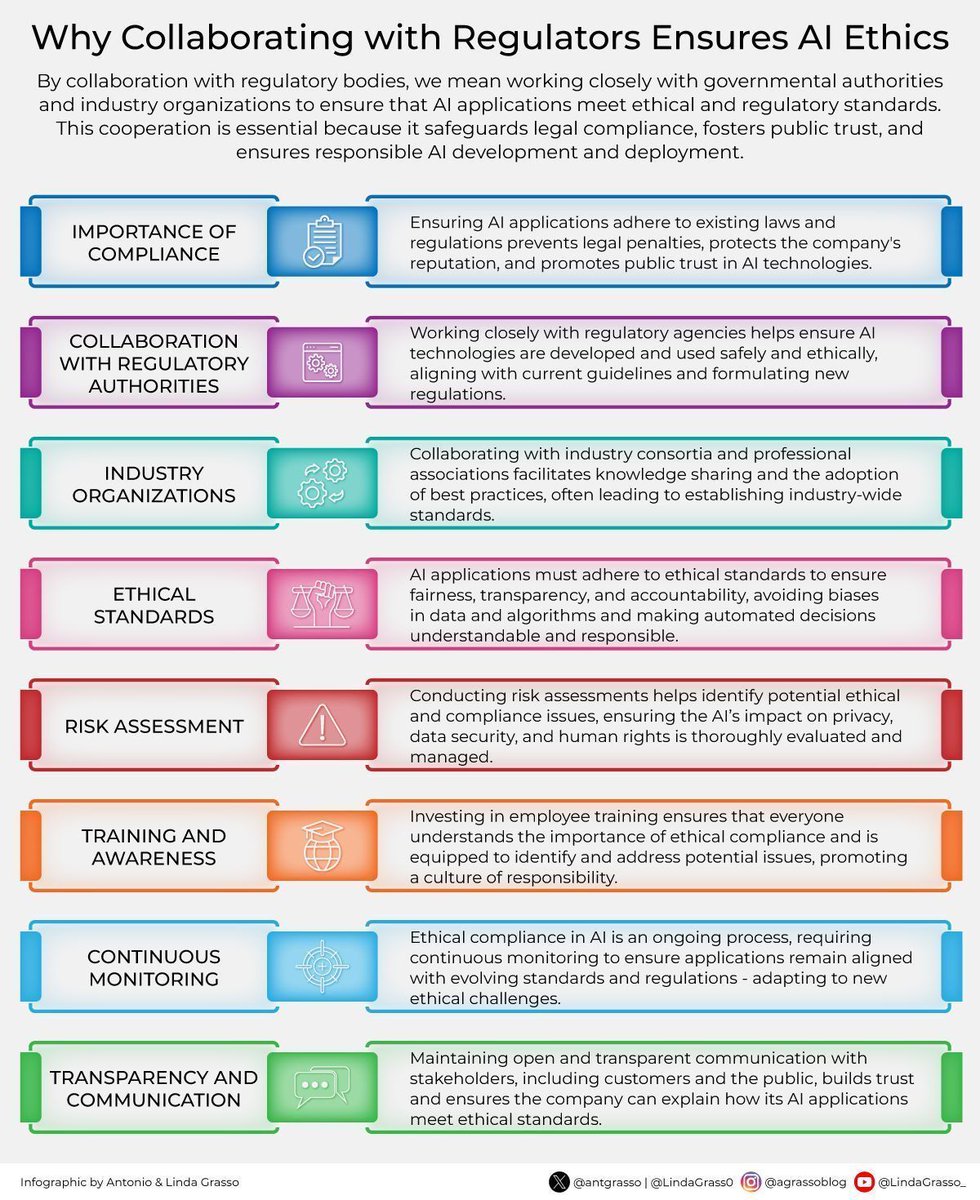
AI ethics becomes practical when companies work with regulators early.
Clear rules help teams design safer systems, reduce legal risk, and explain AI decisions with more confidence.
Microblog @antgrasso
@ola_supports@Olacabs
Your onboarding process , needs to be revised. Gorakhpur majority drivers are cancelling the rides. Calling,channels amt and cancel,this was not for which ola was formed or other
Microservices break applications into smaller parts so systems can change without slowing everything down.
As complexity grows, this approach helps teams update features faster, fix issues locally, and keep services running without large disruptions.
Microblog by @antgrasso
What changes in practice:
- Teams work in parallel on different services, reducing delivery time
- Issues stay contained within a service instead of spreading system-wide
- Scaling targets only what is needed, improving resource use
- APIs make communication between services clearer and more structured
- New technologies can be introduced without rewriting the whole system
Strong coordination is still required to keep all services aligned and working together.
What is Google’s TPU?
A TPU (Tensor Processing Unit) is Google’s custom AI chip, designed from scratch for the giant matrix multiplications that modern models live on. GPUs were built for graphics first.
TPUs were built for deep learning from day one.
At Cloud Next ’26, Google unveiled its 8th generation, and for the first time it ships in two flavors. TPU 8t is built for training, where raw throughput wins. TPU 8i is built for inference, where latency and chip-to-chip speed matter most.
Both still share the same Axion CPUs, liquid cooling, and software stack, so code written for one runs on the other.
The diagram below is a quick study guide to what’s the same, what’s different, and why, based on our understanding of published Google articles.