The @ilyasut episode
0:00:00 – Explaining model jaggedness
0:09:39 - Emotions and value functions
0:18:49 – What are we scaling?
0:25:13 – Why humans generalize better than models
0:35:45 – Straight-shotting superintelligence
0:46:47 – SSI’s model will learn from deployment
0:55:07 – Alignment
1:18:13 – “We are squarely an age of research company”
1:29:23 – Self-play and multi-agent
1:32:42 – Research taste
Look up Dwarkesh Podcast on YouTube, Apple Podcasts, or Spotify. Enjoy!
A good read. AI trade has shifted into a fundamentally different regime after gemini 3. 2026 will be fun observing how paradigms shift and NVDA moves- still could be a good price to enter.
Part 2: The Non-Bubble that disappointed both Bulls and Bears: How Gemini 3 changed everything (again!)
Last week, we wrote how we were undergoing a new paradigm shift in the AI trade after Sam’s Splurge, with increasing questions and scrutiny versus the first 3 years of the trade where most AI infra stocks acted as a monolithic block. If Sam Altman’s spending binge opened up the pandora's box of existential AI questions, the Gemini 3 release this week delivered an even bigger shock to the equation, further reinforcing our view that the AI trade has shifted into a fundamentally different regime.
Describing the market environment last week, we said: “The market is currently doing what it always does after a narrative/paradigm shock: digest, recalibrate, reassign risk premia.” The market did more of that this week, beginning to price a world where Google is the dominant LLM. The work isn't over. Over the last few days, we have found ourselves asking a lot more questions than we currently have answers to. Many of the investors we talk to are in the same boat. Among those questions:
How sticky is ChatGPT and how strong is their first mover advantage? How will GOOGL’s increasing advantage in multi-modal AI shift the competitive landscape of chat-bot LLMs? Does OpenAI pivot? What does that mean for the AI infra space? ChatGPT has proven exceptionally sticky, largely due to the “first mover” advantage. Does Gemini 3 release change this? We’re about to find out.
I think for the vast majority of consumers who use chat LLMs, there is unlikely to be any big difference between Gemini 3 and ChatGPT 5.1, so those who have ingrained habits, saved chat histories, and developed" “muscle memory” for ChatGPT’s interface will likely stick with it.
While no big shift in users would be a good thing for ChatGPT, it also cements an important point: Chat LLM functionality is plateauing.
For power users, it might be a little different as many find G3 Pro faster and crisper than the previous go-to: Chat-GPT 5 Heavy Thinking. While many still use ChatGPT Pro for more complex tasks, my guess is many are likely to shift most of those workloads to Gemini Deep Think when it comes out.
While Gemini 3 benchmarks are overall stunning and lead the pack, along with it being a very efficient model for back-end tasks, it isn’t perfect either — Hallucination rates are much higher than Chat-GPT 5.1. Reading reviews on X and Reddit, many still prefer Codex and Sonnet 4.5 to Gemini 3 Pro, which still has low rate limits.
The Gemini 3 launch has lacked the virality factor so far, but it’s possible the release of Nanobanana Pro (already in the wild) and its next-gen video model Veo4 could change that. We have seen with the ChatGPT Studio Ghibli image model release, Nanobanana’s initial release, and the Sora 2 release that image and video are much more likely to drive virality than chat LLM upgrades. These viral hooks are more likely to entice users to break their habits and try a competitor.
This also brings up another important issue, that ties into plateauing chatbot functionality: the rate of change in improvements in models will likely be increasingly seen in multi-modal like image-gen and video creation, two areas in which having an advantage in token cost will be even more key. GOOGL just proved they are the leader here and their lead is likely to grow with video as GOOG has the whole Youtube corpus of data to train on.
Does OpenAI continue to pursue multi-modal and press the pedal on spend? Multi-modal is a game of marginal costs while reasoning (enterprise) is a game of marginal value. If OpenAI continues to fight Google on multimodal consumer features, they are entering a war of attrition they are mathematically destined to lose.
One could argue deciding to shift away from multi-modal is the best thing OpenAI can do: it decouples them from the “bandwidth wars” where Google’s infrastructure advantage is insurmountable and allows them to reallocate previous compute toward reasoning, helping position them as premium intelligence layer for Enterprise rather than a commoditized content factor for consumers — something closer to what Anthropic is doing. This all depends on image/video functionality not shifting users to Gemini, which would trigger the bear case for OpenAI: users declining and ultimately hurting their ability to monetize the chat-bot through ads.
And we haven’t even touched on the potential emerging advantage for Google’s “all-in-one” ecosystem - not only for multi-modal - but Gemini becoming an ambient layer woven into all the products many of us already use: search, gmail, workspace, Android (and likely iPhone in the future). The competitive landscape is increasingly shifting from “who has the smartest chatbot” to “who has the most integrated workflow” — well, Google has both right now.
This leaves OpenAI in a bit of “no-man’s land.” They can either bleed cash fighting a multimodal bandwidth war they can’t win, or retreat to the Enterprise niche (the Anthropic strategy). But even that retreat is dangerous, as Google leverages its “All-in-One” ecosystem to weave Gemini into the daily workflows of billions of users via Android and Workspace. In addition, Gemini 3 does very well with back-end enterprise tasks, and some of our checks already show some share shift there.
Lastly, while bulls will say Gemini 3 showed scaling laws still hold, bears will say incremental functionality to the average user is minimal. If OpenAI decides that “good enough” is sufficient for 90% of its users and they decide to cede multi-modal, do they slow down purchases of next-gen training clusters? Seems unlikely Sam will cede multi-modal, but economic realities are starker now than they were a couple months ago. We know OpenAI has a deep talent pool, but they also lost a lot of multi-modal talent to META’s MSL.
Is it possible OpenAI pivots R&D to efficiency and focus on making models smaller and faster rather than just smarter? We’ve seen what the Chinese have been able to do with much less compute than OpenAI is about to have. Will a pivot to “Who can run GPT-5 level intelligence locally on a phone?” rather than “Who has the smartest model in the cloud?” be the battleground OpenAI prefers to fight in?
The answer to these questions will have profound implications across the AI infrastructure ecosystem. The Gemini 3 release has accelerated how soon OpenAI and the industry need to confront these questions, among many others which were opened with Sam’s Splurge.
Taking all this into consideration, the post NVDA EPS sell-off across the AI infra space seems more on-point than many initially have posited, as the Gemini 3 release has forced investors to grapple with BIG questions with BIGGER implications.
And maybe the biggest question of all: what does this mean for NVDA’s margins? There were already concerns of peak margins given rising input cost inflation (particularly in memory) and because the Rubin ramp will initially be margin dilutive, and GOOGL’s vertical cost advantage adds an even bigger wrinkle.
Right now, the vast majority of the profit in the AI stack is being captured by one player: Nvidia. Others like OpenAI and Anthropic are operating at near-zero or negative margins to fund Nvidia’s 75% gross margins. This didn’t seem to be a problem for investors until Sam’s Splurge and Gemini 3 brought the questions to the forefront. To keep the ecosystem healthy and thriving, to keep the paradigm “always moaaar compute,” will NVDA keep pricing lower than they otherwise would have for next-gen GPUs? I understand the TCO math for GPUs - at the current token cost, it’s incredibly profitable for whoever buys the racks. I’m also still generally bullish on compute. My only point is there are questions being raised by Gemini’s release that could shift the industry dynamics in unexpected ways, which means less room for arguing a 30x multiple, which we had previously done. GOOGL is already getting more aggressive at selling TPUs externally, and (along with AMD’s more competitive ‘26 lineup) we also think G3’s release and GOOGL’s demonstrated TPU cost/performance advantage will encourage companies to more aggressively pursue their ASICs strategy, which all add more competition to NVDA.
Still, while this week has muddied the narrative significantly — and we love clean narratives here at TMTB — there’s a price for everything. At the current price, NVDA is trading at 20x our 2026 EPS and despite unanswered questions, that seems like a pretty good price to pay.
Recent weeks have forced investors to confront the unforgiving speed of the AI shift. It feels like that scene in Interstellar where time has become dilated: one hour in Tech investing is 7 years back in the SP500. In this environment, having the mental agility to aggressively update priors and remain radically open-minded to the unexpected remains a critical edge. Should be a fun 2026.
A number of people are talking about implications of AI to schools. I spoke about some of my thoughts to a school board earlier, some highlights:
1. You will never be able to detect the use of AI in homework. Full stop. All "detectors" of AI imo don't really work, can be defeated in various ways, and are in principle doomed to fail. You have to assume that any work done outside classroom has used AI.
2. Therefore, the majority of grading has to shift to in-class work (instead of at-home assignments), in settings where teachers can physically monitor students. The students remain motivated to learn how to solve problems without AI because they know they will be evaluated without it in class later.
3. We want students to be able to use AI, it is here to stay and it is extremely powerful, but we also don't want students to be naked in the world without it. Using the calculator as an example of a historically disruptive technology, school teaches you how to do all the basic math & arithmetic so that you can in principle do it by hand, even if calculators are pervasive and greatly speed up work in practical settings. In addition, you understand what it's doing for you, so should it give you a wrong answer (e.g. you mistyped "prompt"), you should be able to notice it, gut check it, verify it in some other way, etc. The verification ability is especially important in the case of AI, which is presently a lot more fallible in a great variety of ways compared to calculators.
4. A lot of the evaluation settings remain at teacher's discretion and involve a creative design space of no tools, cheatsheets, open book, provided AI responses, direct internet/AI access, etc.
TLDR the goal is that the students are proficient in the use of AI, but can also exist without it, and imo the only way to get there is to flip classes around and move the majority of testing to in class settings.
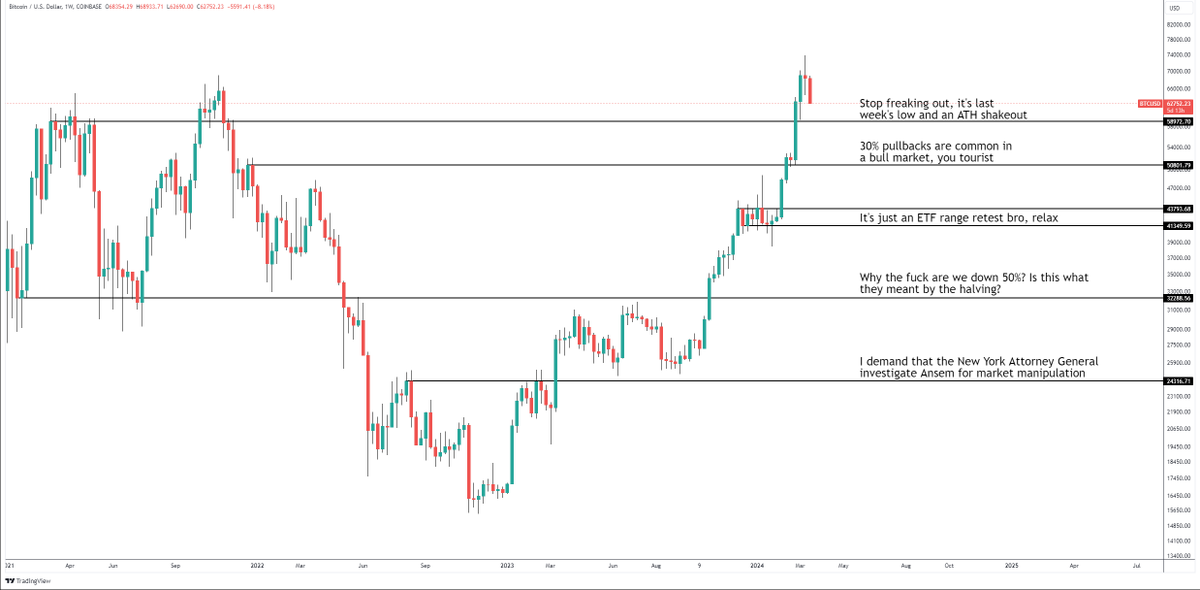
More favorable policy, ETF inflow potential, post BTC halving, macro pivoting to rate cut.
All is pointing to a bull except price action. But most people only care about the short term price action.
I’m more bullish than I have ever been about crypto.
I have been building @Circle for over 11 years, and at no time have I been more optimistic than right now.
I also believe that the overwhelming majority of people have an extremely narrow and limited understanding of what’s unfolding. And that’s super bullish too.
This post explains why I am so optimistic.
My perspective here draws on closely watching internet technology adoption life cycles over the past ~35 years. We’ve seen an unrelenting march of open networks, open protocols and open software, with layer upon layer of infrastructure on the internet that deepens its utility for society and the economy. Each successive wave has transformed major industries, improving utility for people, inverting or transforming unit economics, and opening up radical new possibilities.
The collective contribution of open IP to this ongoing internet revolution actually appears to be accelerating, and crypto seems like it's on the cusp of catapulting society and the economy forward in tremendously powerful new ways.
11+ years ago when Sean and I were thinking about this space, it was totally apparent that crypto represented the next logical layer of infrastructure for the internet. Internet infrastructure had enabled frictionless, nearly free movement of data and seamless ability to connect and deploy software and hardware on a global network, and it was clearly struggling with its own success and weight.
The internet lacked a layer for trust, and without that it was capped in terms of the utility it could provide to the world. There was no way to have fully trusted data, transactions or compute, which led to deepening dependencies on hyper centralized entities (corporate and government).
At the same time, the role of the internet in society was proliferating, and the ability of the internet to play a larger and larger role in how society and the economy were organized was apparent.
And it was right at this moment that Bitcoin burst onto the scene, and a ton of incredibly sharp technologists began to think more deeply about how the fundamentals of crypto could be expanded to provide a more generalized internet infrastructure that could be foundational to society and the economy. Digital tokens, issued on public blockchains, intermediated by smart contracts could unleash a trusted environment on a global scale that would be the foundation of how nearly all of the building blocks of society and the economy could become internet-native.
This is what drew me into this space; I could see clearly then that this would unfold, that these new decentralized internet computers would achieve scale, and that it would ultimately usher in a wave of change that far exceeds the kinds of changes we’ve seen from the internet of information and communications.
In 2013, these ideas were considered insane. Any affiliation with Bitcoin or crypto was viewed as highly fringe, probably illegal, and for most technologists, a largely uninteresting technology development. Back then, the technology was extremely limited, slow, expensive, complex to operate.
Fiduciary institutions – banks, accounting and audit firms, insurance companies, regulators – were extremely hostile and deeply terrified to be associated with anything in this space.
The primary focus of the media was on darknet markets, the silk road, and the winklevoss twins BTC purchases.
But if you actually paid attention to what mostly young and highly creative builders were thinking about and doing, you could see clearly that the bigger vision was going to unfold, though over what exact time-scale it was not clear.
For those of us who have been building and working in this space since 2012 (and many from even earlier!), it’s totally and utterly extraordinary where we are at now. And, as I like to say often, we are truly only in the very early stages of the adoption of crypto in the world, which makes me insanely bullish today, given how far we’ve come in the past decade.
How far have we come? A non-exhaustive list of accomplishments and technical progress.
Public blockchain infrastructure has evolved into its 3rd generation, providing global scale network computers that can handle large scale applications with trusted data, transactions and compute.
There is a massive, thriving and growing competitive and innovative community of dozens of major blockchain network ecosystems, all around the world, that are constantly improving and innovating in the fundamental technology of these networks including in data availability, compute, security, privacy, transaction throughput, and so much more.
We are at the early broadband stage of blockchain networks. Guess what comes next?
We are seeing breakthroughs in security, privacy and scalability based on ZK tech, and now FHE. We can see a world where crypto computing becomes the basis for most significant and important applications.
There are literally tens of thousands of startups all around the world building on top of this infrastructure.
Digital assets have become an accepted part of the emerging global financial system, with virtually every major government in the world setting clear rules for how digital assets can be issued, used and traded.
Bitcoin itself has become one of the largest and most important alternative investment assets on the planet.
The biggest asset management firms in the world are offering products and services built on blockchain technology and offering investments into the underlying digital commodities.
Crypto has become a global political issue, as its importance to national competitiveness becomes clear. Governments around the world are racing to compete with one another to figure this out and ensure that innovation in this space is both responsible but also fostered.
We’re seeing product UX that unlocks consumer-scale usage in ways we’ve not seen before, giving a clearer view of how this will unfold for billions of users in the coming years.
Most of the world's largest payments companies are actively using this technology and exploring how to expand their usage as the benefits of public chains and stablecoins become apparent to everyone.
Stablecoins have exploded in scale and use, crypto clearest killer app, unleashing digital dollars in the world, bringing more people into the future onchain economy, and starting to fulfill the promise of banking the unbanked, lower the costs of remittances, and unlocking more seamless cross-border commerce.
Stablecoins are becoming a legally defined and accepted form of digital money in nearly every major jurisdiction in the world. By the end of 2025, stablecoins will be “legal electronic money” almost everywhere, which sets them up to become a larger and larger portion of the $100T+ market for electronic money.
The infrastructure to build, deploy and operate blockchain apps has advanced massively, with enterprise-grade products and services to help use these networks, with custody infrastructure that scales for end-user controlled self-custody to infrastructure that the world’s largest banks and asset managers can depend on.
Developer tooling, SDKs, and knowledge are proliferating at an accelerating pace. More and more people are becoming “blockchain capable”.
Massive consumer scale companies are bringing online apps that connect to public chains and use digital tokens for a wide array of use cases.
National governments are investing in blockchain infrastructure, ecosystem development and passing laws to provide incentives to companies to build in their regions.
We’re seeing more and more exciting uses of the tech gaining traction every week, from payments to social to gaming to ticketing to enterprise use-cases.
I could go on and on and on, but the scale of all of this right now is truly astounding compared to where we were a decade ago. Like prior waves of open internet infrastructure, this wave is growing, and is coming on stronger every day and every week.
And, like I said earlier, we’re still in the VERY EARLY STAGES in the adoption of crypto. That’s insanely bullish.
What does this look like when digital tokens are a widely understood and legally used form of incentives, governance, and record-keeping all around the world?
What does it look like when a larger and larger portion of finance and commerce constructs are executed and intermediated by smart contracts on public chain infrastructure?
What does it look like when 4th generation blockchain networks support billions of users and millions of applications?
What does it look like when onchain organizations are legally defined and explode and compete for organizing labor and capital and consistently outperform legacy multi-national corporations?
What does it look like when political bodies – cities, states, nations, and new network states – adopt onchain governance and improve how democratic values are expressed in the age of the internet?
What does it look like when 10% of global economic money is stablecoins, and when credit intermediation moves from fractional reserve lending to onchain credit markets built from the ground up on safer, digital cash instruments (e.g. stables), and opens up credit and debt to the long tail of supply and demand in the same way that Amazon did for commerce and AdWords did for advertising?
All of this is achievable over the next 10+ years. The time goes by fast, but when you zoom out and look at what has been accomplished and how that sets us up for the future, it’s hard not to be insanely optimistic right now.
JA
All you need to know about the $ETH ETF --> Current and future events.
-------------------
Past events:
▶️ 9 Nov --> Blackrock files for $ETH ETF "ishares Ethereum trust"
▶️12 Feb --> Franklin templeton joins the race and files it's own $ETH ETF
▶️23 Mar --> Blackrock deploys $100m on the @ethereum blockchain while Larry Fink talks about his plans to tokenize everything. Blackrock files it's "BlackRock USD Institutional Digital Liquidity Fund"
▶️27 Mar --> Larry fink states that he is optimistic about an $ETH ETF approval despite regulations labeling $ETH as a security
▶️27 Mar --> Fidelity files it's own $ETH ETF which includes plans to stake the $ETH it controls
▶️21 May --> Fidelity drops staking plans in $ETH ETF filing
▶️ 23 May --> SEC approves 19b-4 filings from VanEck, BlackRock, Fidelity, Grayscale, Franklin Templeton for spot $ETH ETFs to be traded
Future events and predictions by analysts
---------------------------------------------
▶️Gary gensler foresees $ETH ETF approval sometime before the end of summer
▶️Bloomberg analyst Eric Balchunas foresees the $ETH ETF launching on July 2
Personal thoughts
Seen a lot of opinions around the $ETH ETF about how it wouldn't have any significant demand.
Going through Larry Finks talks and overlooked filings such as Blackrock's own Institutional digital liquidity fund, including it's deployment of $100m tells me a lot about how serious @BlackRock is about onboarding institutional capital onto $ETH.
Frankly even more bullish than ever on $ETH in these conditions. Is the $ETH ETF priced in? Don't ask such stupid questions.
Links:
BlackRock USD Institutional Digital Liquidity Fund:
https://t.co/ohKmSvgAgT
Fidelity dropping staking plans
https://t.co/8ZaeZCMXGg
Franklin templeton filing:
https://t.co/ohKmSvgAgT
When we look back in a few yrs, we’ll remark at the ~similarity between #Bitcoin’s test, consolidation, and breach into price discovery of former cycle ATHs of $20K & $69K - poetic 🤌
What the May jobs report means for the Fed:
Not a whole lot. School's out. We were already looking at a summer holiday, with September as the earliest possible cut. The latest data don't really change the story. More here:
https://t.co/0BNvf4Ay26
Fed officials have a bias to cut rates but need a credible justification to get started
They hiked above 5.25% last summer to address a risk — entrenched inflation above 3% — that looks less salient now than it did then
Inside the latest debate: https://t.co/TybykL79O4
Am frequently asked about when to get long ETHBTC
Response is usually that this is the wrong question
If you think ETHBTC will go up, SOLBTC will go up more
Previous cycle traders need to adapt with the times
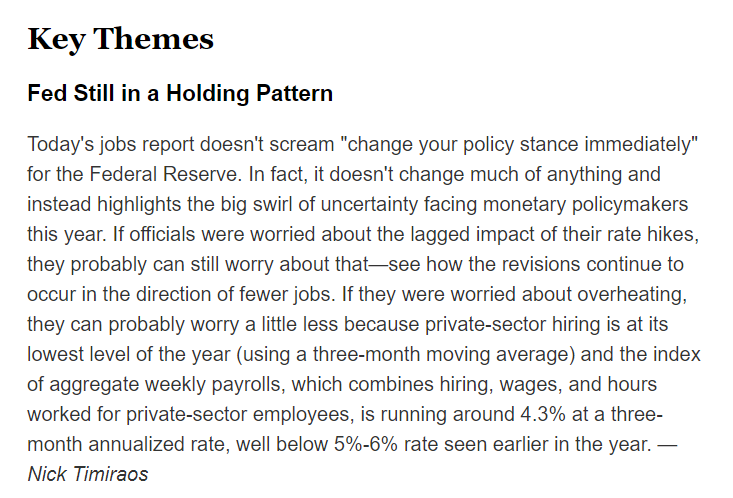
The December jobs report doesn't scream "change your policy stance " for the Federal Reserve.
In fact, it doesn't change much of anything for the central bank.
More in our RTE newsletter -->
https://t.co/XHJ7s79Bo5