Co-Founder of Visa Franchise, Vetted Biz • I like to build stuff (mostly companies), learn, write, grow • Health and Fitness, Growth, Mobile Apps, Crypto/Web3
People asked why I was so blown away by Claude Cowork, so I thought I’d puke some quick thoughts out
The true promise of Claude Cowork, and ultimately any sort of agentic, AI powered workflow tool is to realize the perfect embodiment of the organization as described by Peter Drucker, who famously said:
“Because the purpose of business is to create a customer, the business enterprise has two--and only two--basic functions: marketing and innovation. Marketing and innovation produce results; all the rest are costs”
Build the product and generate demand. That’s what drives value. Everything else is a cost
If you’ve never worked in a large organization, it’s hard to truly explain how many “costs” there truly are, and how many of those costs are just a coordination tax.
Take the launch of a new software product: The business needs to document how the product works, where it breaks and has errors. The support reps need to know how the support it. The onboarding and implementation team need to learn how to set it up. The Account Management team needs to learn how to upsell it and drive value through adoption. The sales team needs to learn how to sell it. The marketing team needs to position it in the marketplace and run campaigns about it. The partner network needs to learn it
The amount of coordination, repackaging, enablement, internal distribution etc is. Absolutely. Staggeringly. Enormous. Hundreds of people involved. Thousands at larger businesses.
Every one of these businesses have created convoluted templates and processes to document, enable, support, service, and sell
Now imagine taking all the market research, customer feedback, data, decisions, positioning, and yes, code, and cascading that automatically through the organization, repackaged using the templates that have already painstakingly been created and refined and honed through hundreds of launches, to the relevant team with the correct context and packaging, directly into the hands of actual internal or external end user
That’s the world that just got way, way, way closer to reality. In fact, the main reason it won’t happen any time soon are the people, many of whom will fight tooth and nail against this automation because they will fight like crazy to protect the status quo
This is why you are already seeing AI-native startups move so quickly. Because product launches are cascaded through the organization and out to the customer with way less friction than incumbents can ever dream of
Incumbents are going to have to whip their companies into the AI era. Their employees will not go willingly. But the future is here, and the startups are moving way, way faster
Software will proliferate just as videos, music, writing did.
The market structure will shift from a “fat middle” to mega-aggregators and a long tail.
It’ll be a slower process due to network effects, but many traditional vendor lock-ins will get eaten by AI.
This equals 40,000 full-time software developers working full time.
End of 2026: 200,000 developers.
2027: just Claude Code alone will be adding as much code as 1,000,000 full-time human developers.
2028: 1B+
Enjoy your last lines of handwritten code. Horses replaced by cars.
AI is amazing for small-TAM custom software.
Indeed, the smaller the market, the more amazing it is. Because small markets typically don’t support the costs of software development.
I genuinely believe we're watching SaaS die in real time and most people still don't see it..
$1 trillion wiped from software stocks since January 2026 and its just getting started..
SaaS multiples collapsed from 18.5x at the covid peak to 4.8x today and in the same time the AI market went from $50B to $539B and it's heading to $3.5 trillion by 2033 if not sooner
the death cross hits around 2027.. that's when AI market trajectory fully overtakes SaaS valuations on the chart
the reason is simple.. the per-seat model dies when 10 agents replace 100 humans and no seats left to sell
every SaaS tool you're paying $50/seat a month for is about to get replaced by an agent that costs $0.003 per task..
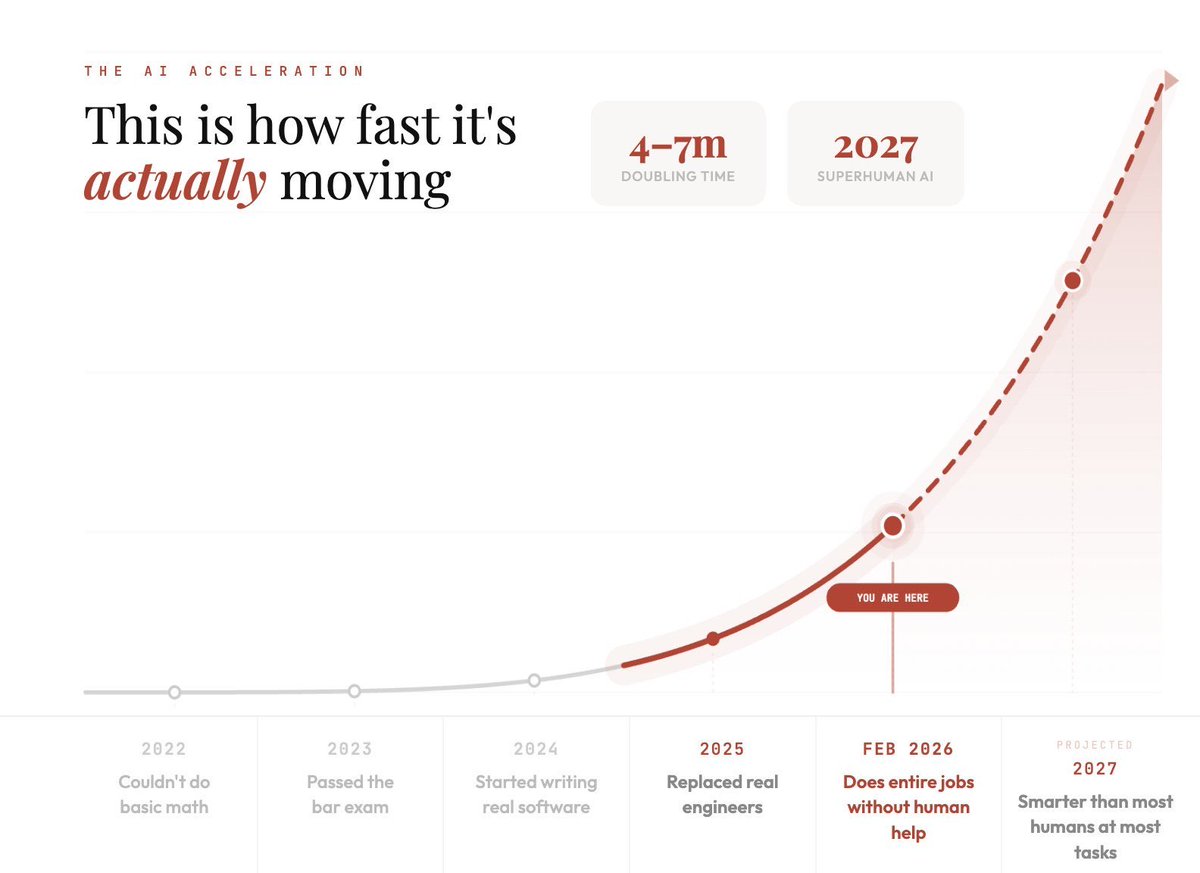
chatgpt opened the door in 2022, claude opus 4 made agentic AI real in 2025 and now multiagent coordination systems like openclaw are making it deployable and accessible to everyone..
every step on that chart the tech gets more autonomous and the SaaS line drops further..
not saying every saas will die but the companies that were built entirely on per-seat pricing and no real data advantage are the ones exposed.
tbh I don't think most founders see it yet, not because the data isn't there, but accepting it means everything they built needs to be rethought..
My biggest takeaways from @bcherny:
1. Coding is now “solved” for most use cases. Boris hasn’t written a single line of code by hand since November, with 100% of his work now authored by Claude Code. At the same time, he remains one of the most productive engineers at Anthropic, shipping 10 to 30 pull requests daily while leading the team.
2. Anthropic has seen a 200% increase in engineer productivity since adopting Claude Code. As Boris notes, “Back at Meta, with hundreds of engineers working on productivity, we’d see gains of a few percentage points in a year. Now we’re seeing hundreds of percentage points.”
3. AI is moving beyond writing code to generating ideas. “Claude is starting to come up with ideas. It’s looking through feedback, bug reports, and telemetry, then suggesting features to ship.”
4. The next roles to be transformed are those adjacent to engineering. Product managers, designers, and data scientists will see similar transformations as agentic AI expands beyond coding. “Any kind of job where you use computer tools will be next.”
5. Build for the model six months from now, not today. One of Boris’s key principles is to design products for future AI capabilities, not current ones. “It’s going to be uncomfortable because your product-market fit won’t be very good for the first six months. But when that model comes out, you’ll hit the ground running.”
6. Watch for “latent demand.” Claude Code was built by observing what people were already trying to do, and then making it easier. Cowork emerged when they noticed people using Claude Code for non-coding tasks like analyzing MRIs or recovering wedding photos from corrupted drives.
7. Don’t optimize for token cost. Boris advises companies to give engineers unlimited tokens during experimentation phases. “At small scale, the token cost is still relatively low compared to their salary. If an idea works and scales, that’s when you optimize it.”
8. Underfund headcount on purpose. When Boris puts one engineer on a project, they’re forced to let AI do more of the work. Constraint drives creative use of AI tooling, not just faster typing.
9. The most successful people in the future will be generalists. “Try to be a generalist more than you have in the past. Some of the most effective engineers cross over disciplines. The people who will be rewarded most won’t just be AI-native—they’ll be curious generalists who can think about the broader problem they’re solving.”
10. Always use the most capable model, not the cheapest. A less intelligent model often burns more tokens correcting mistakes than a smarter one spends getting it right the first time. Boris runs maximum effort on Opus 4.6 for everything.
Here's the full conversation: https://t.co/4hHAEq0Nto
Christian IV’s tax scheme was part of the Øresund Toll, one of the most profitable revenue systems in early‑modern Europe. Every ship entering or leaving the Baltic Sea had to pass the narrow Øresund strait, giving Denmark complete control over maritime trade between Scandinavia and the rest of Europe.
Instead of building a massive bureaucracy to inspect every vessel, Christian IV relied on a deceptively simple rule: captains declared the value of their own cargo, and that number became the basis for the toll. It looked like a gesture of trust but it was really a clever trap.
To prevent captains from lowballing their declarations, the king reserved the right to buy the entire cargo at the stated price. This forced merchants to be honest, because undervaluing their goods meant risking a total loss if the crown exercised its option.
The system was so effective that the Øresund Toll became Denmark’s financial backbone for centuries, funding wars, palaces, and the expansion of Copenhagen. It remains one of history’s most elegant examples of using incentives, not inspections, to enforce economic honesty.
#drthehistories
I think this is my biggest issue with AI right now.
I’ve switched over to 100% AI coding over the last few months. Overall, the experience has been great and I’m starting to get a handle on my new workflow.
While my productivity has easily 5X’d and my brain is enjoying thinking at a higher level of abstraction, the mental fatigue is real.
As someone who is self-employed, it has made it incredibly difficult to draw the line at the end of the day and close the laptop.
Don’t get me wrong, I already worked too much and stayed up too late before AI, but now when a feature is potentially a few prompts and 5-10 minutes away from completion, it’s so easy to say “just one more prompt.” and boom it’s 2AM.
Obviously, it’s a solvable problem and on me to address, but curious how others that aren’t tied to fixed schedules deal with this?
i’m absolutely loving the saas apocalypse discussions on the timeline right now.
to me the whole saas apocalypse via vibe coding internally narrative is mostly a distraction & quite nonsensical. no company will want to manage payroll or bug tracking software.
but the real potential threat to almost all saas is brutalized competition.
i.e. ai doesn’t need to magically recreate salesforce. it just needs to make it trivial for tiny teams to deliver functionally equivalent outcomes at a fraction of the cost. once that happens, pricing power potentially collapses.
imagine payroll… today you’re paying a fat margin for “trust + compliance + saas software” that increases prices so fucking often. like we have a startup & everyone is charging us up the ass for everything on a per seat basis. you can imagine tomorrow a 2 person shop empowered by ai can ship the same output, hit the same regulatory checkboxes, & charge 70% less because their cost structure is basically nil.
today saas margins exist because:
- engineering was scarce
- compliance was gated
- distribution was expensive
ai nukes all three in many ways, especially if you’re charging significantly less & know what the fuck you are doing when using ai. if you go to a company & say we will cut your fucking payroll bill by 50%, they will fucking listen.
the market will likely get flooded with credible substitutes, forcing prices down until the business model itself looks pretty damn suspect. someone smarter than me educate me on why this won’t happen please.
True.
Once the solar energy generation to robot manufacturing to chip fabrication to AI loop is closed, conventional currency will just get in the way.
Just wattage and tonnage will matter, not dollars.
opus 4.6 + codex 5.3 launching within 20min of each other is both insanely cool & crazy overwhelming.
i honestly have no idea what to make of the pace of ai anymore.
zero clue.
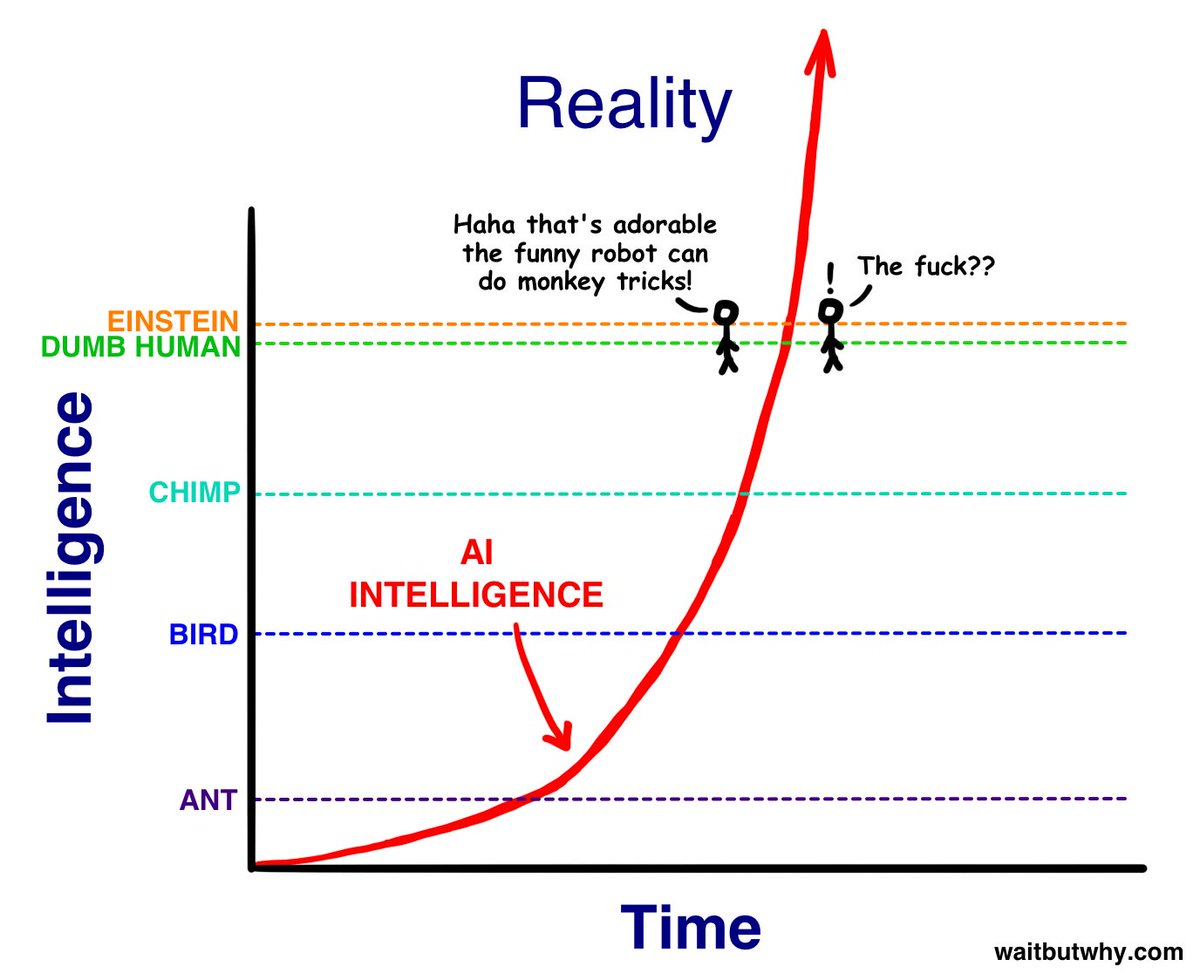
we all knew it was coming, but now that we’re clearly in the start of the takeoff it feels different.
my day is just using 9 different ai tabs at once and commanding them to do everything for me. agents are here, they work, and every week they get better. the exponential is ramping up. i do this all day and i can hardly keep up.
everyone will have an ai that can do or build anything they need on-demand.
you’ll have fleets of these things working for you 24/7 that can do knowledge work better and faster than any human. and that’s gonna be hear within what? a year?
what are you supposed to make of that?
feels like we’ll collectively have to raise our ambitions and that new unimaginably cool things will be possible.
i’m looking forward to those things.
best advice is probably just be happy and don’t die i guess?
or put more beautifully: don’t forget to live.
but the acceleration is speeding up in a *very* tangible way. not enough people read “machines of loving grace” and took it seriously. it’s all happening.
it gets even weirder when you consider that the average person has absolutely no clue that any of this is happening. that part weirds me out. it all sounds so schizo even though it’s obviously not.
sometimes i wish i was one of those blissfully ignorant normies haha. but it’s all just too fun. wouldn’t change a thing tbh.
rare rant from me.
but today had a particularly strong dose of “feel the agi” to it. crazy this is all real, as ilya would say.
turns out that living through the singularity is pretty wild.
god i didn’t think ai would kill entire industries this fast
- claude code is killing SaaS companies, stocks are down -15-30% over last 2 months.
- google genie is killing gaming companies, stocks tanked -15% since public release last week
- video models like kling, veo3 and higgsfield are replacing human content creators - it’s so bad the SAG is creating a new tax for ai influencers to donate to a human actor union fund.
- fortune 500 companies are pulling multi-million dollar software contracts and replacing them with agent platforms
- Oai, anthropic are aggressively partnering with science institutes and launching health features to automate the entire health industry (medical care, pharma, research are worth trillions)
- GPT 5.2 & gemini are solving unsolved problems in mathematics - what’s a math degree worth if an AI can solve complex shit 24/7?
but that’s not even the craziest part
“codex is now building itself, we just supervise” - Tibo (openai codex lead)
anthropic team has said the same about claude - it self-improves.
we’ve reached a point where ai models aren’t just automating away major industries - they’re doing it to THEMSELVES too
the acceleration of human and artificial cognition will come down to an equation of compute, energy and silicon chips
what a total mind fuck