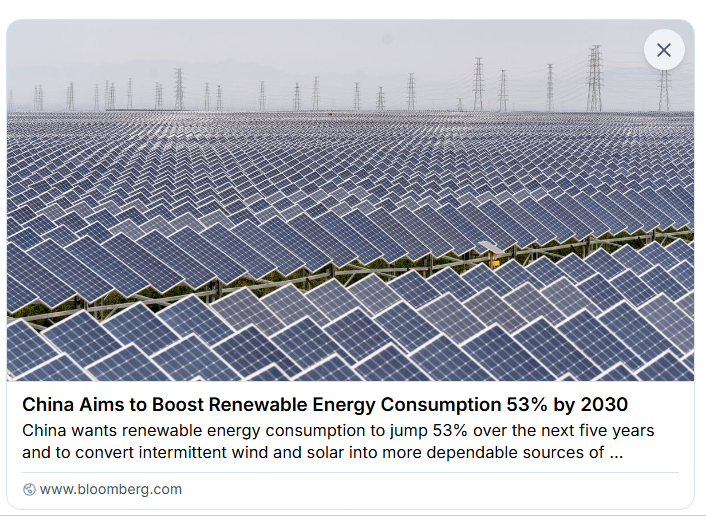
China's updated target: 6T kWh renewable power by 2030, ~50% increase. US total generation in 2025 was 4.43T. Wind & solar to rise from 22% to 30% of total mix. China consistently overshoots & beats its own renewable goals. These targets are destined to be a floor, not a ceiling.
Opinions differ.
Measurements don't.
428.9 ppm atmospheric CO₂.
Every year we delay cutting emissions, the challenge grows, the costs of limiting future warming rise, and the range of available options narrows.
#ClimateChange#ClimateCrisis#ClimateEmergency#NetZero
Britain’s net zero economy is booming, #CBI says
"There are huge costs to not seeing this transition as an economic opportunity."
“There is no tradeoff between economic growth and net zero."
"Quite the opposite. Net zero is the industrial opportunity of the 21st century.”
#EnergySecurity #RenewableEnergy #NetZero #EnergyTransition
https://t.co/pUg6kp0urs
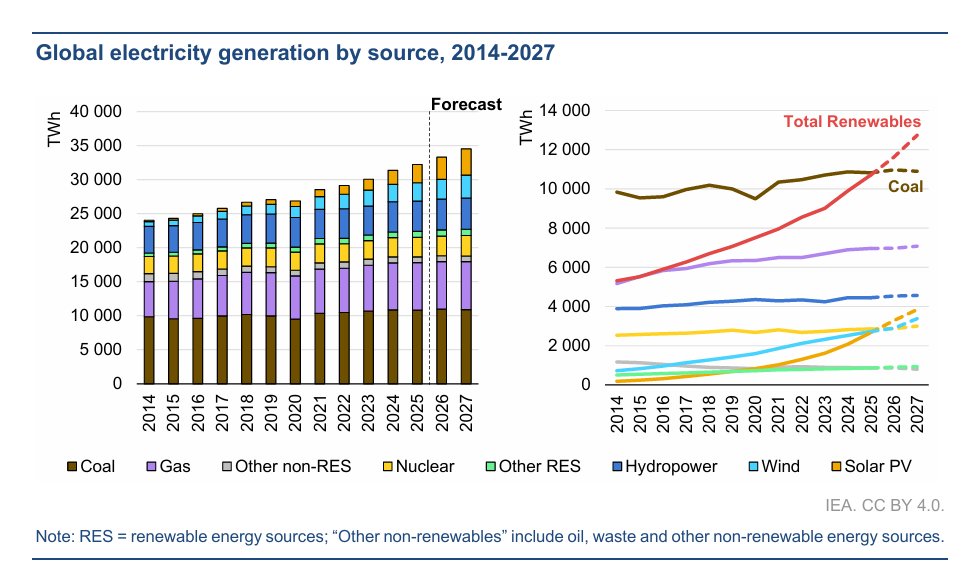
Good morning with good news: Renewables overtake coal in 2026 as world's largest source of electricity, after reaching near parity in 2025.
RE rise to 37% in 2027 from 35% in 2026 & 33% in 2025!
How?
Solar & wind rise to 21% in 2027 from 17% in 2025!
https://t.co/4PncZem2qA
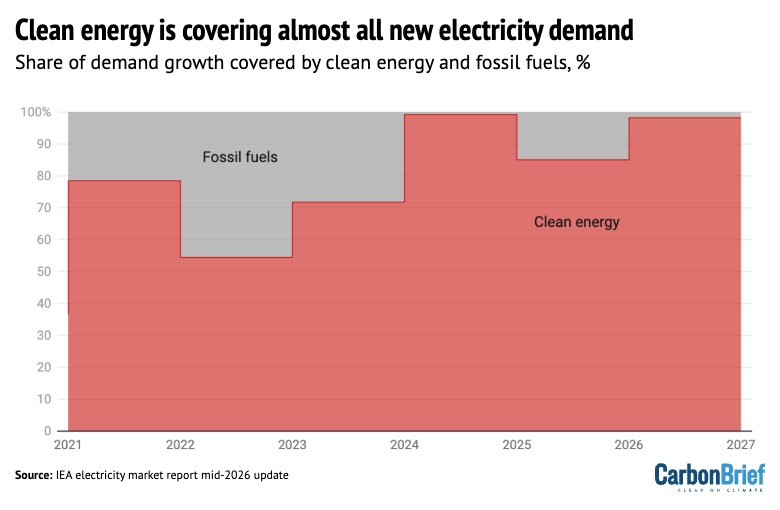
Today, almost all new electricity is coming from clean energy
Once clean-energy growth consistently exceeds the rise in demand, fossil-fuel power will start to decline
Source: IEA's mid-year electricity market update
The obstacle to Africa’s energy transition is no longer the price of clean technology, which has collapsed, but the cost of capital, which has not. A solar plant in the Sahel and one in southern Spain use much the same equipment, benefiting from the same falling panel prices, and powered, in the African case, by a stronger sun. Yet the African plant’s electricity will probably cost more for producers. The reason is not the panels, the sunshine, or the engineering. It is the cost of capital. Financing, not technology, is the obstacle. A generation ago, the reason for slow adoption rested on technology: renewables were expensive and unproven. That excuse is gone. Solar is now the cheapest source of electricity in much of the world, and Africa is the continent with the greatest solar potential on the planet.
FT 22nd July 2026
https://t.co/LGuLvuBA49
Renewables are overtaking coal as the world's largest source of electricity generation, after near parity in 2025.
New @IEA mid-year update: their share goes from 33% to 37% by 2027, solar and wind from 17% to 21%. EU well ahead of global average.
https://t.co/x2kYcEz6Q3
Good morning with good news: China will increase renewable energy generation by 50% to 6 trillion kWh by 2030.
US generated a total of 4.43 trillion kWh in 2025.
RE will rise to ~46% in 2030.
Wind & solar will jump to 30% in 2030 from 22% in 2025.
https://t.co/J2JoG9yAa2
Wow!
Solar surpasses 3 TW of nameplate capacity worldwide.
Wind is over 1.3 TW. Together, they make up 4.3 TW.
For comparison, U.S. average power demand is 0.47 TW, so W+S can now meet a peak of 9x U.S. average power demand or, over a year, 2x U.S. electric energy demand.
Here's more:
Solar added 583 GW in one year (+23.9%)
Wind added 167 GW (+14.4)
Together they added 750 GW.
The world added a NET of only 1.6 GW of nuclear.
https://t.co/84Fnk2P2kd
"The oil and gas industry has known for decades that its wells were releasing far more planet-warming methane than companies acknowledged..." - @HirokoTabuchi https://t.co/esPREBmHZa via @nytimes
How much is Canada responsible for the wildfire smoke reaching the U.S.?
Right now, nearly 900 wildfires are burning across Canada. Last week, Toronto's air quality was the worst of any major city in the world. But as the smoke spread south to the U.S., many politicians began blaming Canada for poor forest management.
It's true that local and regional forestry practices matter. Leafy deciduous trees hold moisture and can act as natural fire breaks; so clearing them for conifer monocultures can leave forests at higher risk to burn. But fire suppression, a big issue in the dry forests of the western U.S. where putting out frequent fires let fuel pile up, isn't a major factor here. Canada's remote boreal forests already burn naturally, in less frequent but higher-intensity fires.
The single biggest reason for the record-breaking *increases* in the area burned by wildfires that are causing all this smoke isn't land management. It's human-caused climate change.
As the world warms, winters are no longer cold enough to kill off tree-eating beetles. Their populations explode, leaving millions of acres of dead trees ready to burn. Warmer winters also mean less snowpack, so soil dries out earlier and the fire season runs longer. And climate change has more than doubled the frequency of hotter, drier fire weather across Canada and increased the frequency of the lightning strikes that spark most fires in northern Alberta and BC.
Every one of those four dials is being turned in the same direction by the same thing: the heat-trapping gas emissions from burning fossil fuels. And that's where the numbers start to tell a different picture.
The United States has emitted more carbon than any country in history: around 435 billion tonnes since the 1800s. That's close to a quarter of all the carbon humans have ever put into the air, 12 times Canada's total and still 50% more than China's 285 billion tonnes.
Look at it by company instead of by country, and 88 of the world's largest fossil fuel producers are responsible for the emissions that led to more than a third of the forest area burned across western North America since 1986. At the top of that list is Saudi Aramco, followed by US companies Chevron and ExxonMobil. The first Canadian company, Suncor, doesn't appear until number 76 ... but that could change, as Canada is building more pipelines!
Bottom line? If politicians want to clear the smoke from our skies, tell them the most effective place to start is by cutting the emissions that are driving these fires - no matter which side of the border we're on.
Sources, I'm a scientist so you know I have them: Doubled fire weather risk (World Weather Attribution, 2023). Fire suppression near communities (Parisien et al. 2020, Nature Communications). Climate-beetle-fire connections (e.g. Woo et al. 2024, Ecosphere). Climate-driven lightning increases in northwestern Canada (Burrows et al. 2024, Atmosphere-Ocean). Cumulative CO₂ by country (Our World in Data). 88 producers behind 1/3+ of western N. American area burned (Dahl et al. 2023, Environmental Research Letters). Company ranking (Carbon Majors). And for an exhaustive review of how we know human emissions are driving climate change, see the next post in this thread.
https://t.co/Spedt9SMaI
Electrification of everything plus using clean, renewable energy and storage for the electricity is the only solution to global warming, air pollution, and energy security, and fortunately now also the cheapest and fastest to deploy. @ProfStrachan@billmckibben@ezraklein@nytimes
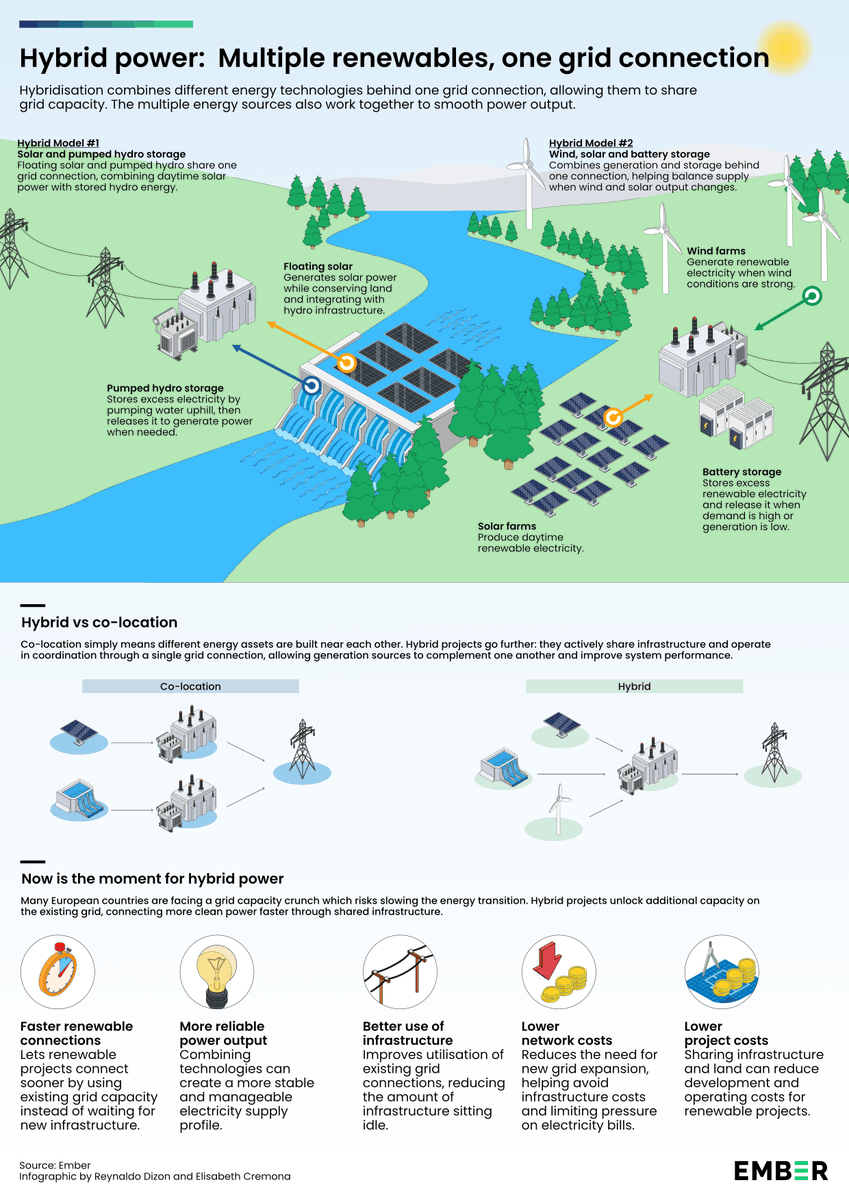
TOMORROW | Hybridisation combines technologies like wind, solar and storage behind a single grid connection – an often overlooked strategy for adding renewables in areas lacking extra grid capacity.
Enter hydro.
🧵 1/3
Good for #WabKinew stepping up for Canadians, and firefighters from both sides of the border. Absolutely ridiculous that it even needs to be said, but in the world of the "ambulance chaser" I'm glad he said it in a way that should connect.