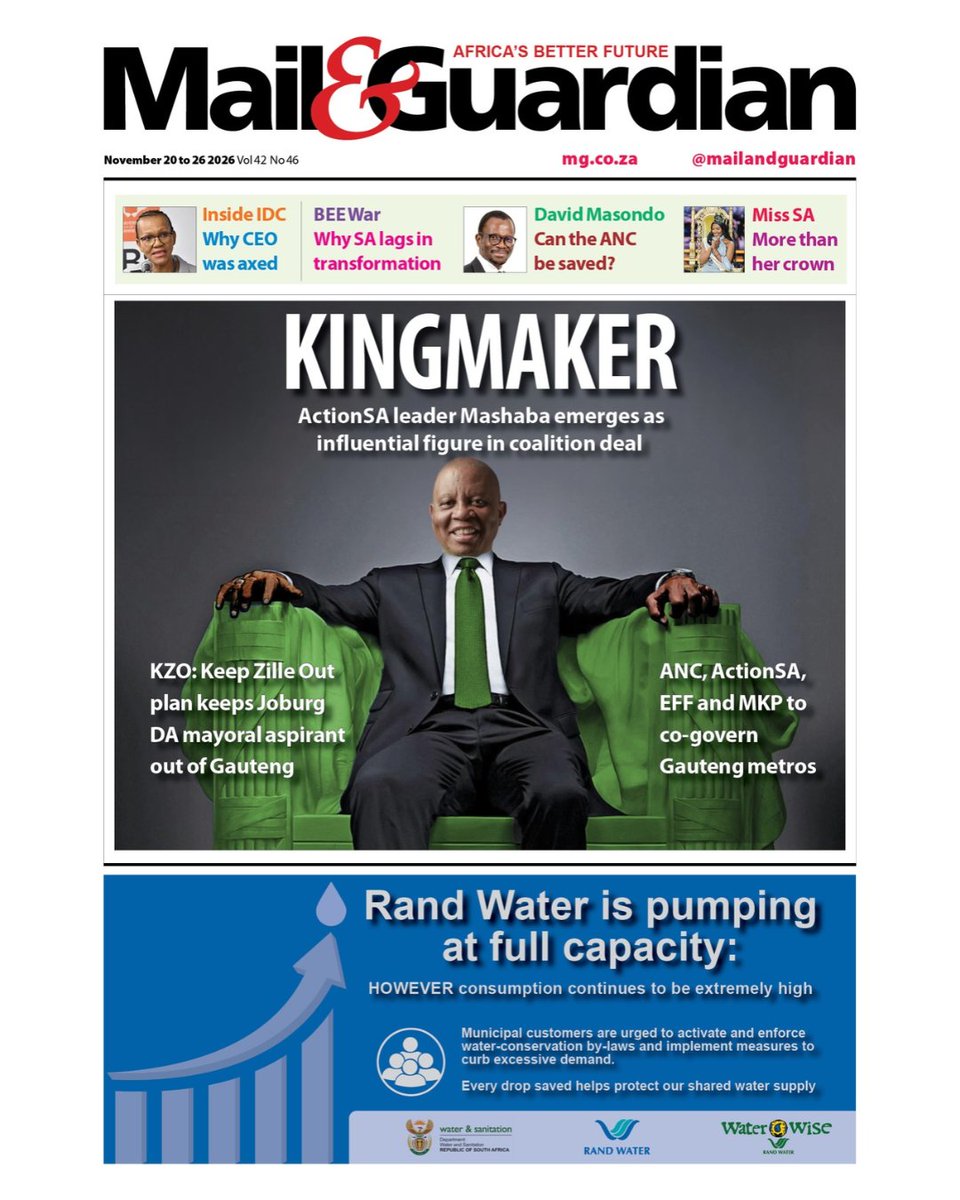
⚪ KINGMAKER: ActionSA leader Herman Mashaba emerges as influential figure in coalition deal.
- KZO: Keep Zille Out plan keeps Joburg DA mayoral aspirant out of Gauteng.
- ANC, ActionSA, EFF and MKP to co-govern Gauteng metros.
⚪ Inside IDC: Why CEO was axed.
⚪ BEE War: Why SA lags in transformation.
⚪ David Masondo: Can the ANC be saved?
⚪ Miss SA: More than her crown.
Get your copy of this week's Mail & Guardian and subscribe at https://t.co/fknaqFyNfg for more!
Zimbabwe’s bubble: extraction, capture and the resources curse
by TENDAI BITI
‘The gold incentive scheme has become a massive vehicle for extraction’
https://t.co/gslgrMWnH0
🔸A summarized list of taxes payable in Zimbabwe:
Pay-As-You-Earn (PAYE)
Corporate Income Tax
AIDS Levy
Presumptive Tax
Rental Income Tax
Commercial Rental Income Tax
Tax on Employment Benefits
Tax on Directors’ Fees
Tax on Business and Professional Income
Tax on Partnership Income
Tax on Farming Income
Tax on Mining Income
Tax on Income from Investments
Tax on Interest Income
Tax on Dividend Income
Tax on Royalties
Tax on Foreign Income
Non-Resident Tax on Fees (NRTF)
Non-Resident Tax on Dividends
Non-Resident Tax on Interest
Non-Resident Tax on Royalties
Withholding Tax
Value Added Tax (VAT)
Customs Duty
Import VAT
Excise Duty on Imported Goods
Excise Duty on Locally Manufactured Goods
Surtax on Specified Imported Goods
Intermediated Money Transfer Tax (IMTT)
IMTT on Transactions Denominated in Local Currency
IMTT on Transactions Denominated in Foreign Currency
Stamp Duty
Capital Gains Tax (CGT)
Motor Vehicle Import Duty
Motor Vehicle Import VAT
Motor Vehicle Excise Duty
Fuel Excise Duty
Fuel-Related Statutory Levies
Carbon Tax on Fuel or Qualifying Activities
Road-Related Statutory Levies
Vehicle Registration Charges
Motor Vehicle Licensing Fees
Toll Fees
Air Passenger-Related Charges and Levies
Aviation-Related Statutory Charges
Excise Duty on Alcoholic Beverages
Excise Duty on Tobacco Products
Excise Duty on Cigarettes
Excise Duty on Spirits
Excise Duty on Beer
Excise Duty on Wine and Other Specified Alcoholic Products
Excise Duty on Fuel
Excise Duty on Specified Motor Vehicles
Excise Duty on Other Designated Products
Carbon Tax
Waste-Related Environmental Charges
Mining Royalties
Betting Tax
Tax on Bookmakers
Tax on Betting Operators
Municipal Property Rates
Rural District Council Rates
Urban Council Rates
Commercial Property Rates
Residential Property Rates
Industrial Property Rates
Land-Related Local Authority Charges
Special Assessments Imposed by Local Authorities
Development Levies Imposed by Local Authorities
Estate-Related Taxes or Duties
Tourism-Related Statutory Levies
Tourism Industry Levies
Accommodation-Related Statutory Levies
Hospitality-Related Levies
Tourism Licence-Related Charges
Hotel and Tourism Regulatory Charges
Telecommunications Regulatory Levies
Telecommunications Licence Fees
Broadcasting-Related Statutory Charges
Financial-Sector Regulatory Levies
Insurance-Sector Regulatory Levies
Banking-Sector Regulatory Levies
Energy-Sector Regulatory Levies
Electricity-Related Statutory Levies
Environmental and Regulatory Charges on Specified Industries
NSSA Employee Contribution
NSSA Employer Contribution
Workers’ Compensation Contributions
ZIMDEF Levy
Industrial Training Fund-Related Statutory Contributions
Employer Payroll-Related Statutory Contributions
Statutory Pension Contributions
Statutory Health-Related Contributions
Local Authority Service Charges
Water Charges
Sewerage Charges
Garbage and Waste Collection Charges
Business Licence Fees
Trading Licence Fees
Professional Licence Fees
Regulatory Licence Fees
Environmental Permit Fees
Fire Inspection and Fire Service Charges
Public Health Inspection Charges
Building Plan Approval and Inspection Fees
Development Approval Charges
Vehicle Registration Fees
Passport and Other Administrative Fees
Court Fees
Deeds Registration Fees
Company Registration and Filing Fees
We need new leaders.🇿🇼
Asking the people of Tshwane to boil water when they have no electricity. @Action4SA rocking it!
If you voted for this circus party, this is what you deserve.
If this is true, it is literally ASA taking the votes of ASA voters and giving them to the ANC. Literally over-riding the constitutional and democratic will of the people. Just take a moment to try and appreciate how seriously un-democratic this would be.
Good afternoon, my brother. Of course we cannot talk about South Africa without talking about race, because the politics and the economy were built on race more than 300 years ago. But we should not invoke race everywhere, because our arguments end up weak and predictable when they rest on one thing alone.
You said they had to ship Helen Zille from Cape Town just to come to Johannesburg, and you asked me to ask myself why. I did. Why is a woman in her seventies seen as the prospective saviour of the most respected city on the African continent?
Because the black-led political parties that have run Johannesburg have failed it. That is the reason Helen Zille is seen in this way.
You spoke about racism. It exists, but we must also face the fact that it is our own black people who voted for the Democratic Alliance (DA) to become the leading party in the Gauteng metros.
In the recent local government elections, the DA won 34.79 per cent in Johannesburg, up from 26.1 per cent in 2021, while the African National Congress (ANC) fell from 33.6 per cent to about 20 per cent. The DA also came first in Tshwane with 34.37 per cent and in Ekurhuleni with 30.68 per cent. That is a damning verdict on governance in those cities.
White voters are nowhere near enough to deliver a vote of that size in Johannesburg. Black people voted for the DA in their numbers. If I follow your argument, black people were forced to vote for a racist party.
For a black voter to be pushed into the arms of a party you call racist, those in charge before must have been terribly bad. That is the reality we are faced with.
I pay my taxes in Johannesburg and I own property there, so I am interested in who governs it. Sometimes I receive a water bill of 60,000 litres, which means 2,000 litres used every single day, yet most of the time only a housekeeper is at home. Residents deal with this kind of failure daily.
So I do not understand why we always reach for race when we should be asking a harder question. If these people are so racist, what is it that makes our people vote for them?
We cannot live in denial, labelling everything about the DA racist, without asking why our own people are now voting for the party we call racist.
Summary of this arrangement in JHB: Included, ASA (lost support), ANC (lost support), MK (lost support), EFF (lost support). Excluded: DA (grew substantially). This is a potential coalition of decline and a pact to put a lack of public faith ahead of growing public faith.
South Africa’s biggest container port has found itself in troubled waters. Backlogs at Durban’s Gateway Terminal are piling up, with delays of up to 20 days rippling through supply chains. eNCA's Nokwazi Qumbisa has more details. Tune in to #eNCA, on #DStv403.
#ZimPresents2027NationalBudget
🔴Budget grows from US$10.95bn in 2026 to US$12.5bn in 2027
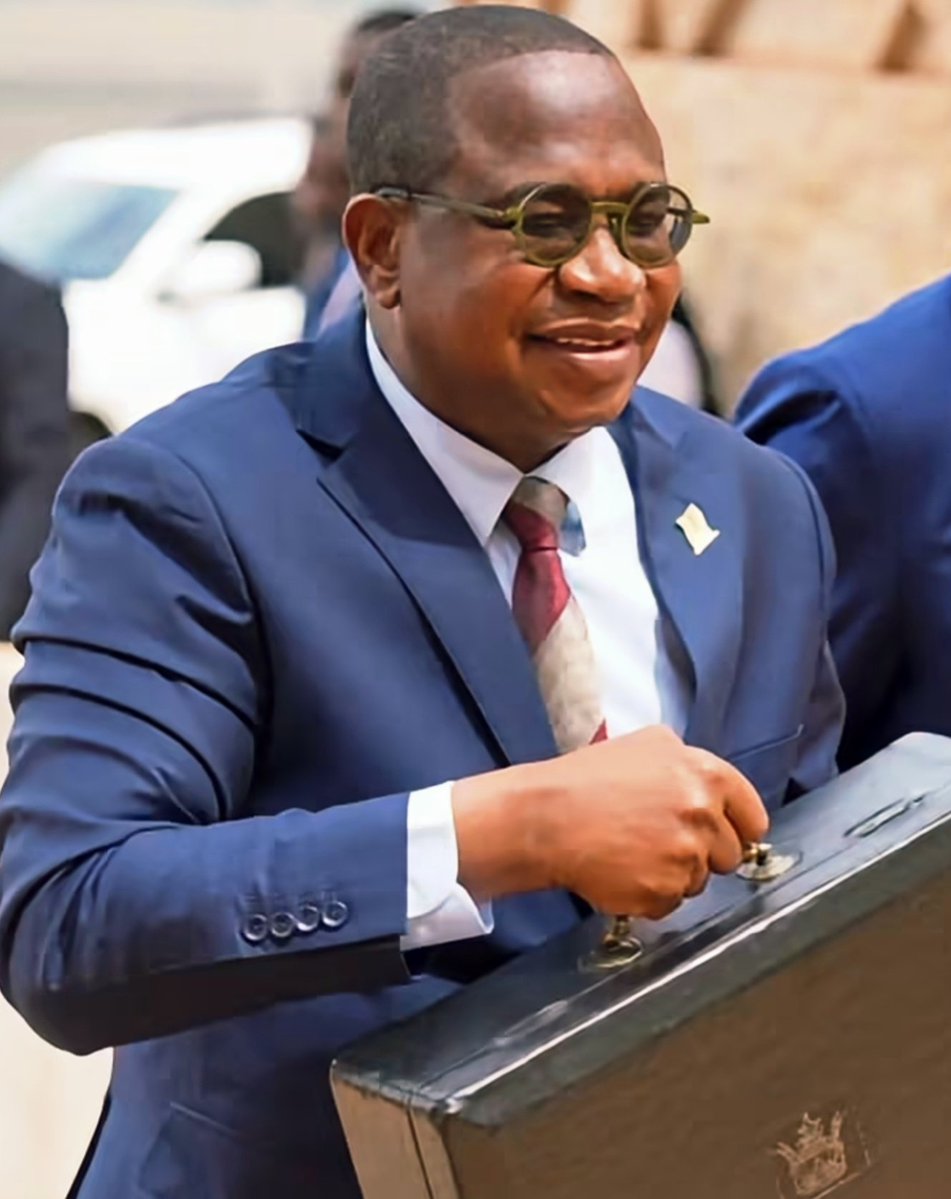
Zimbabwe’s Finance Minister Professor Mthuli Ncube this afternoon presented a US$12.5 billion 2027 national budget - US$1.6 billion more than the current running 2026 budget - themed "Accelerating Economic Transformation and Building Resilience to Climate and Global Shocks" under the National Development Strategy 2 (NDS2). Ncube said government is projecting total revenue collections of ZiG349.5
billion (US$12.5 billion) in 2027, equivalent to 18.1% of GDP.
Of this amount, tax revenue
is projected at ZiG335.6 billion (US$12 billion), while non-tax revenue is estimated at
ZiG13.9 billion (US$498 million).
At the current Reserve Bank of Zimbabwe interbank rate of ZiG26.5639 per US$1, Zimbabwe’s 2026 national budget translates to US$10.84 billion in revenue and US$10.95 billion in expenditure, leaving a deficit of US$120.46 million.
Using the Treasury's original 2026 budget framework (which assumed an exchange rate of roughly ZiG30.6 per US$1), those 2026 budget figures convert to US$9.4 billion in revenue, US$9.5 billion in expenditure, and a US$105.9 million deficit.
Ncube said:
"Revenue collections will be supported by the yield from
the revenue mobilisation measures outlined in this budget statement.
The projected revenue envelope, together with government’s prudent borrowing capacity,
supports an overall expenditure ceiling of ZiG358.3 billion (US$12.8 billion) in 2027,
equivalent to 18.6% of GDP.
This comprises recurrent expenditure of ZiG284.7 billion
(US$10.2 billion) and capital expenditure of ZiG73.6 billion (US$2.6 billion).
The budget envelope includes contingent ZiG10.9 billion (US$400 million) which is 0.6% of GDP, as a precaution against more severe shocks, especially the super El-Nino drought.
The
resources will be financed from government buffers accumulated in 2026.
The expenditure mix reflects a deliberate shift towards capital outlays, which is expected to
rise from 2.3% of GDP in 2026, to 3.8% of GDP in 2027.
Over the medium term, expenditure growth will remain anchored on government’s capacity to mobilise additional domestic and external resources.
The anticipated fiscal deficit of ZiG8.8 billion, equivalent to 0.5% of GDP, reflects government’s deliberate choice to scale up capital and social expenditure, while providing for the clearance of outstanding expenditure arrears on goods and services and the timely
retirement of maturing Treasury Bills.
The deficit will be financed through prudent borrowing,
consistent with government’s commitment to living within its means and safeguarding debt
sustainability.
This stance is critical for sustaining and consolidating macroeconomic
stability.
Government will issue securities to raise ZiG21.5 billion from the domestic capital market
through Treasury bill issuances of ZiG10.3 billion and loans of ZiG11.2 billion, representing
47.9% and 52.1% of the planned borrowing, respectively, as indicated in the 2027 Annual
Borrowing Plan.
Given the prevailing macroeconomic stability, characterised by single digit inflation and exchange rate stability, Treasury will continue issuing securities only through the auction system to ensure competitive price discovery.
On the other hand, government will make debt service payments amounting to ZiG31.2 billion, comprising principal repayments of ZiG22.3 billion, and interest payments of ZiG8.9 billion."
War Veterans Lose Springs Farm Battle, Plot Supreme Court Appeal
WAR veterans who have farmed Springs Farm in Goromonzi for 25 years say they will appeal to the Supreme Court after a High Court judgment went against them in their long-running fight to stop the farm being handed over as compensation to businessman Billy Rautenbach.
Speaking outside court after the judgment, the war veterans said they were “obviously not happy” with the outcome, arguing that critical facts had been left out of the ruling.
“We believe that a lot of facts that have been left out that we thought were very critical in our case,” said Joseph Macheka, a ZANU PF Central Committee member, who has a 10-year joint venture with investors. Government is a part to the tripartite agreement which ends in 2029.
Among those facts, he said, was that the area is zoned for a school and a hospital, and that the court had dismissed the veterans’ argument on the one-time venture.
“It’s unfortunate that we find ourselves in this situation considering that we are beneficiaries of the land reform,” he said. “We look at the history of Zimbabwe, where the land came from, we look at why the liberation war was waged and we look at why land reform took place.
“After 25 years the beneficiaries have only done one thing: to [invest] in production. It can’t be that land is taken away from deserving beneficiaries and given to a private person in the form of Billy Rautenbach.”
25 Years of Investment
The applicants in the case are Joseph Macheka, Alfred Chademana, Tamo Hove Muza, Mangisai Katsande and Unico Chikomo. They are challenging the Lands Minister’s June 2024 decision to withdraw their agricultural offer letters for subdivisions of the Goromonzi farm.
The five say they were allocated the land under the land reform programme and have since invested their lives and savings in developing it — building homes, dams, irrigation, tobacco barns and other infrastructure, and turning it into a productive farming operation.
One of the farmers, Unico Chikomo, was named the 2024 National Young Farmer Award winner, a point the veterans have repeatedly raised as proof of productivity on the farm.
In an earlier judgment in July 2025, Justice Regis Dembure had ruled in their favour, describing the withdrawal of their offer letters as “irrational and inconsiderate” and noting that they had long occupied the land and depended on it for their livelihoods.
That judgment was later rescinded.
In a judgment dated May 21, 2026, Justice Chitapi rescinded Justice Dembure’s 2025 judgment and granted the minister additional time to submit opposing papers, reopening the case.
The Compensation Deal at the Centre of the Case
At the heart of the dispute is a compensation deal for Rautenbach’s company, Marimba Residential Properties Limited.
According to a letter dated March 14, 2025, from Local Government Minister Daniel Garwe, the government offered Marimba Subdivision B of Springs measuring 671.7604 hectares and the remainder of Stuhm Farm measuring 412.1091 hectares as “total and final compensation” for land in Aspindale Park, Lochinvar and Salisbury Park.
A deed dated June 5, 2025, recorded the transfer of approximately 671.6 hectares to Marimba, describing the award as compensation.
The veterans dispute the basis for that compensation entirely.
They point to a High Court ruling on March 25, 2019, which they say declared that Marimba Residential Properties Limited was not the rightful owner of the Aspindale Park land, and that the land had been lawfully acquired by the State and allocated to housing cooperatives.
Therefore, there was no basis for compensating Rautenbach in the first place.
In their court papers, they argue Rautenbach is being compensated with over 1,100 hectares of prime farmland for about 180 hectares he claims to have lost in Aspindale Park.
*Joseph Macheka (left), Zanu PF Central Committee member and former Chitungwiza mayor.
Marondera Central MP Caston Matewu reacts to the budgets statement, saying it has nothing to offer for the poor. He says the poor will remain poorer while the rich will remain richer.
Those who defend BEE should watch this video, explain it without getting defensive, and show me how any of this helps new, young, black entrepreneurs. There’s just no way.
The party that won Johannesburg just told its own caucus to pack up.
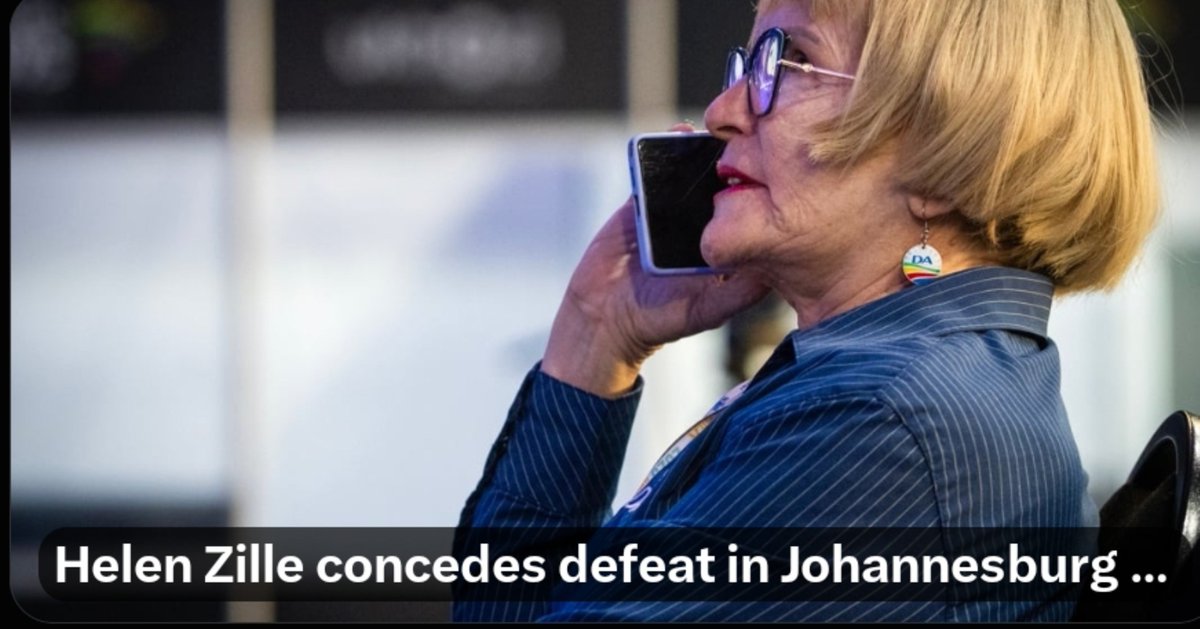
Helen Zille addressed the DA's Johannesburg caucus this week. Her message: the die is cast. The DA is going into opposition.
She named it. The "Doomsday coalition." ANC, ActionSA, EFF, MK Party. 138 seats. Two more than the 136 needed.
The DA won 91 seats. 34.8%. First place. And it is being shut out.
Here is how you get 138 seats from four parties that agree on almost nothing.
ANC: 63. ActionSA: 43. EFF: 17. MK: 15.
One holds the working class. One holds the aspirational middle. One holds the radical left. One holds the Zulu nationalist base.
They share exactly one thing: they all want the DA out.
The reason is personal.
Herman Mashaba made Zille's removal as mayoral candidate a condition for any deal with the DA. He was DA mayor of Johannesburg once. He remembers what that cost him.
The DA called the demand unreasonable. The party won the most votes. Why should it surrender its candidate?
Nobody blinked. The DA offered to swap Hill-Lewis for Zille. Mashaba said no.
Zille plans to return to Johannesburg as a part-time councillor. "Finish what we started," she told the caucus. She wants the DA to become "the best opposition we can be."
But Ashor Sarupen, the DA Federal Council Chairperson, went on record: this is not the party's official position. Negotiations continue.
The leader says it is over. The chairperson says it is not. Both are true. One is a message to the caucus. The other is a message to the press.
New councils must be constituted by 27 November. Eight days.
Johannesburg has had a decade of unstable coalitions. Multiple mayors. Service delivery that never recovered.
The DA topped the poll and is about to watch from the gallery while four parties that cannot agree on anything except hating it try to run the city.
Winning the vote and governing the city are two different things in South Africa.
The DA learned that the hard way. Again.
‘No one and no place will be left behind’ except the kids selling loo rolls on the side of the road and blind beggars at the (non functioning) traffic lights and the 27% of children who are stunted and the 42% of the population who live in extreme poverty (according to the UN)
Today, I had the honour of presenting the 2027 National Budget to Parliament under the theme: "Accelerating Economic Transformation and Building Resilience to Climate and Global Shocks."
This Budget builds on the foundations of macroeconomic stability we have worked so hard to restore. Our reform success is now being recognised globally. Zimbabwe has been removed from the World Bank Group's fragility classification, admitted as a borrowing member of the BRICS New Development Bank, and elected as a non-permanent member of the United Nations Security Council for 2027-2028.
The numbers tell the story of transformation: Our economy grew by 8.3% in 2025, the fastest in SADC and second fastest in Africa, and is projected to grow by 5% in 2026. The size of our economy is now approximately US$66 billion, more than double the US$21 billion in 2019, and GNI per capita now stands at approximately US$4,100, making us 7th in Africa. Inflation has stabilised, averaging 4.0% in ZiG terms for the first ten months of 2026, and foreign currency receipts increased by 33.7% to US$15.9 billion in the first nine months of 2026.
For 2027, we are projecting total revenue of ZiG349.5 billion (US$12.5 billion) to support expenditure of ZiG358.3 billion (US$12.8 billion), including a ZiG10.9 billion (US$400 million) contingency as a precaution against the super El Niño. This Budget prioritises our people: ZiG47.7 billion for Primary and Secondary Education, ZiG35.5 billion for Health, ZiG27.6 billion for Agriculture, ZiG21.5 billion for Social Protection, ZiG17.5 billion for Devolution, and ZiG10.8 billion for Transport.
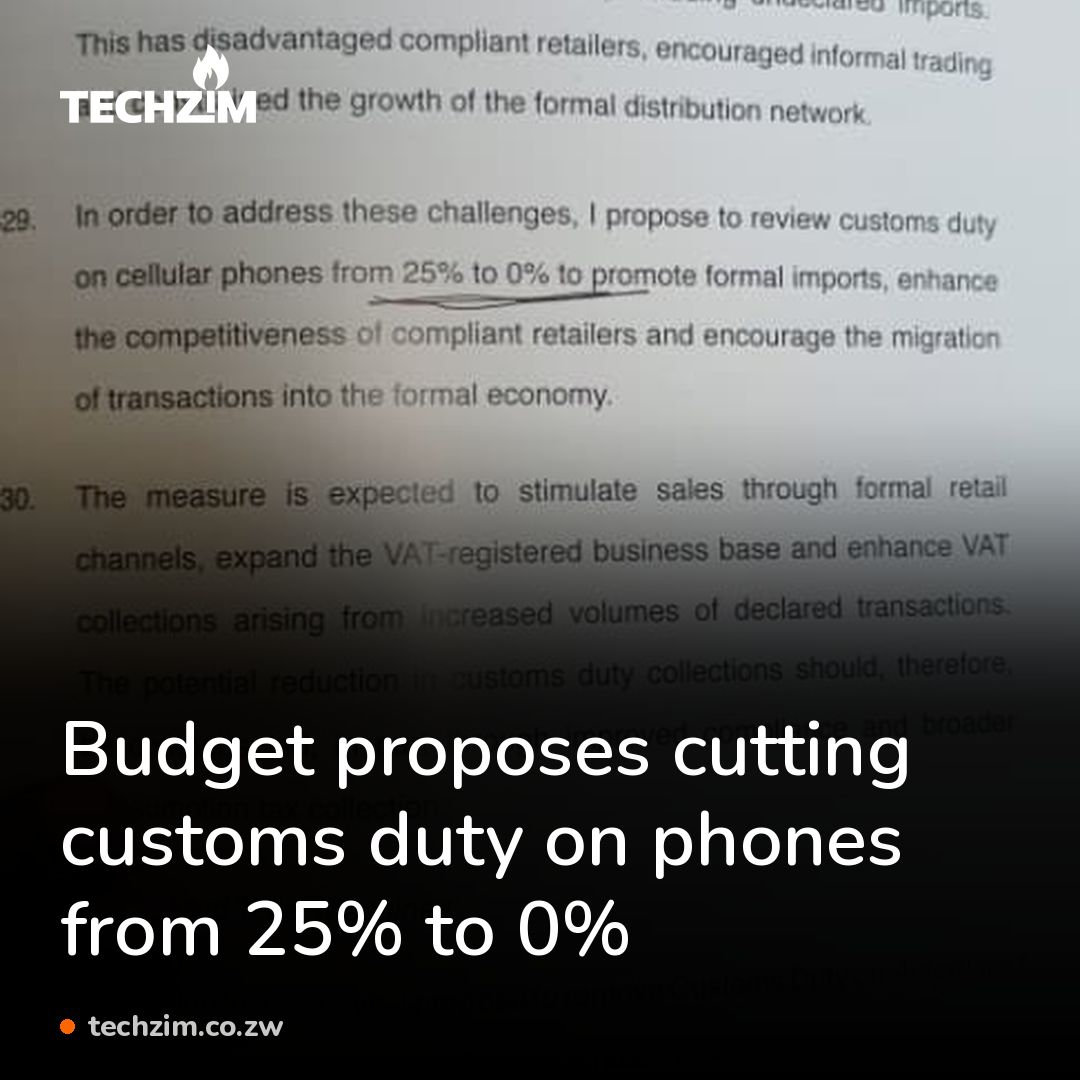
We are also putting more money back in your pockets: the Personal Income Tax-free threshold increases from US$100 to US$150, IMTT is reduced from 1.5% to 1.25% on ZiG transactions and from 2% to 1.75% on foreign currency transactions, customs duty on cellular phones is removed from 25% to 0%, and duty on electric vehicles is reduced from 25% to 10%.
This is a Budget to accelerate transformation, protect our gains, and build resilience for every Zimbabwean. No one and no place will be left behind.
Finance Minister Mthuli Ncube has proposed removing customs duty on cellular phones. He announced it today, 19 November 2026, in his national budget statement. The duty is currently 25%.
The move follows lobbying by representatives of smartphone manufacturers and by industry leaders. They argued that the high duty was encouraging smuggling and grey imports.
The Minister agrees. He says the 25% duty has created a price gap between phones brought in formally and phones that come in through informal channels, including undeclared imports. That has hurt shops that follow the rules and pushed buyers to informal traders.
Cutting the duty to 0% is meant to encourage formal imports and make registered retailers more competitive. The Minister expects more phone sales through formal shops and more VAT collected, which would partly make up for the lost duty.
If Parliament approves it, phones from registered shops could get cheaper.
Such a poor country of course. No gold no diamonds. Oh wait. In 2025 the mining sector generated R477 billion. SA supplies 70% of the global platinum. I could go on!
ICYMI | Minister of Sport, Arts and Culture Gayton McKenzie has encouraged athletes to find their own sponsorships to advance themselves, saying government can simply not afford to fully sponsor all sporting bodies. https://t.co/k0oAsIPXkr
This is the best long-game decision for the Democratic Alliance (DA). Let the other parties take charge and let voters watch them govern while the DA prepares for 2029. If an African National Congress (ANC)-ActionSA coalition fails to deliver services and tackle corruption, the 2029 elections could turn into an electoral bloodbath for them.
Local government is about service delivery, not colonial rhetoric or immigration tales that a mayor of Johannesburg cannot fulfil.
This will also teach South African voters a hard lesson: a vote for a small party is a wasted vote. It is better to vote for a party that is likely to deliver what you want than to vote for fringe parties. By 2029, Gayton McKenzie and Herman Mashaba will have taught South African voters, the hard way, why voting for fringe parties comes at a cost.