I can suggest an equation that has the potential to impact the future:
𝐍𝐚𝐭(𝐇𝐨𝐦(−, 𝐶), 𝐹) ≅ 𝐹(𝐶) + AI
Given a category 𝒞, a functor 𝐹 : 𝒞ᵒᵖ → 𝐒𝐞𝐭, and an object 𝐶 ∈ 𝒞.
This equation combines Yoneda’s famous Yoneda lemma, which relates a category (𝒞) to a functor (𝐹: 𝒞ᵒᵖ → 𝐒𝐞𝐭) and the speed of light (𝐶 ∈ 𝒞), with the addition of Al (Artificial Intelligence). By including Al in the equation, it symbolizes the increasing role of artificial intelligence in shaping and transforming our future. This equation highlights the potential for Al to unlock new forms of energy, enhance scientific discoveries, and revolutionize various fields such as healthcare, transportation, and technology.
@garvidge I don't know if computers just take binary input, at least that's a pretty reductionist way of looking at it. How would this capture running two programs at once for example.
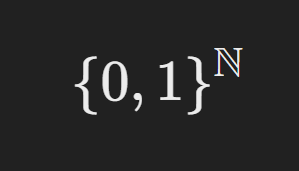
By the way, the set in question is infinite sequences not finite ones.
I think this is more like a particular choice of semantics for programs, which makes sense in some contexts but not others. Or maybe I'm missing the point that all programs can be reduced to these somehow?
@myers_jaz@BowToChris The reason for this is because a lax functor 1 -> D is the same as a monad in D, so making it normal means there's no algebras and you have to add them back in to get an equivalence
@myers_jaz@BowToChris Well you've got an equivalence
normal lax C -> Alg(D)
And
lax C -> D
So Alg is actually the right adjoint. I think that makes normal lax functors a coreflective subcategory?