@ChrisRMcGuire Finally, the AI x Knicks discourses have converged, which means I can now share an important take I’ve been withholding: there’s no greater sign that the singularity is nearing than the Knicks ascension. And if that means the end is upon us, I’d say it’s worth it
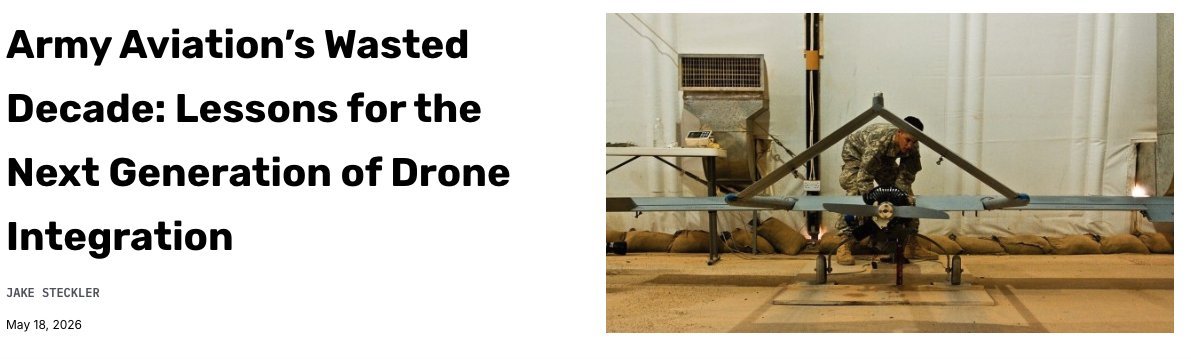
When I was in middle school, the Army first paired Apache helicopters with drones in Iraq. 20 years later, Army aviation made little to no progress in manned-unmanned teaming.
When units that quietly fail get rewarded and units that report failure get sidelined, you don't get honest feedback. You get a decade of wasted progress. https://t.co/jN6ELWVALo
Failing to address these challenges risks another stagnant decade where the tools change but the Army doesn't. Full article here: https://t.co/7cONTow0zV
I don't think automation of AI R&D will rapidly lead to domain-general super-intelligence.
I think this will be true even if AIs can do *literally everything* a human AI researcher does today.
Even after the full automation of AI R&D, further capabilities progress will only happen through
(1) widespread deployment of AI throughout the economy, accompanied by data collection; and/or
(2) the wholesale recreation of much of the economy by AI labs.
Without access to the real-world signal provided by either of the above, I think that the only thing produced by automated AI researchers would be a "Goodhart Singularity".
If I'm right, this is obviously good news. I make the case for this in a new piece on my substack
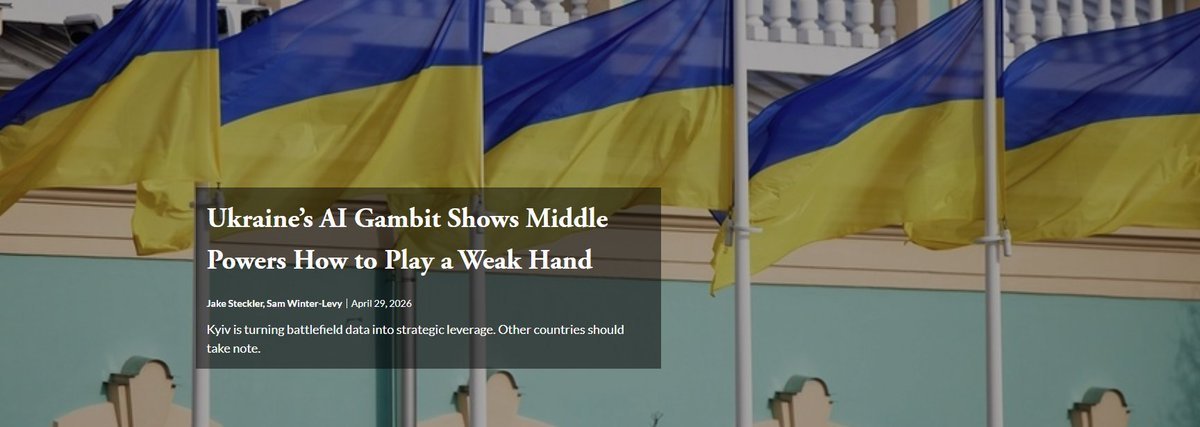
Ukraine recently started sharing millions of drone videos with allies to train AI models. In @lawfare, @JakeASteckler and I argue it offers useful lessons for middle-power AI strategy.
Last month, Ukraine announced it would make battlefield data generated from millions of drone videos available for allies to train their AI models.
Ukraine is doing something most of the world's middle powers have failed to do: find leverage in the global AI race.
New piece in @lawfare with @JakeASteckler, on how Ukraine has turned a weak hand into a degree of leverage in the AI race. Other middle powers, dependent on the US and China for access to critical AI capabilities, should take note.
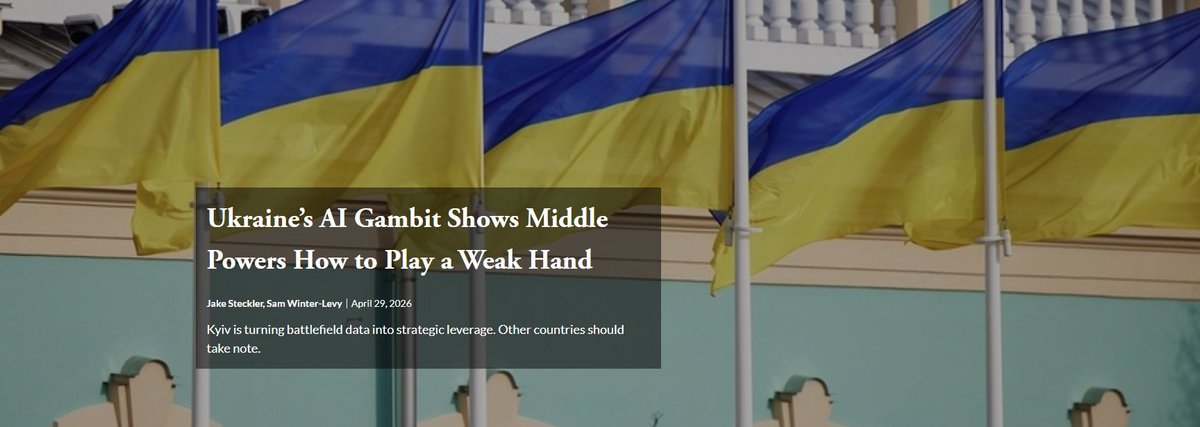
.@JakeASteckler and @SamWinterLevy explain the implications of Ukraine's announcement that partners would be able to train AI models on drone videos and other battlefield data for the AI race between great powers and what other middle powers can learn from this decision.
Over a weekend and with ~$760, I (not a biologist) used Claude Code to fine-tune a biological AI model on human-infecting viral sequences. Although my experiment wasn't dangerous, it demonstrates how coding agents are changing the biosecurity risk landscape.
In a new @GovAIOrg blog post with @lucafrighetti and James Black, we describe this experiment and its policy implications.
Biosecurity has traditionally divided AI risks into two buckets: general LLMs that "raise the floor" by democratizing knowledge and specialized biological AI models (BAIMs) that "raise the ceiling" by enabling experts.
Increasingly capable coding agents blur that line via three mechanisms:
1) Coding agents let both novices and experts operate BAIMs more effectively, expanding the pool of potential misusers and letting experts test more designs faster.
2) Data filters on BAIMs are brittle when coding agents can autonomously fine-tune the models, as my experiment shows.
3) Coding agents speed up ML engineering, making it more feasible for threat actors to train new specialized models optimized for harmful capabilities from scratch.
Policy recommendations: BAIM developers should move beyond data filtering toward trusted-access programs; LLM developers should test agent interactions with BAIMs; policymakers should prioritize physical chokepoints like DNA synthesis screening.
Read the piece: https://t.co/OkOCmebpO0