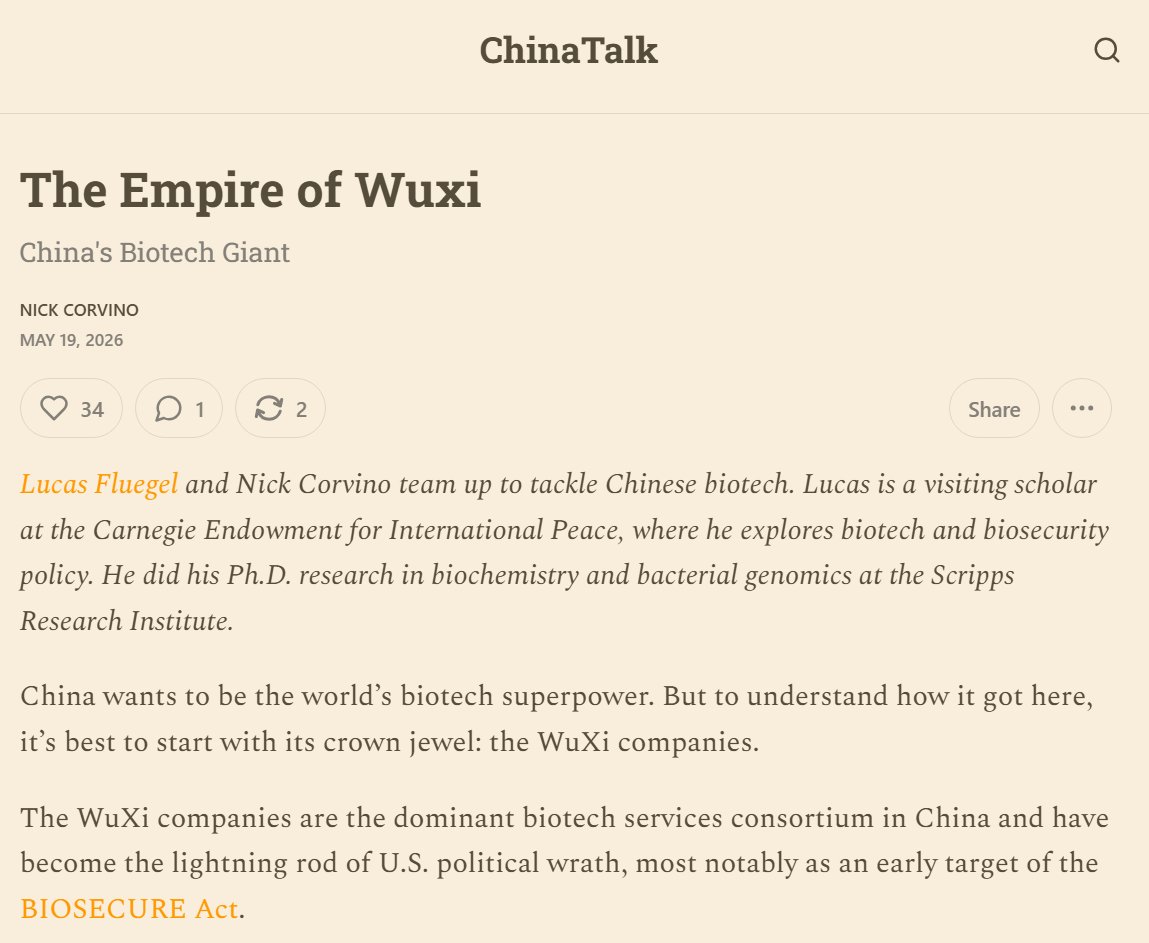
Had a great time analyzing WuXi's Empire—the US's biotech bogeyman—with Nick Corvino for ChinaTalk. There's a lot more to unpack here, so let me know what we got wrong!
Link: https://t.co/zJyKtvlXhr
Thanks to @jordanschneider et al. for the opportunity!
PS: First X post✅
Fantastic from @chinatalk / Fluegel and Corvino on WuXi AppTec and the Chinese biotech sector and its historical US link. From a strategy perspective, it's surprising how many leading Chinese firms (WuXi, CATL, Foxconn, etc) are pure econ of scale/scope plays.
Fantastic from @chinatalk / Fluegel and Corvino on WuXi AppTec and the Chinese biotech sector and its historical US link. From a strategy perspective, it's surprising how many leading Chinese firms (WuXi, CATL, Foxconn, etc) are pure econ of scale/scope plays.
AI strategies everywhere hinge on widely available American frontier AI. Post-Mythos, amid compute crunches, security concerns and distillation crackdowns, that paradigm is under threat.
Today, I argue the era of widespread access to frontier AI is almost over.
I don't think automation of AI R&D will rapidly lead to domain-general super-intelligence.
I think this will be true even if AIs can do *literally everything* a human AI researcher does today.
Even after the full automation of AI R&D, further capabilities progress will only happen through
(1) widespread deployment of AI throughout the economy, accompanied by data collection; and/or
(2) the wholesale recreation of much of the economy by AI labs.
Without access to the real-world signal provided by either of the above, I think that the only thing produced by automated AI researchers would be a "Goodhart Singularity".
If I'm right, this is obviously good news. I make the case for this in a new piece on my substack
Congress is trying to close a longstanding loophole that allows Chinese customers to remotely access restricted U.S. chips.
In a new article for @CarnegieEndow, I discuss the logic behind these "cloud controls" and why they're more complicated than they seem.
My takeaways below:
For middle powers thinking about how to leverage datasets to build a stake in the AI stack (often said but vaguely explained), this piece by @SamWinterLevy is a must read: https://t.co/xgxJYgbOlA
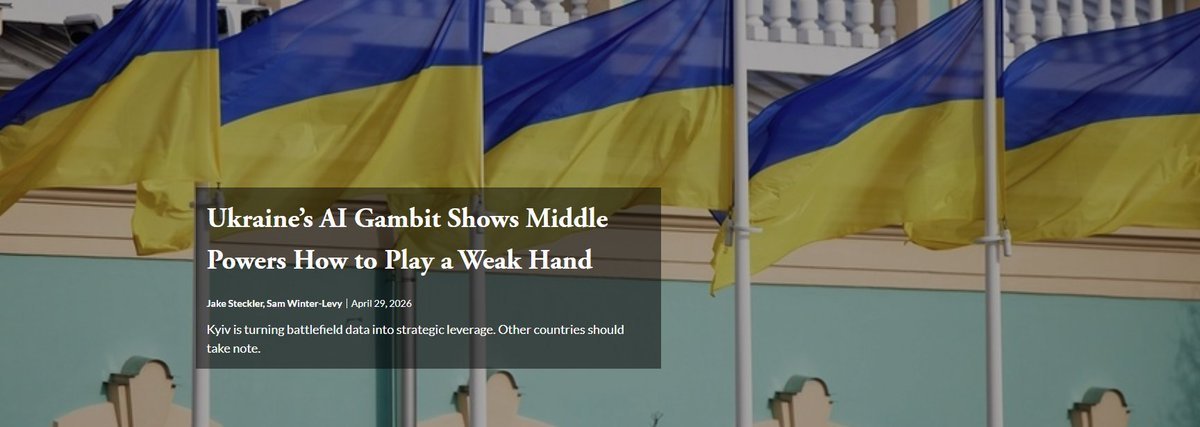
Ukraine recently started sharing millions of drone videos with allies to train AI models. In @lawfare, @JakeASteckler and I argue it offers useful lessons for middle-power AI strategy.
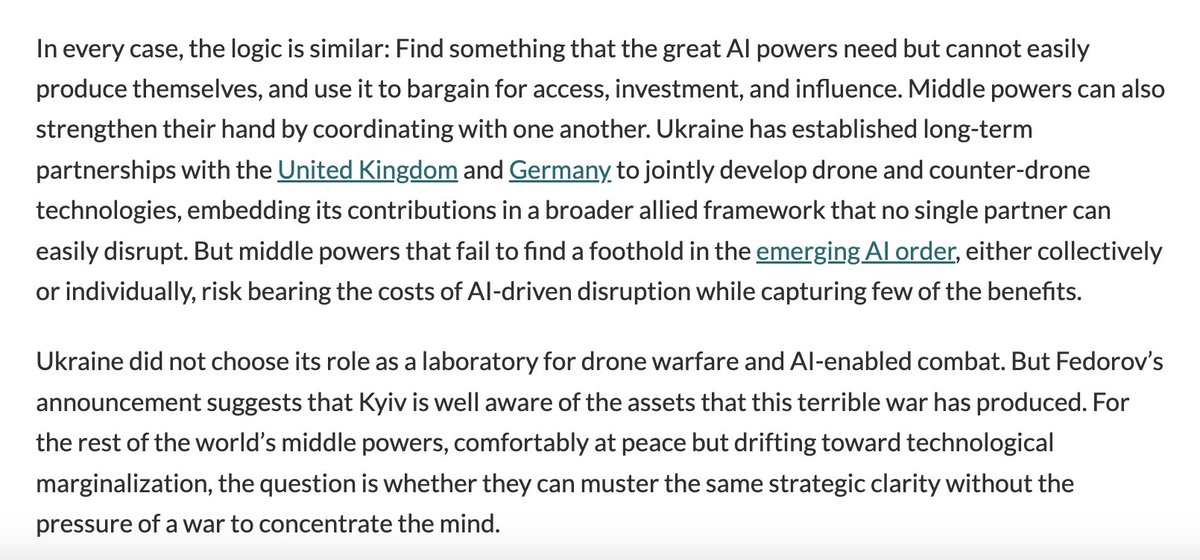
Still, there are lessons here for middle powers. Most won't control a node in the semiconductor supply chain. But many can find complementary assets to frontier AI, and use those to bargain for access and influence.