EU crypto lawyers and founders, are you ready to dive into MiCA without the headache? Introducing the first browsable, structured version of MiCA.
A MiCA Gitbook.
Your regulatory nightmare just got easier. 👇
Over a trillion dollars worth of perps are traded every month, yet 99% people have never heard of them.
This @LawofCodeFM episode is a multi-hour deep dive on perps, starting from the history of grain futures in Chicago to Friday's historic @CFTC announcements. It took me months to put this together.
My goal: the internet's most comprehensive explainer on perps.
You'll hear from the world's leading experts on the legal layer of perps; @jchervinsky and @BradBourque of @HyperliquidPC, @BrettHarrison of @Architect_Fi, @kkirkbos, @_Ryne_Miller, @mdf2000 and David Shafer of @coinbase.
By the end of this episode, I promise you'll be in the top percentile for understanding perps, regardless of where you're starting from.
(You just might need to listen twice. There's a lot here.)
Timestamps:
0:00 Intro
4:04 What is a perp @BrettHarrison
7:18 Why futures contracts exist
8:15 Liquidity fragmentation
11:01 History of U.S. futures @_Ryne_Miller
17:08 Richard Nixon, the gold standard and financial futures
21:27 Birth of the CFTC
24:27 Robert Shiller's 1992 paper @kkirkbos
30:09 Price convergence
32:00 The funding rate
43:41 Oracles and manipulation risk
47:39 Are perps swaps or futures?
52:44 A @ChairmanSelig clip on perps
54:02 The DCM framework
59:16 DCMs, DCOs and FCMs explained
1:04:55 History of crypto perps (BitMEX)
1:13:00 How Hyperliquid works
1:25:41 CFTC's historic announcements on May 29, 2026
1:35:00 Fireside with @jchervinsky and @BradBourque of @HyperliquidPC
Nothing in this podcast is legal or investment advice.
Check it out: https://t.co/2vxJrIdayY
And let me know what you think and what you would like to see:
- more links to NCA guidance?
- more case studies?
- other regimes and jurisdictions?
Early 2025 I built mica(.)wtf.
A Gitbook for MiCA regulation. The first browsable, structured version of MiCA.
Sharply after the launch, the Bybit hack happened and I was in the middle of it, working on legal for Safe{Wallet}. While I was heads down navigating emergency mode for months, I had to leave the page as it is.
I'm now on the other side of this, helped build Safe Labs, learned a ton, and also realised the page had been chucking along nicely. Apparently, there is a small group of users that finds this tool useful. Visits are trending up, even though I was inactive there or pushing anything.
Should we build out mica(.)wtf more?
"Young Americans hate you. They view you as a bunch of paternalistic dickheads who crashed the system in 2008"
Austin on why the bank lobby has gotten old, out of touch, and is losing the stablecoin debate
"The bank lobby has gotten incredibly old and out of touch. SoFi has opened more accounts over the last few years than all of the big four combined. They don't like you guys"
"You're arguing things that are factually wrong and the people who are informed on finance understand this. Anybody saying US dollar stablecoins cause deposits to leave the banking system in aggregate does not understand how bank deposits work"
"It is not mechanically possible for that to happen. Bank deposits are destroyed when you take money out of an ATM, when you repay a loan, when a bank sells an asset off the balance sheet. None of those involve a stablecoin"
1/ Yesterday’s bipartisan vote on the Clarity Act was a historic step forward. But digesting 309 pages of technical legislation – how’s that going to work!?
To help everyone dig in, we developed in interactive map of Title 1: https://t.co/GrSHsUqtRf. Come play!
@JayaGup10 in absolute crush mode here 🔥
The importance of insane talent is finally taking headlines as it should. We over rotate on career history and undervalue future potential. Never before has the latter been more game changing…
'who thinks abstractly? the uneducated, not the educated.' hegel told us in 1808.
crypto talked about 'account abstraction' for years but never shipped it at scale. now fintech did it for us.
except they didn't abstract the account.
they abstracted crypto itself. away from the people who were supposed to use it.
who knew stablecoins were just an intercompany accounting tool? circle mints USDC on its own balance sheet, shuffles it between its own subsidiaries, burns it. the bank sends fiat in, gets fiat out. $68M across 8 entities in one month, settled in minutes. the stablecoin is born and dies inside circle's corporate group. nobody else ever touches it.
who knew you could build an entire blockchain where the whole point is that nobody knows they're on a blockchain? stripe shipped tempo, a chain where businesses issue virtual addresses to their customers and all funds route to one master wallet. the customer sees a payment. the business sees a ledger entry. the blockchain is a backend detail, like a database vendor.
who knew 'self-custodial' could mean signing up with an email? privy ships passkey wallets where the credential is bound to a single app domain. the user never sees a key, never signs a transaction, never knows the wallet exists. self-custody as a legal classification, not a user experience.
of course. this is the WaaS playbook. circle does it for banks. stripe/privy does it for fintechs. both for consumers. the plumbing works. but it's hidden plumbing. and incumbents will always be better at hiding crypto than we are.
let them have it.
except every roadmap tells a different story.
I call it account graduation:
circle's own press release says the quiet part: managed payments is designed so institutions 'gradually evolve from a managed model toward greater ownership and control.' that's graduation language. start with training wheels, end with direct ownership.
tempo is building the infrastructure for what comes after the training wheels. access keys with spending caps so businesses can delegate without losing control. a shared policy registry so compliance rules apply once across every token. ISO 20022 memos so on-chain payments reconcile against ERPs without custom code.
abstraction features graduate to ownership features.
privy's Q4 roadmap points the same direction. preconfigured agent policies. a treasury management suite. the tools you need once you stop hiding the account and start actually running it.
everyone starts by hiding crypto. then they build accounts. the abstraction is transitional. the account keeps floating to the surface.
crypto's job is not to build more abstraction layers for people who don't want to touch it. the incumbents have that covered.
instead, cryptos job is to builds the concreteness. the ownership infrastructure that the training wheels eventually come off onto.
the uneducated abstract. businesses ahead of the curve make it concrete.
kanye had a word for this on graduation: 'good morning and look at the valedictorian; scared of the future while I hop in the DeLorean'.
good morning. welcome to graduation. 🧸
'who thinks abstractly? the uneducated, not the educated.' hegel told us in 1808.
crypto talked about 'account abstraction' for years but never shipped it at scale. now fintech did it for us.
except they didn't abstract the account.
they abstracted crypto itself. away from the people who were supposed to use it.
who knew stablecoins were just an intercompany accounting tool? circle mints USDC on its own balance sheet, shuffles it between its own subsidiaries, burns it. the bank sends fiat in, gets fiat out. $68M across 8 entities in one month, settled in minutes. the stablecoin is born and dies inside circle's corporate group. nobody else ever touches it.
who knew you could build an entire blockchain where the whole point is that nobody knows they're on a blockchain? stripe shipped tempo, a chain where businesses issue virtual addresses to their customers and all funds route to one master wallet. the customer sees a payment. the business sees a ledger entry. the blockchain is a backend detail, like a database vendor.
who knew 'self-custodial' could mean signing up with an email? privy ships passkey wallets where the credential is bound to a single app domain. the user never sees a key, never signs a transaction, never knows the wallet exists. self-custody as a legal classification, not a user experience.
of course. this is the WaaS playbook. circle does it for banks. stripe/privy does it for fintechs. both for consumers. the plumbing works. but it's hidden plumbing. and incumbents will always be better at hiding crypto than we are.
let them have it.
except every roadmap tells a different story.
I call it account graduation:
circle's own press release says the quiet part: managed payments is designed so institutions 'gradually evolve from a managed model toward greater ownership and control.' that's graduation language. start with training wheels, end with direct ownership.
tempo is building the infrastructure for what comes after the training wheels. access keys with spending caps so businesses can delegate without losing control. a shared policy registry so compliance rules apply once across every token. ISO 20022 memos so on-chain payments reconcile against ERPs without custom code.
abstraction features graduate to ownership features.
privy's Q4 roadmap points the same direction. preconfigured agent policies. a treasury management suite. the tools you need once you stop hiding the account and start actually running it.
everyone starts by hiding crypto. then they build accounts. the abstraction is transitional. the account keeps floating to the surface.
crypto's job is not to build more abstraction layers for people who don't want to touch it. the incumbents have that covered.
instead, cryptos job is to builds the concreteness. the ownership infrastructure that the training wheels eventually come off onto.
the uneducated abstract. businesses ahead of the curve make it concrete.
kanye had a word for this on graduation: 'good morning and look at the valedictorian; scared of the future while I hop in the DeLorean'.
good morning. welcome to graduation. 🧸
Agents need two primitives: permission and payment. Stripe is building the payment layer. Cloudflare is building the deployment layer. Once agents can buy domains, pay suppliers and deploy code with approval, they become operators. https://t.co/6dSJJCMnky
I share the concern, but not the disillusionment.
the account will help you see through the risk jungle.
the spectrum is the unlock.
as self-sovereign as you like, as degen as you like, as corporate as you like. all in you own account
I believe self custody of assets with private keys is legitimately one of the most powerful tools for sovereignty we have ever devised but the industry has completely bastardized this term to the point of uselessness. The original notion (in my mind at least) of self custody was having a string of letters and numbers or 12 words that unlock your assets. “Self-custody” when interacting with smart contracts and defi has become virtually meaningless at this point, encumbering coins with layers and layers of risks and dependencies, incredibly misleading
A lot of this narrative was ostensibly for regulatory reasons: “we don’t take custody of your assets, you deposit them in this pool or contract with self-executing code” but that’s so obviously not true at this point it’s an insult to our lived experience. Or, if it is “true” in the literal sense that the code technically always does what it is allowed to do, the “self-custody” component is very far down the list of what is actually important with these systems, a red herring really. Clearly Drift depositors didn’t (don’t) have “self-custody” of their funds. And the common retort is “well Drift doesn’t really either.” ok but North Korea does now.
At this point I liken self-custody in the context of defi to saying that you are the only one with the keys to the front door of a bank vault but there’s another door on the other side of the vault that criminals (or regulators, who knows) can enter with impunity and take your assets. Is it really that relevant that you’re the only one with a key to the front door?
The reason this is jading is because truly securing your wealth with private keys if you choose is a 0 to 1 unlock for some people (maybe the only real 0 to 1 unlock in this space) but that was conflated with all of these systems that have multisigs, upgrade keys, oracle dependencies, layers upon layers, turtles all the way down, often times with very obvious single points of failure. What is the value of self custody when a multisig can reorg your assets out of existence? The whole thing is very disillusioning
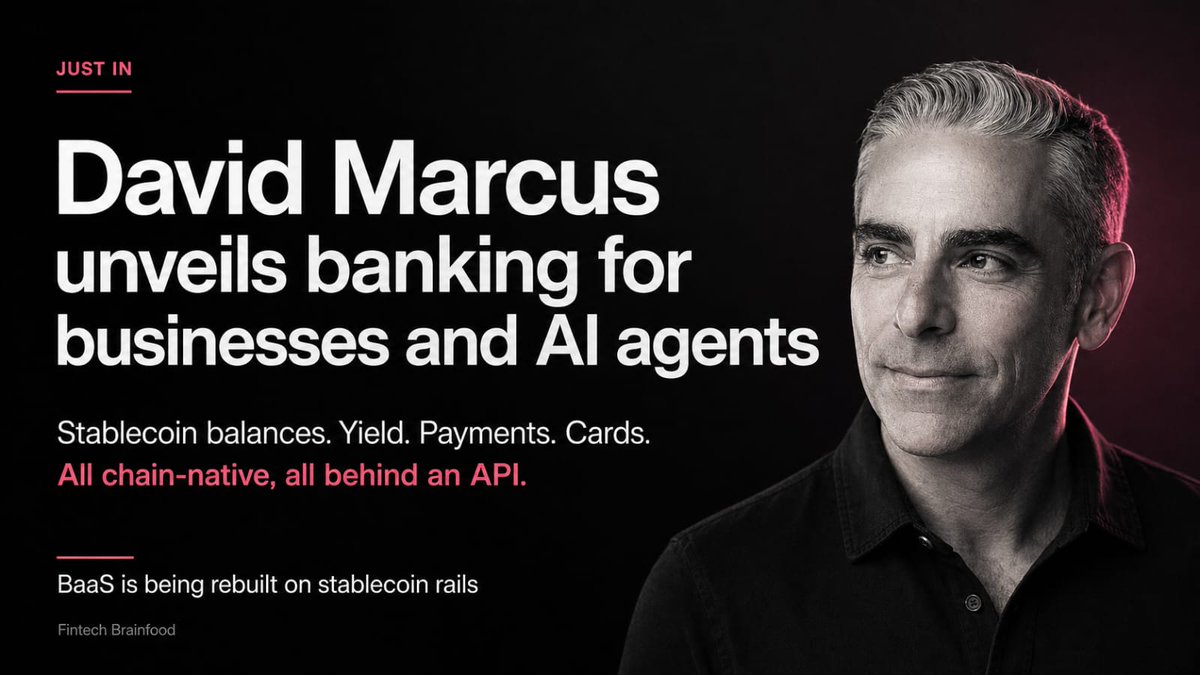
🚨 JUST IN: Former PayPal CEO David Marcus just unveiled a stablecoin banking product for businesses and AI agents.
Stablecoin balances. Yield. Payments. Cards. All chain-native, all behind an API.
This is Banking-as-a-Service but onchain.
---
Banking-as-a-Service is getting rebuilt on stablecoin rails.
The old stack
- Middleware (e.g. Unit / Synctera)
- Galileo
- FBO accounts at a sponsor bank
There's now a chain-native version.
- Squads Grid does it on Solana.
- Bridge built it for fintechs, payroll and non banks
- BVNK ships it embedded.
Lightspark now joins them, with distribution into 65 countries and a Bitcoin L2 underneath.
---
I keep thinking about how the "account" itself is being unbundled.
What used to be a sub-ledger entry at a partner bank becomes a programmable smart account that holds dollars, settles 24/7, keeps its own yield, issues cards, and accepts agent-scoped permissions.
The bank charter turns into a feature you plug in for accessing other rails.
---
The agent piece is marketing, but its also more than that.
Lightspark is already inside Google's AP2 protocol.
As agents want to become platforms in their own right, re-sell financial services to their customers, they'd want a BaaS like thing. Why not go for something that uses stablecoins?
---
Marcus has THE most fascinating back story
- Former CEO of PayPal, has moved money traditionally
- Behind Libra at Meta a global bank account and "stablecoin" that regulators pushed back on.
Now this is a global stablecoin bank account distributed through an API, post-GENIUS Act, sold to businesses and machines.
Sometimes timing is everthing.
Does this compliment or commoditize BaaS over time?
I expect the answer becomes obvious within 18 months.
if you are becoming sarcastic about this industry you are right, but you are also wrong. big time.
the timeline after the rsETH hack somehow touched on every single thing that is exciting and fascinating about crypto.
having been on the other side of a lazarus hack with safe during bybit, i watched this one with a very specific kind of attention.
first off, the obscurity of rsETH itself. i did not know re-staking was still a thing. go to literally any person outside right now and try to explain to them what this asset is and why it exists. they will offer you treatment, not investment. absolute meta levels of financial alchemy. yet: hundreds of millions. allocators behind this are either insane, genius, or achieving some kind of 4d chess tax gymnastics through exposure to a finance matryoshka.
then the bridge protocol layered on top. trying to analyze "layerzero bridged rseth on arbitrum" is a DDoS on any kind of risk framework. Error 503. the level of layered grey zones exceeds anything any analysis can parse in a way that still makes sense. whatsoever.
decentralization in any of this? censorship resistance? let's call it: early stages. it's all as decentralized as necessary and as centralized as possible. regulators are simply not going to follow you into the jungle of financial, social, legal and technical engineering at play here. that's a factor of practicality, not of affirmation.
what do we do?
accept it as collateral for permissionless lending.
of course.
this is insane. but it is also genius. maybe accidentally genius. but still genius. it is exactly the kind of frontier thinking we need. how else are we going to find out if we don't fuck around? this is science. test it, break it, fix it. i'll come back to that.
we all know what happened next.
the 1-of-1 bridge got poisoned. lending facility drained. lenders rekt. almost 300M gone in under an hour.
turns out the dprk is deeper into the defi stack than most defi users. kim's guys knew what "dvn" is. not many others did. kino.
then the whole thing detonates.
the spiderman meme. kelp pointing at layerzero. layerzero pointing at kelp. "you used a 1-of-1 config." "it was YOUR default config."
now it gets interesting.
look around. watch closely. learn. who steps up when it gets serious? who is in it for the finding out and who is just along for the fucking around?
turns out at this point we are not only testing smart contracts, protocols and mechanisms. we are testing people. who you can trust. and how to know.
seal-911 showed up. this financial system has communist hacker villains, yes. but it also has a badass avengers team.
arbitrum froze funds. stani put 5k eth of his own money on the table. not a governance proposal. money. lido, etherfi, golem, bgd labs, mantle, community members. over 100M pooled in days. defi literally united.
let's not get romantic. most actors had direct exposure. the system made the damage legible, the exposure obvious, and the coordination rational. incredible, but rational. in days. without a court order.
the underlying eth? still there. accounting broke, not collateral. onchain balance sheets meant everyone could see exactly what broke and what was intact. people showed up with real money to fix it. in public. with names on it.
there is no global chapter 11 for a lending pool. the law hasn't caught up and it may never. so some incredibly courageous people just looked at the gap and filled it.
action first, insight second, regulation third. always has been.
test it, break it, fix it. all three happened in one week. proof of work.
spacex doesn't get to rockets that land by simulating in a lab. they get there by launching, exploding, and fixing. live. the explosion is the method.
we are building a global financial system on open rails. modular stack. complex, novel, obvious risk. root access for everyone. we are not there yet. but this week we got closer. and the ones still building after another blowup? godspeed. 🫡
if you are becoming sarcastic about this industry you are right, but you are also wrong. big time.
the timeline after the rsETH hack somehow touched on every single thing that is exciting and fascinating about crypto.
having been on the other side of a lazarus hack with safe during bybit, i watched this one with a very specific kind of attention.
first off, the obscurity of rsETH itself. i did not know re-staking was still a thing. go to literally any person outside right now and try to explain to them what this asset is and why it exists. they will offer you treatment, not investment. absolute meta levels of financial alchemy. yet: hundreds of millions. allocators behind this are either insane, genius, or achieving some kind of 4d chess tax gymnastics through exposure to a finance matryoshka.
then the bridge protocol layered on top. trying to analyze "layerzero bridged rseth on arbitrum" is a DDoS on any kind of risk framework. Error 503. the level of layered grey zones exceeds anything any analysis can parse in a way that still makes sense. whatsoever.
decentralization in any of this? censorship resistance? let's call it: early stages. it's all as decentralized as necessary and as centralized as possible. regulators are simply not going to follow you into the jungle of financial, social, legal and technical engineering at play here. that's a factor of practicality, not of affirmation.
what do we do?
accept it as collateral for permissionless lending.
of course.
this is insane. but it is also genius. maybe accidentally genius. but still genius. it is exactly the kind of frontier thinking we need. how else are we going to find out if we don't fuck around? this is science. test it, break it, fix it. i'll come back to that.
we all know what happened next.
the 1-of-1 bridge got poisoned. lending facility drained. lenders rekt. almost 300M gone in under an hour.
turns out the dprk is deeper into the defi stack than most defi users. kim's guys knew what "dvn" is. not many others did. kino.
then the whole thing detonates.
the spiderman meme. kelp pointing at layerzero. layerzero pointing at kelp. "you used a 1-of-1 config." "it was YOUR default config."
now it gets interesting.
look around. watch closely. learn. who steps up when it gets serious? who is in it for the finding out and who is just along for the fucking around?
turns out at this point we are not only testing smart contracts, protocols and mechanisms. we are testing people. who you can trust. and how to know.
seal-911 showed up. this financial system has communist hacker villains, yes. but it also has a badass avengers team.
arbitrum froze funds. stani put 5k eth of his own money on the table. not a governance proposal. money. lido, etherfi, golem, bgd labs, mantle, community members. over 100M pooled in days. defi literally united.
let's not get romantic. most actors had direct exposure. the system made the damage legible, the exposure obvious, and the coordination rational. incredible, but rational. in days. without a court order.
the underlying eth? still there. accounting broke, not collateral. onchain balance sheets meant everyone could see exactly what broke and what was intact. people showed up with real money to fix it. in public. with names on it.
there is no global chapter 11 for a lending pool. the law hasn't caught up and it may never. so some incredibly courageous people just looked at the gap and filled it.
action first, insight second, regulation third. always has been.
test it, break it, fix it. all three happened in one week. proof of work.
spacex doesn't get to rockets that land by simulating in a lab. they get there by launching, exploding, and fixing. live. the explosion is the method.
we are building a global financial system on open rails. modular stack. complex, novel, obvious risk. root access for everyone. we are not there yet. but this week we got closer. and the ones still building after another blowup? godspeed. 🫡
if you price the risk correctly today, most exotic collateral activity just dies. the math doesn't work. but that's also the point. cheap capital is subsidizing the frontier. lenders are funding the R&D whether they know it or not. the job now is to build infrastructure that actually earns the lower rate. risk pricing up, actual risk down. they have to meet in the middle
. @JakeSenftinger is one of the most interesting commentators in crypto. Almost like a rolling stone writer decoding things with lucidity, technical and legal chops and memelordship. Remincent of @citrini energy 😝
His @KelpDAO rsETH incident deep dive ⬇️