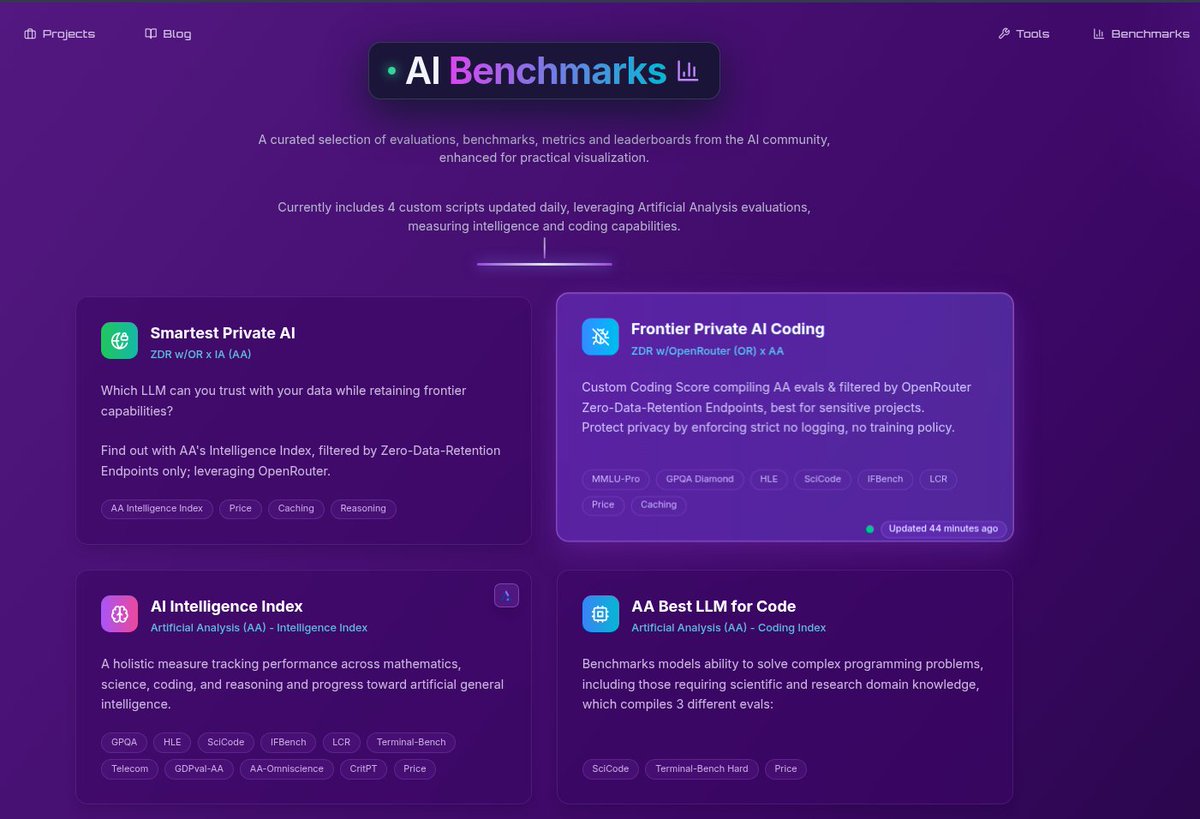
2026 - WHICH AI IS THE BEST FOR *YOUR* NEEDS?
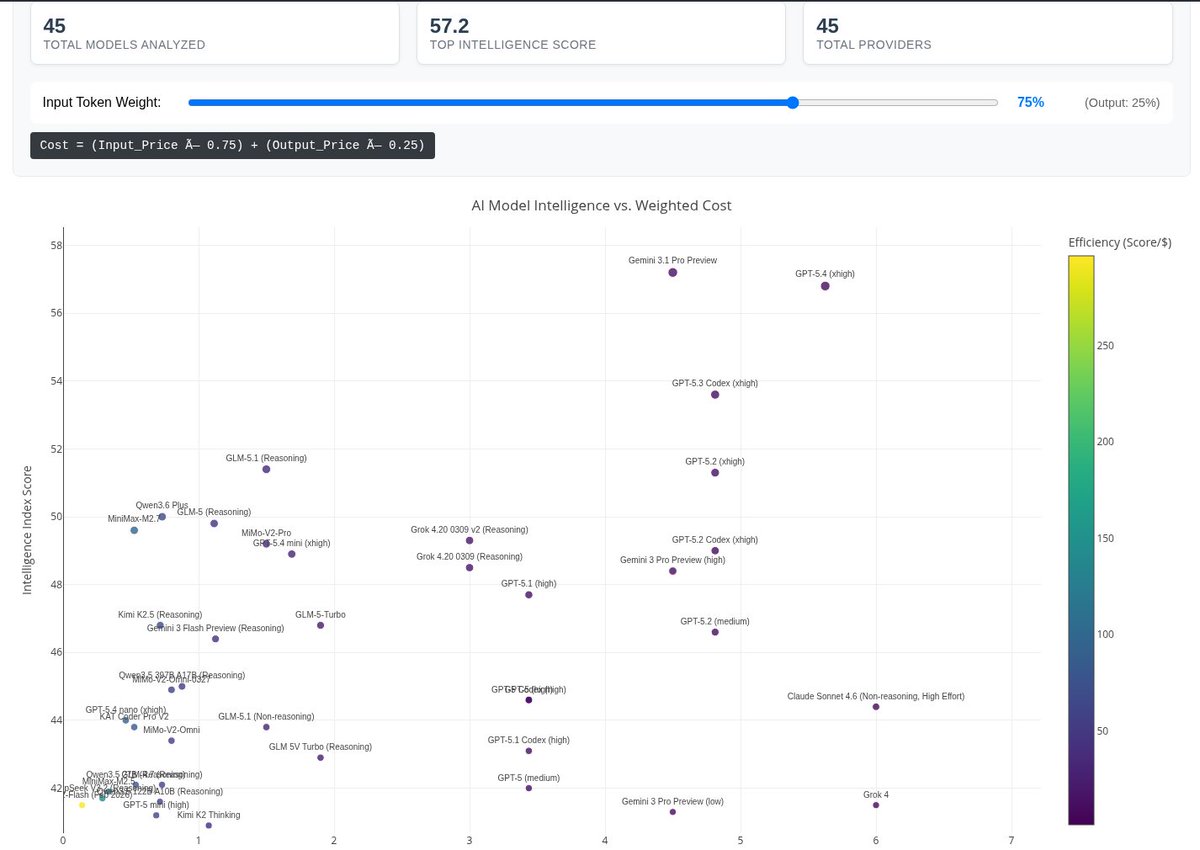
Privacy, Code, Price? Auto-updated charts at https://t.co/OZDCCXK5RT let you decide with a quick glance or dive deep in comparisons: how-to video & findings below 🧵
https://t.co/MTEqg3wNBB
As we start Feb26, the LLM landscape is about to get even more exciting! Competition intensifies and OSS labs close the gap.
So I've decided to bring auto-daily updates to my custom leaderboard charts (you'll need it!), along with a video to understand how to make the most of 'em!
Three Cline agents. Same 120B model. One rule: terminate your opponents' processes before they terminate yours.
We tested raw inference across an @NVIDIA_AI_PC DGX Spark, an RTX 4090, and cloud. Time-to-first-token decides the race. Throughput decides who ships.
DGX Spark: 42.9 tok/s. RTX 4090: 8.7. Same weights. 4.9x gap.
#AIonRTX
https://t.co/tFk7lpsGsv
Verdict tackling a mildly complex task:
spent hours with GPT 5.4 mini, got a mess, scaled up to GPT 5.4, 1h later, out of credits and still a mess, still stuck to Phase 1.
moved to MiniMax M2.7 sub, 1h later, phase 6 complete.
@nafonsopt I'm not sure they've been interested in solving the 'dictatorial bureaucracy problem'
They already planned Linus death
I would not be surprised to see new contenders emerge & gain more traction
@perplexity_ai how are you able to suggest such accurate research suggestions when all the privacy-worrying features are disabled?
You're using my conversation data without my consent here
This robotic hand can weave itself together in minutes.
Allonic developed a process that "braids" robot bodies around a 3D-printed skeleton in a single automated step.
The tech draws from the textile industry, using braided fibers instead of traditional mechanical joints and bearings.
Their braiding system grows tendon-driven structures directly onto skeletal cores, creating flexible yet durable parts without screws or assembly.
One finger only needs 4 skeletal elements. Then thousands of braided fibers wrap around them to handle force and articulation.
The software converts designs directly into machine code that runs the braiding process.
But what matters is that robotic hands like this can cost up to $30,000, ~20-30% of a humanoid robot's total price.
Allonic's braiding process could crush those costs while enabling custom designs at scale.
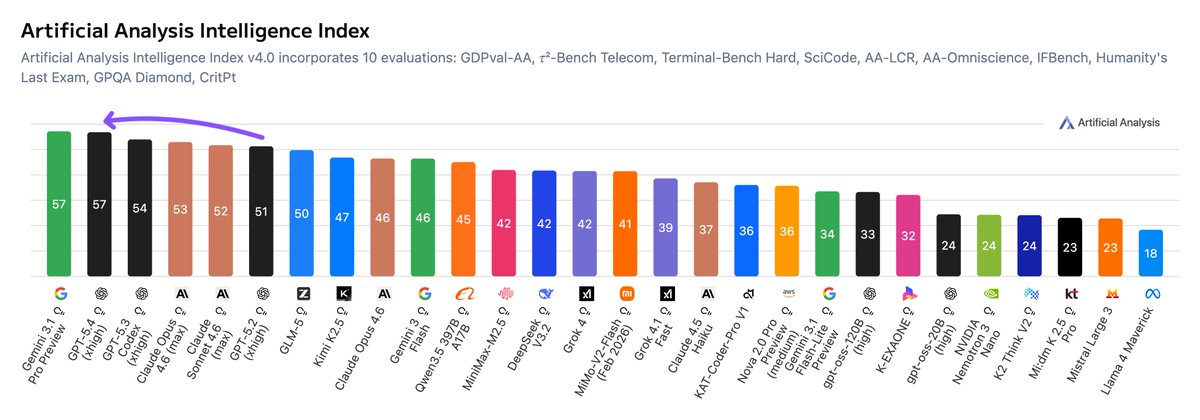
Xiaomi has released MiMo-V2-Pro, which scores 49 on the Artificial Analysis Intelligence Index, placing it between Kimi K2.5 and GLM-5
@Xiaomi's MiMo-V2-Pro is a new reasoning model and a significant upgrade over their prior open weights release, MiMo-V2-Flash (309B total / 15B active, MIT license), which scores 41 on the Intelligence Index. Xiaomi has not yet released the weights of this model and it is currently only available via Xiaomi's first-party API.
Key takeaways:
➤ MiMo-V2-Pro scores 49 on the Artificial Analysis Intelligence Index behind GLM-5 (Reasoning, 50). It is ahead of Kimi K2.5 (Reasoning, 47) and Qwen3.5 397B A17B (Reasoning, 45). On the overall leaderboard, it places #10, just behind GPT-5.2 Codex (xhigh, 49) and ahead of Grok 4.20 Beta (Reasoning, 48)
➤ Leading Elo of 1426 on GDPval-AA (Agentic Real-World Work Tasks), ahead of peer models: On GDPval-AA, MiMo-V2-Pro places ahead of GLM-5 (Reasoning, 1406), Kimi K2.5 (Reasoning, 1283), and Qwen3.5 397B A17B (Reasoning, 1209). GPT-5.4 (xhigh) and Claude Sonnet 4.6 (Adaptive Reasoning, max effort) have an Elo of 1667 and 1633 respectively
➤ Competitive AA-Omniscience Index driven by low hallucination: MiMo-V2-Pro scores +5, ahead of GLM-5 (Reasoning, +2), Kimi K2.5 (Reasoning, -8), and Qwen3.5 397B A17B (Reasoning, -30). For context, Claude Opus 4.6 (Adaptive Reasoning, max effort, +14) and Gemini 3.1 Pro Preview (+33) remain ahead
➤ MiMo-V2-Pro is more token efficient than peers. It used 77M output tokens to run the Artificial Analysis Intelligence Index, significantly less than GLM-5 (Reasoning, 109M) and Kimi K2.5 (Reasoning, 89M)
➤ MiMo-V2-Pro costs $348 to run the Artificial Analysis Intelligence Index at $1/$3 per 1M input/output tokens. This is less expensive than GLM-5 despite scoring only 1 point lower on the Intelligence Index. For comparison, GPT-5.2 (xhigh) cost $2,304 and Claude Opus 4.6 (Adaptive Reasoning, max effort) cost $2,486
Key model information:
➤ Context window: 1M tokens
➤ Pricing: $1/$3 per 1M input/output tokens, for 256K token input and $2/$6 per 1M input/output tokens for 1M token input
➤ Availability: Xiaomi first-party API only
➤ Modality: Text input and output only (no multimodality)
@VibeMarketer_ "In consumer apps, this could transform how platforms like social media or streaming services suggest content: a text query might return a video whose audio sentiment matches"
Finally
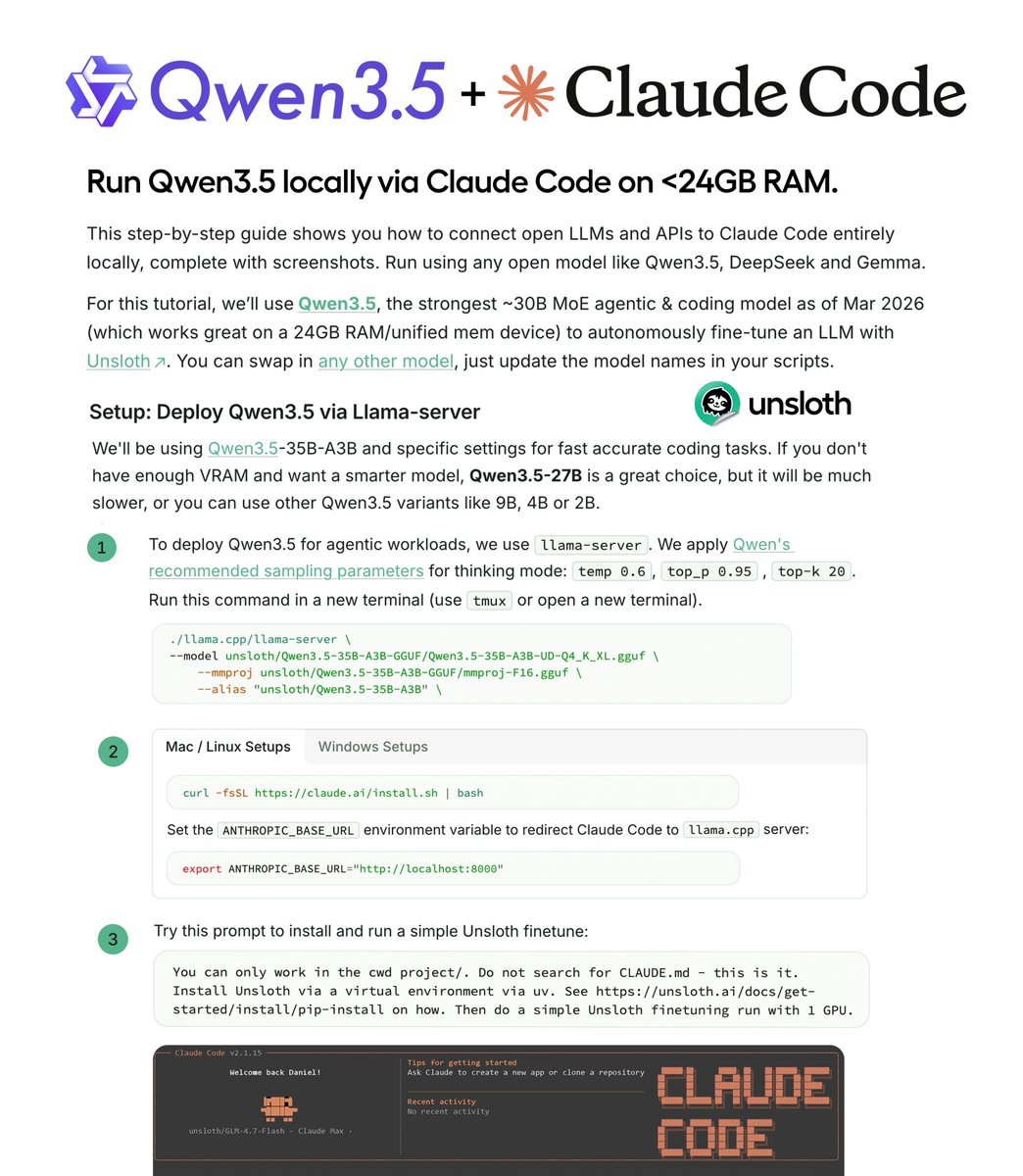
Learn how to run Qwen3.5 locally using Claude Code.
Our guide shows you how to run Qwen3.5 on your server for local agentic coding.
We then build a Qwen 3.5 agent that autonomously fine-tunes models using Unsloth.
Works on 24GB RAM or less.
Guide: https://t.co/JDPtuIJAZC
Best 2025 AI Coding Model (best as in most efficient)
@ArtificialAnlys Coding Index= SCICode+LiveBench+Terminal-BenchHard
* Gemini 3 stands out: Pro's got the best score, Flash's the most efficient!
* Deepseek, just like a year ago, is the best value model, cheap and high-performance with v3.2!
OpenAI’s new GPT-5.4 (xhigh) lands equal first in the Artificial Analysis Intelligence Index alongside Gemini 3.1 Pro, but at a cost increase compared to GPT-5.2
@OpenAI's GPT-5.2 (xhigh, 51) was the most intelligent model as at end of 2025. Since then, OpenAI released two GPT-5.3 variants: GPT-5.3 Codex, a coding-focused reasoning model, and GPT-5.3 Instant, a ChatGPT-only model without thinking capabilities. GPT-5.4 is the first general reasoning model release from OpenAI since GPT-5.2.
GPT-5.4 comes with slightly higher per-token pricing ($2.50/$15 vs $1.75/$14 per 1M input/output tokens for GPT-5.2) and a significantly expanded context window of 1.05M tokens, up from 400K for GPT-5.2. GPT-5.4 supports five reasoning effort modes (none, low, medium, high, and xhigh); all key takeaways below are based on our evaluation at xhigh, the highest reasoning effort. GPT-5.4 Pro is a separate system that we are currently evaluating on frontier reasoning tasks (CritPt) and will share results when available.
Key benchmarking takeaways of xhigh variant:
➤ Equal first in intelligence: GPT-5.4 (xhigh) returns OpenAI to the top of the Artificial Analysis Intelligence Index, matching Gemini 3.1 Pro Preview (57). GPT-5.4 scores 57, a +6-point jump from GPT-5.2 (xhigh, 51).
➤ Leading in scientific reasoning and agentic coding: GPT-5.4 shows particular strength in frontier scientific reasoning and agentic coding, leading all models we have tested in both categories. On CritPt (Research-level Physics), GPT-5.4 scores 20%, ahead of Gemini 3.1 Pro Preview (18%) and GPT-5.3 Codex (xhigh, 17%). On TerminalBench Hard (Agentic Coding & Terminal Use), it scores 58%, ahead of Gemini 3.1 Pro Preview (54%) and GPT-5.3 Codex (xhigh, 53%). We are currently running GPT-5.4 Pro on CritPt and will share results shortly.
➤ Greater knowledge, but more hallucinations: GPT-5.4 improves factual accuracy on AA-Omniscience over GPT-5.2, but a higher attempt rate drives a worse hallucination rate. The AA-Omniscience Index rises from -1 (GPT-5.2, xhigh) to +6, with accuracy improving from 44% to 50%. However, GPT-5.4 attempts 97% of questions vs 91% for GPT-5.2 (xhigh), pushing the hallucination rate from 80% to 89%.
➤ Best GDPval-AA result: GPT-5.4 achieves the highest GDPval-AA ELO of any model we have tested, representing a significant jump in general agentic capabilities over GPT-5.2. GPT-5.4 scores 1,667 on GDPval-AA, up from 1,462 for GPT-5.2 (xhigh), a +205 point gain. Statistically, however, this places GPT-5.4 within the 95% confidence interval of Claude Sonnet 4.6 (Adaptive Reasoning, max effort, 1,633), meaning we conclude that the two models are equivalent on agentic real-world tasks.
➤ More expensive despite modest token efficiency gains: GPT-5.4 is slightly more token efficient than GPT-5.2 (xhigh), but notably less so than GPT-5.3 Codex (xhigh), and higher per-token pricing means the cost to run the Intelligence Index increases ~28%. GPT-5.4 used 120M output tokens to run our Intelligence Index, vs 130M for GPT-5.2 (xhigh) and 77M for GPT-5.3 Codex (xhigh). The effective cost to run our full Intelligence Index is ~$2,951 for GPT-5.4, vs ~$2,304 for GPT-5.2 (xhigh) and ~$1,654 for GPT-5.3 Codex (xhigh).
➤ Broad benchmark gains across most evaluations: GPT-5.4 shows broad gains across evaluations vs GPT-5.2 (xhigh), with improvements in scientific reasoning, coding, tool use, and long context reasoning. We saw gains in CritPt (+8 p.p.), TerminalBench Hard (+11 p.p.), HLE (+6 p.p.), τ²-Bench (+7 p.p.), SciCode (+5 p.p.), GPQA (+2 p.p.), and LCR (+1 p.p.). The only regression is a small decline in IFBench (-2 p.p.), indicating a marginal reduction in instruction following precision.
2026 - WHICH AI IS THE BEST FOR *YOUR* NEEDS?
Privacy, Code, Price? Auto-updated charts at https://t.co/OZDCCXK5RT let you decide with a quick glance or dive deep in comparisons: how-to video & findings below 🧵
https://t.co/MTEqg3wNBB